The Podcast · 6 November 2026 · 38 min
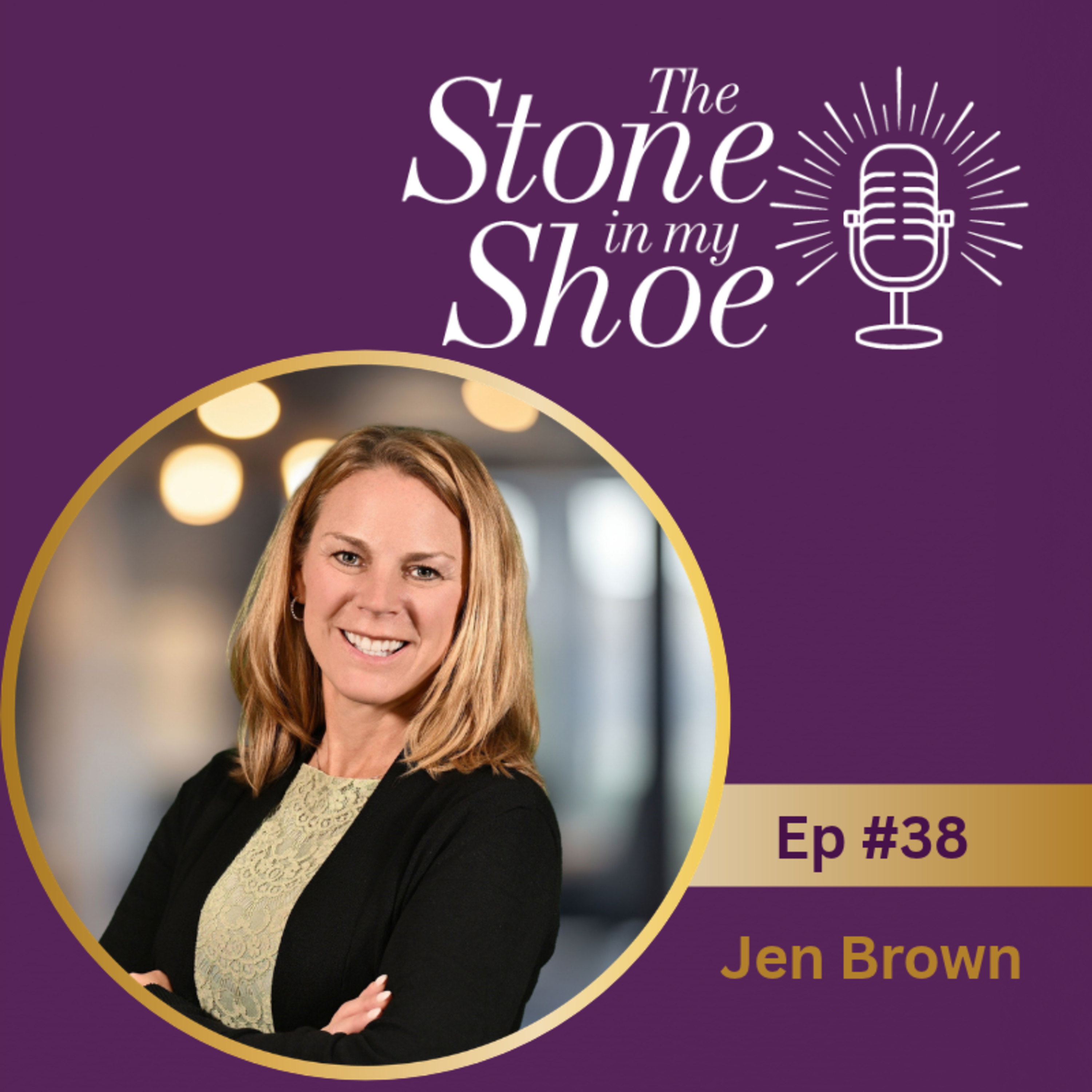
Self-Worth: Why Your Worth Isn't Tied to What You Do | Jen Brown
Listen to this episode
Chapters: tap one to jump to it
What happens to your self-worth when it gets tangled up with what you do? If you're the capable one everyone relies on, and you've never stopped to ask whether that is costing you, this conversation is for you.
In this episode of The Stone in My Shoe, Debbie speaks with Jen Brown, a former US diplomat who spent 23 years leading teams in high-pressure situations around the world, and the author of Coming Home to Me. Last year she left the Foreign Service, and she didn't just leave a job. She left the title, the mission, the community and the country, all at the same time. Jen is now a leadership coach who helps people move from autopilot to something more intentional.
Jen shares the story below the story. She was the first in her family to go to college, a non-traditional student working by day and studying at night, and when she joined a Foreign Service full of brilliant, gifted people she wondered whether she fitted in. A quiet "am I good enough?" taught her to work twice as hard, to treat every mistake as a personal reflection and to cover a lack of confidence with self-deprecation. Over time her identity became what she did: diplomat, consular officer, leader and mum. Then her son called her out as "the phone lady", and she stopped.
Together they explore how self-worth can become fused with a role, and what happens when that role changes, whether it's a career change or a season of parenting. Jen talks about the high achiever mindset and the Type A drive, how perfectionism and the belief that she had to have every answer led to burnout, and what changed when she found a coach and let the people around her come up beside her. They talk about how the limiting beliefs we carry can feel like personality until we stop and look at where they came from, and why self-compassion, which Jen simply calls grace, was the hardest kind to learn.
It is also a conversation about finding yourself again beyond the labels, and the personal growth that comes with it. As her son heads off to college and she builds a new chapter, Jen is moving through a life transition, rediscovering her authenticity and her purpose, and describing herself without a job title: a person of faith who thrives in nature and music and loves to add value.
Along the way she and Debbie talk about the pendulum that swings between work and rest, with grace as the point it returns to.
Why your self-worth is not tied to any role, title or achievement, and where the belief that it is can begin
What can happen to your identity when a long career, or a season of parenting, comes to an end
The high achiever mindset, and how believing you must have all the answers can lead to burnout
How limiting beliefs and perfectionism can feel like personality, and what it means to challenge them
Why grace for yourself can be harder than grace for anyone else, and how self-compassion helps the pendulum swing back faster
Why vulnerability is so hard for the capable one, and the book that arrived when Jen was ready for it
Why there is no such thing as perfect work-life balance, and what an intentional pendulum can look like instead
Why making space to listen to yourself matters, and what it can cost in stress, health and burnout when we don't
If you have ever wondered who you are without the title, or why it's so hard to rest when everyone needs you, stay curious. Sometimes someone else's story helps you see your own.
Read the full transcript
At least for me, my identity started really becoming this is who I am, right? This is what I do, it's who I am, it's the lifestyle piece. And some not so proud mom moments came into that as well when I wasn't fully present with my son too. I don't wanna go too far into this, but there was a moment where my son called me out as the phone lady. And if there were a stone in my shoe, it was then because it made me stop and say, wow, how have I not been so present here? Hi, I'm Debbie Thompson, and this is a stone in my shoe podcast. Like a stone in your shoe, we all carry things that quietly shape the way we walk through life. And through honest conversations and powerful stories,
we discover the wisdom that helps us understand ourselves and walk a little more freely. And today we're gonna be talking about what happens when your worst gets tangled up with what you do. When being capable and dependable, stops being something you're good at and becomes who you are. So if you're the capable one and people rely on you and you've never stopped to question whether that's costing you, this one's for you. And today's guest is Jen Brown. She spent 23 years as a US diplomat, leading teams in high pressure situations all over the world. She left the foreign service last year and she didn't just leave a job, she left the title, the mission, the community and the country all at the same time.
She's since written a book called Coming Home to Me about reconnecting with who she is underneath the roles. And she now works as a leadership coach helping people move from autopilot to something more intentional. Jen, welcome to the Stone in the Shoe podcast. Oh, thank you so much. It is really a pleasure to be with you today. And vice versa. And so before we begin, I just wanna ground this for the person or the woman who's listening. What do you hope she takes away from your story today? It is all about connecting with ourselves and knowing that our worth is not tied to any role we have. Our worth is really because of who we are,
just in and of ourselves. And when we focus on that piece, we get to love ourselves far deeper than any role, title, amount of money, anything external. Beautiful. And we will come back to that because I'm sure it wasn't always like that. No. As with every story. So who are you in the season of your life and what feels the most important to you right now? Such a great question. When I left the government, I said this is my Gen 2.0 phase, second half of life, if you will. And I'm still figuring this out. What I know is I love connecting
with such a range of people, being able to create and add value, being able to make decisions about what my day looks like. And I love to work. And this is the piece of still figuring it out. I can sometimes swing that pendulum so far on the work side that I miss out on some of the things I love to do for fun and hobbies. So I'm really discovering that piece now as my son is away at college. And so it's more than the job title, it's the mom title that's also shifted. So it's a fun stage for me to see who I am. And that's beautiful is the fact that it's a fun stage because you're getting up there,
you're trying different things on and you're seeing what works. And the fact that there's a pendulum, because I'll really relate to that, is that it can swing, but that you can look at that pendulum with compassion and know that it can swing back and you're not stuck there. And that you have control of that. I love that you latched onto that. When I worked with the State Department, people would talk about work-life balance. And it just didn't sit right with me because I thought there is no balance to this. When the job requires me to be all in, I am all in. And when my son requires me to be all in, I need to be all in there. And so I thought, no, this is really a pendulum.
And the goal is how do I be intentional about swinging it where it needs to go? And what does that look like? And not just be on autopilot of work go-do-do, but rather if I'm intentional, where's also that space for me? And where's rest? What does rest look like? So that pendulum piece has just been so pivotal in how I see life. And what's beautiful about that is it's ever moving. And so life is ever moving. And you were saying, you're just loving, you have so much fun in connecting, creating, adding value and seeing where this next stage takes you. And that is about shifting and changing
and being open to swings and changes and not, because I think so many of us are like, okay, that's it. Now this is what I'm gonna do. Now I'm stuck here. Oh my God, it's not working. Why is it not working? Failure. But instead of just almost the pendulum being like a stream flowing through and we just jump on and we see where it takes us. I think that's so true. And failure to me really, I've done a fair bit of work. I'm still doing work in this rejection, failure, all of that as being, no, it's just teaching me something. And it's helping me to get to that next level, whatever that next level looks like. And so I don't see it as being a negative.
I'm learning, you said compassion. It's really something I'm looking at with compassion as, okay, there's a lesson. And then where's the next beautiful stage ahead? Let's keep going. That's set a beautiful stage for us to talk about the stone in your shoe. So every stone starts with a story and it's really the story, the self itself. It's what we make to mean about ourselves around the story. And so it's the story below the story, which is really the stone in the shoe. It's the unconscious beliefs and patterns that have shaped us and show us how we walk through life. So let's go through. And I don't mind if you start with the story and then move into the stone over to you, Jen.
Yeah, I think this is so great. When I started, I was a nontraditional college student. And so I took some time off. I was working, going back to school at night and to finish my degree. And when I learned about this thing called the foreign service to serve with the US government, I studied Spanish and I thought, this is what I wanna do and I want to focus on Latin America. And when I saw the incredibly smart gifted people in the foreign service, I thought, wow, my background's a little different here. I'm not sure that I fit in. And what I really started to recognize within myself is the power of self-deprecation
as a way to compensate for that insecurity or lack of confidence. And that belief system became a part of my journey. It's probably always been a part of my journey to some extent, if I'm honest, but it was so notable for me at that stage in my career. And I think we all know the phrase, fake it until you make it. And I just really don't like that phrase because that does not sound authentic to me. And as I fast forward through my career with this, I started to learn to own my leadership. I own who I am, but I will say that when you are living a career
where so much is dependent on you, at least for me, my identity started really becoming this is who I am, right? This is what I do, it's who I am, it's the lifestyle piece. And some not so proud mom moments came into that as well when I wasn't fully present with my son too. And so recognizing just how that story shows up in life. And I don't wanna go too far into this, but there was a moment where my son called me out as the phone lady. And if there were a stone in my shoe, it was then because it made me stop and say, wow, how have I not been so present here? So let's just go back to pre-college.
You said, or at college, where you had this belief system. And what was that belief system? And looking back now, where do you think that belief system came from? I think that's a great question. I have a super supportive family. I'm the first in my family to go to college. And so I think there's a sense of adventure. For me, I'm like, let's go try it, right? But not knowing what that path would look like, not knowing financially how things would work or where the job would go. And I wouldn't change one bit of it. It just was, I think a bit of am I good enough to go do this? And I think that through some adversity
and when we have trials in life, and I know from when I was a young child, there were some challenges growing up at that stage. And I think that probably embedded some of that into my belief system, into my essential nervous system, if you will. And it's taken a long time to work through some of those, even though post that era have a wonderful supportive family, right? But it's amazing what our young brains remember, I think. And I think big human, we can't escape the I'm not good enough. I'm not worthy. We are all touched by that at some point. And it's often things that is so inconsequential, a teacher saying some throwaway comment when she's having a bad day.
And our brains go, that's a fact. Yeah. That's right. That's right. And I think it's looking in at what's driving us. So I wonder if I am not good enough at this. You're going into the foreign service, which is new to you and your family and all these amazingly smart people. So I'm not good enough means I've got to, I don't know, I'm asking you this. I have got to try that much harder. I have got to be seen and be better and be the best. Of course. It means work twice as hard at least, right? I'm going to put in the hours. I am going, if there is any mistake, then that was tied to me. So that sense of failure that I mentioned earlier, I didn't always have that, right? If there were a mistake or a failure on my watch,
then that was a personal reflection on me. And really taking that type A type of personality to the extreme of this is everything and I'm going all in on it. And in some ways that type A personality that takes you all in has got some really good benefits because it's hard working, it's courageous. There are so many amazing things from it. But when the pendulum goes there, that type A personality leaves so much that you can't connect to. Were there points along the way where the stone was getting sharper or was there one, I'm curious to know what made you go, whoa, Jim, hey, this is not where I need to be.
But yeah, talk me through that. Yeah, no, that's great. A couple of places along the way. But I think there was something that you mentioned and I want to just touch on that first. The good qualities of that type A. When I talk a lot about being on autopilot and that is, there can be really great moments where our strengths and things that we know, training for crises, that's all wonderful, right? It's when we overuse those qualities in a way where we're not even aware what we're doing. And so that's the moment to be mindful and reset. And so I think that's the pivot to the stone piece. A couple of points, one of them for me
in my professional journey was I had stepped into a larger leadership role and we had normal challenges, operational challenges, base constraints, higher demand with the public, what do we do? Limited staffing, all of the typical things you might find. And then personnel challenges because we're human and as leaders, that's what we face. And I had this belief that leadership meant I needed to have the answers. My team was working so hard to do the day to day. And how could I put more on them? And let's, I'll be honest, let's couple that with the my worth comes from, what I do and I'm a problem solver.
And so I thought I need to resolve all of this. And what I was doing was bringing myself out and siphoning the creativity that could flow up from my team. So that's that stone right there led me to learn about leadership coaching. I got a coach and I just started feeling myself shift and grow and unlock this, this belief system. And so by doing my work, I really created a space to get out of the way and let my team come up and join me. And it was wonderful. Another phrase, leadership is lonely at the top. Yes, but it didn't have to be as lonely as I had made it.
And I think that's the power of who's around you as a leader, who, where are you getting those unique perspectives and people to challenge you and people to offer creativity and innovation. And as soon as I started doing that work and bringing the team up, well, they came up with far better ideas than I ever could have, right? And that was like, that was such a wonderful place to see leadership start to thrive because I did my own work and built them up. And that was the job. It wasn't that I had to solve the actual problem for most of the issues. And so that piece was a keystone for me. And fast forward, I went through some personal challenges,
another stone and worth coming from, this is my identity and who I am. And when you start to question things in your life, it's okay, it's time to get real again. And grace became such a key piece of how I view life. It was grace in leadership, grace in life, grace for myself, grace for others. And the hardest piece was actually grace for myself. But I'll be honest, and that really was okay. Who I am and things in life don't define who I am. So it sounds like there were a lot of little points along the way and looking back now at the leadership
and so many people have these beliefs that I need to have the answers because if I'm a leader, I know what I'm doing. And particularly if coming from a deep one is I'm not worthy and we build these stones and they get bigger and sharper. But what I'm curious about is how long does it take you to go, I need a coach or I need to change this? Was it a slow burn or almost to the point where you were falling off the cliff and you needed help? That's a great question. I was super lucky. I had amazing bosses who were very supportive, who encouraged me to look into leadership coaching. So really it was maybe nine months into my assignment at that time.
And I felt that was the right, that was the perfect time to be honest because by then I understood some of the patterns and things that were going on and some of the normal fixes if you will were not long-term fixes. And I think that also shapes how I see coaching and working with leaders today because yes, there are certain things that we can try, right? And we can all get where we wanna go on our own. It's the question of how much time do you want to put into it because my coach within a couple of months got me so much further along so fast or deeper than I could have done on my own during that time. And that's the power of having someone
to walk alongside you, right? And understand that stone and what have you tried? Where are you challenge you and challenge that belief system for sure. And I think it's really important to challenge that belief system because it's so ingrained that we think it's our personality. And yet when we can remove ourselves and look and go, interesting, I wonder where those set of rules came from there? Actually not mine. And then as you said, I love the word grace because then you can give yourself grace. You can give yourself grace to all the things that you've perhaps done and not be so hard on yourself but go, that's interesting
because that wasn't even my rule and yet I was living by that. So yeah. It's so true and it is such still a work in progress for me, right? Like I work with leaders all the time on these issues and I still do my own work. The issues themselves, I don't think go away. Our ability to recognize and move from that autopilot stress state into grace, into being intentional in how we show up. That's the piece that gets faster and that we start to learn to do on our own a lot faster. I've almost got this image of this pendulum and the full cream in the middle is grace. Yes. Oh, I love that.
Yeah. And we get triggered and we happen and we'll go there but we come back so much quicker. We're not stuck there for days or months or whatever it is, we can bring it straight back. And the intentional, I love the fact that everything's on grace and intention and it's okay because we've got that middle point, haven't we? We've got that. That's great. Yeah. And what's interesting about your story as well is it wasn't an overnight, it was a slow burn, one almost the 1% today, moving interest, ah, that's it and moving on. Tell me more about when, if you look back now when you first started to where you are now, what are the main things that you've learned? Oh, so much.
One that leadership really starts in how we lead ourselves and that self-awareness piece being so critical. We think we can mask when we're stressed and our teams know all of that. They know our vulnerabilities are and yet I think often they're waiting for us to acknowledge them and when we can do that, wow, they can really work with us and help us in a different way. So one is just really knowing ourselves and leading ourselves well, building in self-care at rest. And I, at this new stage in my life, that's a piece I'm intentionally trying, I shouldn't say trying, I don't wanna say trying, I'm intentionally working on not so successfully,
I'll be honest and yet I know where I need to go. The challenge is real. Looking back, I would also say the power of communicating clearly and building connection and trust. We think we communicate clearly with our teams, with our families and yet we often talk past each other and don't ask for that feedback loop of what did you hear me say? What are you taking from this? And then when the frustration comes back, the project's late, it's not done right. All of these things, how much of that is on me because maybe I didn't invest what I needed to upfront and where's the opportunity to coach this person on the other side? So, let's see, getting to those opportunities much faster
as a result of what it means to know ourselves, to invest in our team. And I will say culture. What we establish as a company culture, our family culture, the set of values, the set of rules, if you will, of what does respect look like, what does trust look like and what are those expectations? Not just to have something nice on the wall. How do we live that out? I call it live it out loud, lead it out loud and do our actions represent and body what we have said is important here.
And then how do we celebrate that? And this was something most of the teams I have led have been amazing. We have done a lot of celebrating in small ways and big ways, but the power of building in celebration into smaller milestones and not just waiting until the end of something which could be months or years down the line. So how do we build that momentum to really represent our culture? Gosh, so much said that. So much resonates with me. And I think the first thing I wanted to just touch on was vulnerability. And because particularly for an A-type personality to be vulnerable is, and I don't know,
but I'm pretty much the same. And for me to be vulnerable was hard because I felt like I was failure or there was something wrong with me. Did you have the same kind of feelings and how challenging was it for you to be really vulnerable? Certainly had those. And at different stages, this is the power of connection and building trust. If we are asking our teams and others in our lives to share with us, what are we giving them as that starting point? And so yes, difficult for sure. Again, I went into this assignment that I mentioned thinking I have to have the answers. And guess what? I don't. When I don't have answers and people are looking at you like, what do we do?
Okay, we're going to figure this out. So my being vulnerable really started looking like it's my job to connect our strengths, to build that capacity, to set the vision and know what the outcome needs to look like. Mostly, right? Sometimes we don't know exactly and we together are going to figure this out. And by doing that, I can then also say, hey, I'm working on not owning so much. I'm working on being intentional this way and not showing up as a perfectionist here. So can you help me? And one amazing colleague of mine, such a strong leader, and he recommended to me during this part of my journey,
Renee Brown's The Gifts of Imperfection. I was just about to bring her name up. Gonna shove it straight down me because I was just about to bring Renee Brown up, yes. Yeah. And that book was so powerful for me at that stage. The Gifts of Imperfection and really embracing were not perfect, right? And what's it like to live with that shame and guilt constantly running around and weighing us down? But I don't think I would have gotten that resource from him if I hadn't been vulnerable. Yeah, and our teachers appear, whatever they look like when we're ready. Great. And that's okay because that's part of the journey. So as we're going down the stream, you will see that beautiful tree when you need to see that beautiful tree.
And don't worry about it. It will all unfold in good time. And what I loved about the vulnerability is, as Renee Brown said, anyone listening, I would highly recommend finding a book or listening to a podcast because I think if we can look at shame and guilt and bring them into the light and really be truly vulnerable, our connection, our communication, everything will go to the next level. And as a result, hopefully everyone will be happier and more content. But so I'm really glad you brought that up. And the other thing I really loved was the fact that you said, celebrate. Because so many particularly type personalities, it's next one. All right, we've achieved it. Moving on next thing, what's the next thing? And where we've come from
and to not celebrate who we're becoming, what we've achieved as a team by ourselves, I think it goes back to that grace, doesn't it? It really does. And just knowing, look, this journey was hard. We've extended grace, right? Let's live in this moment of grace here and be grateful, gratitude for how far we've come, what we've learned, what didn't work. Because there's so much power in what doesn't work that gets us to where what does work, right? And that celebration piece, as I was saying, it can be, let's just go around a meeting and celebrate people with their wins. I've learned to keep an evidence list now.
I'm in business by myself at the moment. And so I don't necessarily have that team, per se, right here. So keeping my own list of, wow, what did I do well today? What did I learn today? What didn't I do? And I wanna celebrate that too. And so just really bringing that in. And that's the smaller side of the scale, if you will, or the lower effort side of the scale. But the power of play and time away and hobbies and all of that are so important too. So having that range of what celebration looks like at different stages is so important. And I think for the person listening, I know, for me, unless it finished the way I wanted it to,
there was no celebration. And very often it doesn't finish the way you wanted. But if you look back, the learnings you got from that are way more than the actual result. But it's reframing it. It's looking at it slightly differently and giving ourselves grace, yeah, beautiful. So there was a time in your life where very much who you were, who you are was based on the work you did. And if you had to take yourself back then and you had to describe yourself to people, I am Jen and I, what would you have said? I probably would have said I am a US diplomat, a consular officer, a leader. Certainly a mom was definitely in that mix as well.
It wasn't all work, mom was quite high. But I don't think any of that really talked about me just as a person. So fast forward, we are now in a notes work in progress. That's what's so beautiful about it. If I said, Jen, who are you? What would you say? I am a person of faith. And I, yeah, I thrive in nature and with music. I love adding value. So I look at those core values for me and not necessarily a title per se. And even on LinkedIn, I had started with coach, blah, blah. And I was like, and capacity builder
just felt like such a more powerful term for me because it is like, I want to be this person who can help lift other people. So yeah, I think, yeah, that's my aspiration there. Amazing. And what I loved about that, who tied you back to what you said at the beginning is that your worth is not tied to who you are and what you do. Worth is just you as a person. The fact that we're born is a miracle. And we need to really go inwards to see who we really are. And I think that's incredibly powerful and beautiful. Thank you. It's really hard when we think about how do we describe ourselves without saying a job title? And what do we want to be known for?
And at the end of the day, I recognized I had some people around me who only saw this professional side of me and they didn't know the fun side of me. And I thought, wow, that's the image I'm giving off now. And I'm out of tune with me. And we have so many different parts of ourselves. And it's, as you said with a pendulum, sometimes that part needs to lead the way and sometimes, but it's when one or two are leading the way all the way, that's when the balance gets out. Yeah. Exactly. Do you feel like you're living your purpose now? I do. And it's a challenge being in business for myself at this stage. And this is newer to me at this point, but I do. And the reason I say I do is because I know
that my purpose is to help lift others and do that through communication and connection, being so powerful. And when I don't know how this will turn out, I don't know how my business will exactly go. I probably would fail an entrepreneurial class right now because I'm rolling with it. And yet I feel that when I'm in tune with my faith and taking care of myself and what matters around people and seeing people, I just feel that next step is ready to be uncovered. Like you mentioned, I'm going down that stream and my guides are being revealed to me as I go. And I think that makes life so much more fun because you don't know what's going to appear.
You're more open. The controller doesn't need to know exactly where you're going. And when you go on a journey and stuff reveals and you hadn't planned for it, often it's just so magical, isn't it? And it's so much greater than we thought. But letting go and trusting the process and trusting your guides and trusting your faith is for me anyway, was a challenge. But when it flows, life is so much more fun, so much easier, so much less resistance. It is. And I compare this to when we go on vacation. Not everyone likes to go explore and be spontaneous. I understand that. But I'm the type of person when I go on vacation, I love to go explore and be adventurous. Why is that limited to vacation?
Why can that not be a part of my everyday? And yes, I love structure. Don't get me wrong. I like that controller piece with structure. And yet I don't want it to be so far out of alignment that there's no room for spontaneity. And I'm working to claw some of that back because I've kept a pretty strong calendar. It is so hard to retrain our brains. And it takes active intention every day. And I don't claim to have this perfect. I just know when I see it. I'm like, wow, I'm living that old way again. And it's time to bring this back to what's important to me here. And I want to have some spontaneity and fun that comes into the day. And I think it's so untrue
because it's intention and consistency. There's no magic bullets. There's no magic pill that you can take to go from there to there. Your brain has been wired that way. And it's slowly, the pendulum, be kind to yourself. It's a process. And when you fall off the wagon, that's okay. You've learned something. But the most important is be curious and kind and compassionate. So I just wanted to finish. So thank you so much for everything that you've shared and being so open and vulnerable and sharing your story. But just finished speaking to the woman who's listening and she still has a sense of built herself on being capable and needed. And questioning is hard because it's just
when you first start questioning who you are and why this is so important. And maybe she's never questioned it before but what would you like her to know? What would be the thing to start her on this journey? I think the thing to start her is to make space to listen to herself. And I share that whether it is faith, meditation, nature, whatever that looks like for each person it's different. For me, it was faith. And when I leaned in heavily during my transition last year I felt this power of saying, I want you to write a devotion. And I was like, I'm not qualified to do that. And that book, everything about it,
it's called coming home to me. I wrote it for me. I didn't know why I was doing it. But when you listen, you get the messages you need. And that was the message I needed to be able to figure out what does coming home to me look like? Coming home in my faith, coming home to myself, finding my voice again. And so whatever that looks like, we can't hear that message when all the noise is around us every day. When we are running and doing and being and tying our identity into jobs and family status and friends and whatever the case may be. So we think we don't have time,
but the cost of not making that time looks like burnout, health conditions, mental stress, all of those things. And so there's a cost one way or the other. You just got to figure out where you are in the pendulum to pay it. There's always a price to pay, isn't there? Yeah, there is. And it's a fact that everybody's journey is different. It's finding what works for you and don't just keep chipping away. It's not a one-off thing. This is a journey. This is next part of your life, but it's intentional. And it's who you are authentically. And when you live with authenticity,
I just think it opens up a totally different world. I totally agree. I totally agree. And I don't think I have fully leaned into authenticity earlier in my career, to be honest. I think when you start to go through some of the trials and feel it, that's when the questions start coming up. Is this all there is? And then getting real with who am I in this process? And I think that's one of the things that really got me is, and I've just forgotten her name right now. And she wrote a book on the top regrets of the dying. And the top regret is I wish I'd had the courage to live in life true to myself and not others. And I thought, yeah, we got this, we got to do it.
Got to be true to ourselves. Is there anything else you would like to say before we finish? I would just love to say that our value isn't tied to any external source, right? So wherever you are, show up. And I would love to connect with anyone who feels that maybe their worth is tied to something else and that they're not sure how to get out of it because it's a hard journey when you do it alone. Thank you, Jen. And if you want to find out about Jen's book and her work, all the links are in the show notes below. So thank you, Jen, really appreciate your time. Thank you so much for this wonderful conversation. And as you finish listening today, perhaps there was a moment where you recognized something in yourself.
And if it was there, just stay curious because sometimes someone else's story finally helps you see your own. And if you're curious about the stone in your own shoe, there's some resources on our website, all the links in the show notes below. Thank you for listening.
Want to know what your Stone could be?
Take the free reflection