
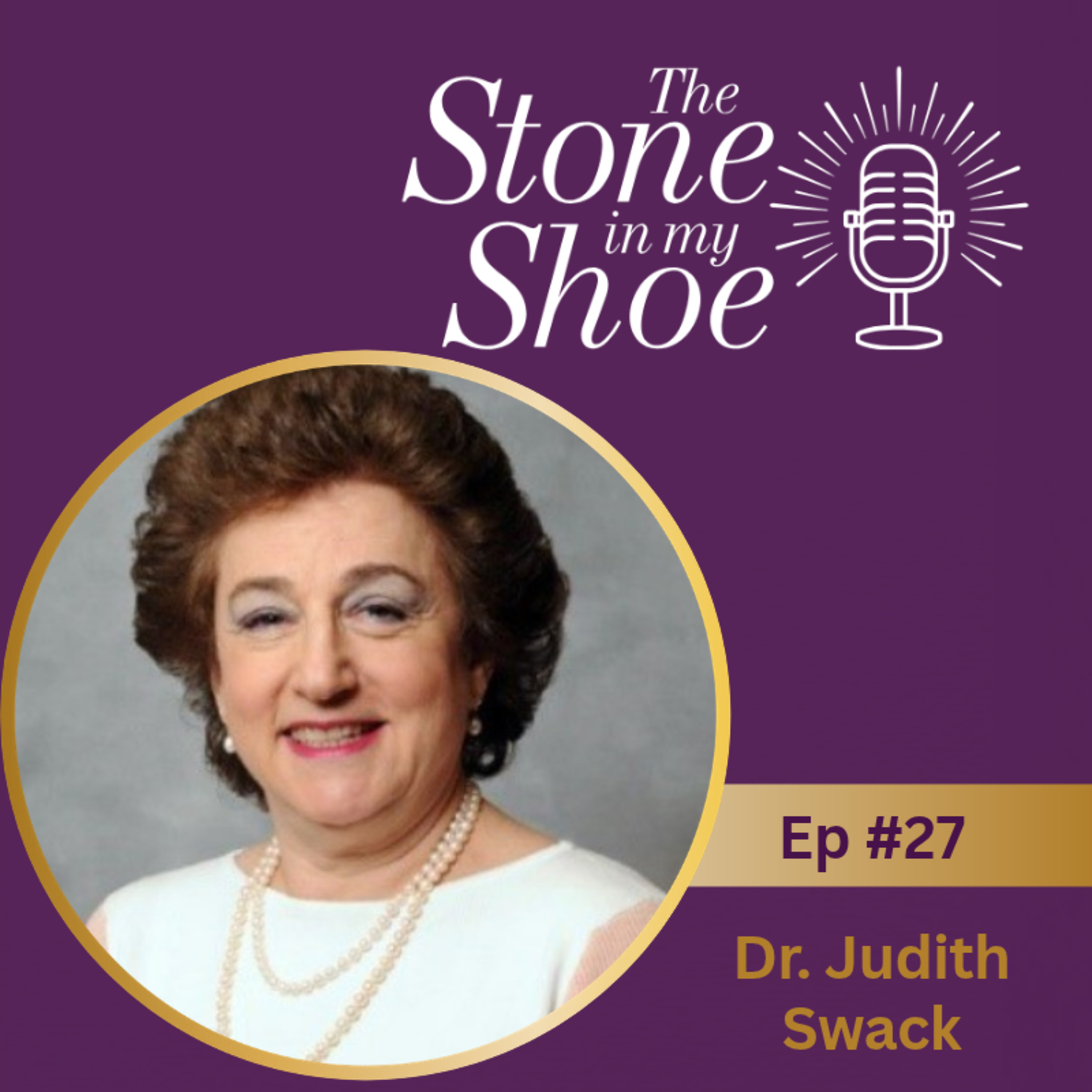
The Podcast · 21 August 2026 · 44 min
Why We Repeat the Same Relationship Patterns | Dr Judith Swack on Unconscious Beliefs & Self-Worth
Listen to this episode
Chapters: tap one to jump to it
Why do we keep repeating the same painful relationship patterns, even when we desperately want things to change?
You will hear why understanding a pattern with your mind often isn't enough to change it.
You will hear how growing up with abuse and neglect can create unconscious beliefs that quietly run our choices.
You will hear why hyper-independence so often develops after childhood neglect.
After building a successful scientific career, Dr Judith Swack asked herself a deeply personal question: "I'm a smart woman. Why can't I figure out why I keep attracting emotionally unavailable men?" That question became the beginning of a journey that challenged everything she believed about healing.
Judith shares how growing up with abuse and neglect created unconscious beliefs that shaped every area of her life, from relationships to career. We explore the difference between the conscious and unconscious mind, the protective strategies that once kept us safe, and why so many people stay stuck despite years of personal development.
Judith is a biochemist, an immunologist and the creator of Healing from the Body Level Up (HBLU). She describes treating everything as an experiment, and a tapping approach that works with the body as well as the mind.
What you will hear
Why we unconsciously repeat the same relationship patterns
How childhood trauma shapes adult beliefs and behaviours
The protective strategies that once kept us safe
Why understanding your mind isn't always enough to create change
How emotions carry valuable information rather than simply getting in the way
Why hyper-independence often develops after childhood neglect
The role purpose, intuition and the body can play in healing
If you're struggling with difficult relationships, healing from childhood trauma or wondering why certain patterns keep showing up, Judith offers a compassionate way of understanding what may be happening beneath the surface.
Read the full transcript
but my love life was a disaster. And I'm gonna tell you that was very painful. So I kept attracting the same emotionally unavailable man in different bodies, and at least I had the wisdom to see it was just the same pattern over and over again. It wasn't the person's, it was the pattern. But I didn't know how to change the pattern. I didn't know what to do. And so I literally pointed to my head and I said, I'm a smart woman. Why can't I figure out what I'm doing wrong and change this? But notice I was looking at my head and I was tuning into my conscious mind and the answer was not there.
Hi, I'm Debbie Thompson and this is a stone in my shoe. Like a stone in your shoe, we all carry things that quietly shake the way we walk through life. Through honest conversations and powerful stories, we discover the wisdom that helps us understand ourselves and walk a little more freely. And today's guest is Dr. Judith Swack, PhD, a biochemist, immunologist, and the creator of Healing from the Body Level Up, HBLU. An approach that helps people heal trauma at the conscious unconscious body and soul levels. She's also the author of Clear Trauma Now and has spent decades combining scientific research with clinical experience to help people uncover
and heal the root patterns behind emotional and physical distress. Judith trains professionals around the world and works with people who haven't found answers through more traditional approaches. Dr. Judith, welcome to the stone in my shoe. Thanks, Deb. Can I call you Deb? Yeah, perfect, lovely. Thank you for that lovely introduction. You made it all happen for yourself. It's quite interesting though when you hear it from another person, you go, wow. Yeah, I should go, wow, I did that. Wow. That's the magic of looking back and being able to reflect on all the amazing things we create. But before we begin, I would just love to ground this for the woman who's listening.
As she listens to your story today, what do you hope she begins to see or understand about herself? I want her to respect her soul and understand that she has a purpose. Every soul has a purpose and every life has meaning. And in order to make a difference in this world, you just have to show up and do what you can. It doesn't have to be grandiose. It doesn't have to be earth shaking. It's just show up and do what you can to make the world a better place every day. So it's just this small thing showing up and making the world a better place.
And from that, if someone's listening going, I don't really know what my purpose is. Will that eventually, by showing up every day, making the world a better place, will that become something that they can see and become clearer on? Yes, healing from the body level up. Presupposes that we have a soul and it's in a body. And I asked scientifically why, because we think in questions. We don't assume. So I gave it deep thought, and I'm not the only one who ever thought this, but I gave it deep thought. We have a soul and it's in a body. And it's a unit of God energy that's part of the larger collective God energy,
which I think of as a big fluorescent green amoeba in the sky, and we're all pseudopod extensions. So this packet of soul energy has embodied in order to experience this life and create the best experience you can in this form, in this dimension, in this time. So each soul packet has a purpose. And we also have at the same time, a conscious mind and an unconscious mind in the body. And the thing is your conscious mind is what you're aware of consciously, and it's your logical rational mind. But your conscious mind is not aware of your unconscious mind. Hello, because it's your unconscious. And it doesn't really know what's going on in your body
because it's not connected that way, and it doesn't know what your soul is saying. So I train people that we are multi-level beings and to stop just thinking that you're a conscious mind, but start learning to communicate with your inner levels. And I teach people how to communicate with their souls directly by muscle testing. So can I just stop you there? Because you started off, you got a PhD in biochemistry and immunology, very scientific. And yet today you've dedicated your life to helping people exactly as you said through the soul and the unconscious and the conscious. Now there's a story there because you started off in a very scientific way and almost 180. And that is really what I'd love to hear. And I'm sure that is the stone in the shoe
that got you thinking. So before we go into your methodology, I would love to tell your story if that's okay. Oh yeah. So just before we get that, before just so we know a little bit more about you, we can see you're highly accomplished, but who are you now in the season of your life and what is the most important thing to you? The most important thing to me is spreading my word to everybody on the world. I've got a body of work that really helps people. It's reproducible. I wanna train more people. I want it to be the standard of care for any kind of mind, body healing or mental health methodology. I want everybody in the world to know how to do this because over the decades, I like to say decades,
I have created a body of work that's reproducible and robust and can do things that nothing else can do and anybody who follows the protocols and trains with me can also do it. And I really feel the push to get it out there now because it's been decades. And getting it out there, if you look back and you've got it out there, what would that mean to you? I guess it would mean that I've fulfilled my purpose. So is the purpose healing bodies and souls and minds? How would you encapsulate that purpose? Yes, my wording for my purpose is I want to help the world alleviate unnecessary suffering. Unnecessary suffering. You're so right and we create so much ourselves but we'll go into that.
So this stone, because that's what it's about and it's a story and the stone is often has a number of things below it. But if you had to name the stone, what would it be and how would you describe it? Remember as a scientist in my 30s, I thought that the purpose of the body was to carry around your head. But I was working at the NIH, the National Institutes of Health, the National Cancer Institute to be precise. And I was a successful scientist in helping the field expand in the area of DNA replication. But my love life was a disaster. And I'm gonna tell you, that was very painful. So I kept attracting the same emotionally unavailable man
in different bodies. And at least I had the wisdom to see it was just the same pattern over and over again. It wasn't the person's, it was the pattern. But I didn't know how to change the pattern. I didn't know what to do. And so I literally pointed to my head and I said, I'm a smart woman. Why can't I figure out what I'm doing wrong and change this? But notice I was looking at my head and I was tuning into my conscious mind and the answer was not there. So one of my dates recommended I take a self-help workshop. And in that self-help workshop called actualizations like Life Spring or Esther stuff like that, they basically showed us the unconscious mind,
which I had been unconscious of. And I was astonished that there's this entire world inside of me that I had no idea was there that was running my entire life. But being a smart woman, I figured out that in order to get the goals accomplished in my life, I was gonna have to coordinate and align my conscious mind with my unconscious mind, which means I was gonna have to learn how to communicate with it and how it worked and then how to heal it. So I asked the trainers, how do you know how to do what you do? And they say we're trained in neurolinguistic programming. And I'm like, fine, then I'm gonna train in neurolinguistic programming. So I signed up for the two semester class and I learned how to communicate and heal my unconscious mind
and coordinate my levels. And I thought I'm set for life. And the fact of the matter is that after I cleaned out my unconscious mind with the help of other NLP trained therapists, I did get happily married. Yes. And I've been married for 37 years and I have a lovely daughter who's also happily married and that worked out. But I had to clean up a lot of stuff in there. I had to find. But when I was... Sorry, I guess as a scientist, was it difficult for you to accept some of the concept that healing might involve something beyond logic and analysis? No, I was just fascinated that I had a whole new territory of information to study.
So my scientific curiosity just lit up. Oh, look, a whole new world to study. Oh, look at this discovery, discovery. I was like ecstatic. Yeah. And so when you went into this neurolinguistic program for anybody who listening, who doesn't really, they've heard the term but they don't really know what it means. Can you just describe some of the things that you did that were the most helpful to you? The first thing is to recognize that you have emotions. Now remember I was a walking head, yes? And emotions are in the unconscious mind. So I had to recognize that I had feelings. And then I had to be able to communicate with my feelings and understand that they had information.
They're not just nuisances, they're carrying information. And so I was able to talk to my feelings and connect in with my intuition, which I had also been ignoring of course, right? And then honor those parts of me that had information and then to understand that I'm a multi-level being, I have many different parts and their intention is to serve my health and well-being. And so we really all need to work together instead of fight with each other. And that was really the huge revelation. Yeah, and that's incredibly powerful work. And for anyone who hasn't done that, I would highly recommend doing that. And when you unraveled the parts of you
that was attracting these emotionally unavailable men, what were the main parts that you discovered and the emotions that you had to hone into? Just a couple of examples. We're gonna get right into trauma now, aren't we? Yeah. So what I found in me and in other people is that if you're raised in a dysfunctional family where you're abused and neglected, you reproduce those family patterns in your romantic relationships and in your friendships and in your work relationships because your unconscious mind just projects that reality into everything around you. So I had to go in and what I call clean out the closet.
I had to clean out and heal the dysfunctional internal parents, the dysfunctional internal family system patterns and clear the trauma that was making me believe that people were dangerous. Either people are dangerous and you can't trust them because my mother would just snap and start beating us. And even if there were people around she would become unconscious. So she wasn't even aware. So she would just is really very frightening, so I have to say. And so I was afraid of people because I was projecting that they could at any moment snap and start beating me. And of course, that'd be dangerous. I couldn't let him get too close to me. On the other side, we were neglected. So the story in neglect is
you can't get what you need to survive. So you have to be fiercely self-sufficient and independent. So I could never let anybody take care of me. So I couldn't have a mutual relationship because I couldn't let him take care of me because I couldn't trust them to not be there for me when I needed them. So you can see how that would seriously interfere with developing a healthy, supportive, romantic, two-way, synergistic relationship. It's okay. And thank you so much for sharing that. And I think it's something that so many people could relate to. And even if you don't have as what you see a very neglectful family, but if you're a highly sensitive child
in a family that's slightly dysfunctional as most are, that trauma can still be in there. It doesn't have to be the big T trauma. It can still be the little T trauma. And you peeled everything back. What belief was, you said those two things, the belief sitting underneath it all, was it that you were not safe and that you had to do it all yourself? Or was there something else? Yes, that's right. No, it's exactly right. That's exactly right. And you've seen that before, huh? Absolutely. And such a common one as well that you have to do everything yourself. And that's why you get these very, very strong, capable women. So looking back now with this belief that you were holding, which is really the stone that was in your shoe, dictating how your friendships, your love life,
probably your professional career as well, being so hardworking, so ambitious, do you think that you were getting feedback earlier to tell you there's a stone and this needs to be dealt with? And you just weren't able to see it or couldn't see it? I was unconscious. So if it was there, how could it not be? I didn't see it until I got hit over the head with a two by four. Which was that I need, these relationships are just not working out. It was like the fourth or fifth one, because I'm dense or stubborn, something. And by the time the fourth or fifth one did the same thing, I basically had it and thought, I can't do this anymore.
I have to do something different. And even though I was nervous to take this self-help workshop because I'd never really heard of these things or heard them vaguely, but I didn't really know what it was. And I was nervous. I thought, I have to do something different because this isn't working. And I jumped off the cliff and did something different. And then it took me into a whole new world, which was very exciting and got me over the hump. But I'm telling you, the same thing happened in my career is I got hit over the head with a two by four on that one because I'm stubborn. I have to laugh at myself. I was very stubborn. So I was determined to be a doctor. From the age of fourth grade, I was gonna be a doctor. So I went to pre-med and everything.
And when I asked for recommendations from my professors, they said, we don't think you'd be good as a doctor. You'd be wasted. You have a rare gift. You have a research mind, which means you find new things and then you expand the field with your knowledge. If you're a doctor, you have to follow routines and you have to do what you're told. But if you're a researcher, you expand the field, you have a gift for this. And I said, but I wanna be a doctor. So I didn't get into medical school because unbeknownst to me, one of my professors who wrote me a letter of recommendation said she'd be wasted as a doctor. She should be a researcher. So they didn't let me into medical school. But of course my first job was in a research lab doing biochemistry and I fell in love with it.
But I was still determined to be a doctor. So I thought I'll get letters of recommendation from the medical school biochemistry department where I'm working and then they'll let me into that medical school. But I asked one of my colleagues to write me a letter of recommendation and he actually shouted at me, no, you'd be wasted as a doctor. You have a gift as a research mind. You should be a researcher. And he shouted. At which point I went like this, okay, I've only heard this five times. The doors are closed on me. I really love research. I love my lab. I love biochemistry. I feel I'm home. And I don't even feel like being a doctor anymore but I was gonna push myself anyway because I had decided to. But no, all the doors shut. So what, I got a degree in research.
And I've been happy ever since. So it was almost the universe telling you five times. And what do you think the stubbornness was of I need to be a doctor underneath it all? What was the belief that held you on to I need to be a doctor? I think it was the wrong belief that I'm in control of my life and I have to make all my decisions for me. And I think that part of that was the echo from the neglect, which is the self-sufficient and I have to take care of myself. So it made me rigid. So I got hit over the head with a two by four and ended up course corrected. And then I ended up going to the Dana-Farber Cancer Institute doing research in human immunology, which is what I always wanted to do
because I love immunology. But at the meantime, I was seeing clients doing NLP because when I took my NLP training, some of my classmates asked me to work with them privately. So on the side, I had an NLP practice. And then I was still gonna do the famous immunologist, yes. But my husband, after a couple months of dating, called me up on the phone. He said, I'm fainting because he was afraid of blood and he'd been cleaning the bathroom. He got a little sliver and he almost fainted. So he called me up and I said, oh, just do some tapping because at that point I had learned meridian tapping techniques. So I had him do some tapping and he stopped fainting and he felt better. Then he said to me, this is amazing. You have to do this full time. You have to do this healing work. This is just miraculous.
I'm gonna quit my job and I'm gonna help you build a business doing this. And I said, because of course, I wasn't paying attention to God's messages here. I said, oh, you don't have to do that. I'll just continue my practice and you do what you wanna do and you just support me to be whatever. So then what happened was I lost my grant money because grants and I had nothing better to do. And so I said, I got a job in industry. I made good money and helped them a lot and got pregnant and had a baby. Yay, because remember I got married heavily. And at that point I said, you know what? I cannot raise a baby, work a full time job and do a part time healing practice. Something has to give. And then I basically said, where does my being best serve the collective?
And they could hire another biochemist and there aren't too many people who had already developed a healing methodology that worked reproducibly and really well. I thought, this is my niche. So I said to my husband, I'm gonna quit my job and I'm gonna go full time into my healing practice, but I'm nervous about this. And he said, no, I'll support you, you have to do this. And I felt like I jumped off a cliff because my identity was so tied up in being a bench scientist with a lab coat. Literally when I took the lab coat off, I felt naked. Okay, just saying. And I jumped off a cliff and took a huge risk. But I went from six clients a week to 20 clients a week in three months. When I let everybody know I had space and availability, boom. And then I've been doing this ever since.
So this is, when did you stop doing this? How many years ago? 1986. So NLP was quite new then, wasn't it? Yes, I was always cutting edge. I was always doing the newest thing. But the thing is, I tested in my lab. People come in and say, here, Judith, try this, or here, I want to show you this. And then I test it. And if it works on me, if it works on my clients, then I add it to my menu. So at this point I've mapped, oh, I don't know, 400 different patterns. And I have a menu of 52 techniques that will actually clear these patterns at the conscious level, the unconscious level, the body level, the soul level, wherever the energy of that pattern is, you have to match it with the right technique and it clear it. So yeah, I've been doing this since 1986. But remember, I'm a scientist.
So I'm always doing cutting edge. I'm always learning something new and expanding the field. So when you left and going into something very cutting edge, and not the spiritual and the mind-body thing hadn't really been agreed on then, and you were going into very new, as you said, cutting edge technology ideas. And you said you felt naked without your lab coat on. How, when you left and did this, how did your colleagues and people around you respond to this and how did that make you feel? It's pretty funny. I did a study while I was still post-doc'ing at the, I had switched to the New England Medical Center and I read an NLP paper that said they could cure allergies. And I read the paper and I said,
oh, I can do that protocol. I know how to do it. I'm gonna test people to see if you really can heal allergies. Now, of course, my first reaction to that is that's not possible. And then I read it and got curious and went into, let me try it. So I actually brought that study to the, I was in the tumor immunology or immunology oncology lab and I showed it to my colleagues and I said, here's this study and you can actually cure allergies in 15 minutes with an NLP technique. And their reaction was no, but hey, let's develop a study. So then they sat there and helped me design the study. So real scientists are curious. They'll go no for about a minute and then they get curious and like, oh, we could test this. We have ways of how are we gonna measure this? And can you reproduce the method?
And they be strictly set on, I remember being in the lab talking it over with them. And we designed the study and I did the study and I was able to reproduce their results. So there you go. Which is incredibly powerful for you because coming from this very scientific mind is you said this huge curiosity, but the curiosity was matched by the evidence from the research that you were doing that this was working. So you can keep moving and keep experimenting because no, many scientific people and doctors in my life are very skeptical about spiritual side of things. They say no, unless it can be proved in science, we're not interested. It's this wonderful combination that you have of curiosity and because of your research testing, getting the evidence and then just keep adding and adding.
Yes. There's a difference between remember being a doctor and being a researcher, real researchers, real scientists get curious and are willing to test things. They test them. They try them. That's the difference. That's what makes a researcher. So I've known people who are like MD, PhDs or psychiatrists or whatever, who were skeptical and resistant at first, but the curiosity nagged at them and niggled at them. And finally, they were interested in seeing the research. They were interested in testing it on themselves and then they got enough information to go into it. So I've seen people in my field who were skeptical at first but tried it because their curiosity, the science mind, that's a science mind.
It's like, I'll try it and see if it works. I'll test it. So you've went into this NLP and you test all the stuff and you're getting amazing results and life showed up, you need jump off a cliff. But I guess whenever you jump off a cliff, there's always a safety net there because if you're jumping off the right cliff you don't know how it's gonna go, what the path is. And for you as well, as you said earlier, is not having control over things and not seeing, how did you manage that? What did you learn about yourself? Deep down, in my soul, I feel like I just have to show up and do what I'm meant to do
and test the results. And if something isn't working, then I'll do something else, but I'm gonna try this first. But what's true is that my husband is the man behind the successful woman. I jumped off a cliff, I took a great risk, I was terribly anxious, but I showed up every day and did what I did until the results came in and then I calmed down. But he said to me, I will support you to do this, which gave me the backbone, oh, I had the backbone, but gave me a feeling of security because I even said to this man who I'm still married to, and this is why, I said to him, what if I fail? What is the business fails? Then he said, give it a year and if it doesn't work, get another science job,
that's all. And I went, oh, okay. It's so obvious, isn't it? It doesn't matter if you fail because your curiosity, not everything you do in life is going to be what we call a success, but maybe it's a success in what we learn about ourselves, in how we change as people. Success is not just, oh, it's a successful business with those guys. There's so many other ways of looking at success, aren't there? Yeah. So I don't really worry about success and failure because I think of everything as an experiment and you do the experiment and you get the information and the information tells you something and then you change the experiment. Yep. And so you've learned all this NLP, you've started out on your own and of a success quite quickly.
You've got a lot of new clients. How did your work then evolve from when you first started to where you are now? At the time I learned NLP, I learned about the unconscious mind and of course you'll laugh. I thought, now I knew everything because I knew the unconscious mind. I'm good now, I'm sick. I don't have to do anything else. I can relax, right? And then of course what happened was a client came by and said, I know a woman who gets me through my stuff faster than you do. And I'm like, no. So I took a training with that woman who happened to be in town the following week and I signed up right away and she taught muscle testing and she taught how you talk to the soul and then she taught how you talk to the body. And I'm like, oh my God, there's a body in a soul now? So there's two new realms
that I have to study now and explore because they exist. I didn't even know they existed, we're back to that. And now I have to explore this. So I got tools and techniques that work at the body level. So energy psychology techniques, for example, tapping, you probably heard of EFT tapping, that works at the body level to clear trauma and I learned applied kinesiology techniques and I learned muscle testing. And once I learned the muscle testing, I realized that I could connect somebody's conscious mind with their soul and that their soul was gonna lead the healing. So I switched from the NLP model or the therapy model of, I'm the therapist, I'm gonna tell you what to do or I'm gonna make suggestions for you to I'm gonna ask your soul what it wants to do and I'm gonna offer it my menus and your soul's gonna lead the healing
and I'm gonna ask questions. And it switched the way I worked and I would never go back because it's different every day and I can't predict. And it also saved me from my control freak self because I can't tell them what to do and most of the time, I don't know what we're gonna be working on. Their deepest wisdom leads to the healing, I step in and follow their deepest wisdom and then it always works out really well and of course we can measure the results. So it was a very interesting switch and then I had a colleague who came to me and said, you have to look at the ego structure and I said, no, not something else I have to read books on and study. And I resisted, I literally resisted him for a year and a half. No, I don't wanna do it. And he basically nagged me until I said, fine.
Then I looked at that. Yes, there was a whole another world in the ego structure and now I use the Enneagram model of personality. So at this point, we've got the conscious mind, the unconscious mind, the body, the soul, the ego structure and the energy field, the aetheric or auric field here. So at this point I say, we've got five different levels and that doesn't mean that's all there is cause you never know. The brilliant thing about this is that your journey was from curious scientists to NLP which is provable to then going into the soul and which is again, but it's the next step because going from where you were straight to soul might have been a step too far
because you're just building these things one upon the other to get more and more curious. That's a good point because I'll tell you a funny story. So when I moved to the greater Boston area for my post-doctoral fellowship, I was doing my private healing practice and I was doing NLP and I called it one session phobia cures because I could use NLP techniques to cure people with phobias. So a bunch of people came in with phobias, flying, public speaking, claustrophobia, this kind of thing. And then one day a social worker came in and said to me, I don't have any phobias, I wanna work on trauma. And I of course said, and I remember I was in my 30s so you can laugh. I said, I'm not interested in trauma, I only cure phobias.
And she yelled at me, see the stubborn thing here? The universe yells, people yell at me. She literally yelled at me. Trauma is the most important thing that you could ever treat in life and you will figure it out. She literally shouted at me. I said, all right, all right, I'll figure it out. And so I mapped trauma. So that's my book is 40 Years of Research on Trauma which she was right. It is the most important thing that you ever can teach somebody in how to treat in your life, trauma. People walk in with trauma. Yes, I do dysfunctional family system patterns. Yes, I do cultural and religious brainwashing. Yes, I do. But what people walk in with mostly is trauma because that's the most common problem everywhere. And I figured out how to heal trauma in hours. My book says heal trauma in hours, not years
because I figured out the structure of trauma. I did the research and I mapped the actual structure of trauma. And then I just paired it, the structure with meridian tapping techniques to clear it out of the body and the unconscious mind and boom, you can clear a trauma in half an hour. So if somebody's listening and goes, but I don't really have trauma, I grew up in a fairly happy family and the word trauma is not something I relate to. What would you say to them? I have a whole chapter in my book about did you know that this is trauma? Did you know this is trauma? Did you know this is trauma? So for example, if you get fired from a job, that's a trauma. I'm just saying. But the strangest thing I ever had,
I treated a Navy SEAL for PTSD. And he came in and I asked him how long he'd been in Vietnam before he got shot through the head and basically got taken out of the military for that. And he said, oh, I was only there for minutes. And then I said to him, yeah, I don't think so. So did you ever shoot anybody? Did you ever kill anybody? I said to him conversationally and he slammed up. So I said, well, did you ever get shot at yourself or did any of your comrades ever get killed? And then he said, yes, we've got shot. Obviously got shot through the head, I knew that. But his best friend got his head shot off just standing right next to him. And he's talking in a very conversational tone. And I said to him, that's traumatic.
And he goes, really? Yeah, that is like looking back at now that that is serious trauma. I guess what I'm asking is for the person who doesn't feel that they've got big T trauma, maybe a little T trauma, who is not a scientist like you, but some things in their lives are just not working out the way they want to. They're getting the same repeated feedback like you were with the men. What would you say about being curious about, because a lot of people resist trauma. They, I don't know, and their curiosity is perhaps stopped by stubbornness. What would you say to that person? I'm unfamiliar with that completely. Ha ha ha ha ha ha ha ha ha.
Here's the thing. If you ever broke up with a boyfriend in high school, you have trauma. If you ever had pneumonia, or a serious infection, or COVID, you have trauma. If you ever were in a car accident, you have trauma. If you ever fell down, you have trauma. If you ever lost a family member, you have trauma. If your family was ever divorced, you have trauma. If the guy next to you got laid off, you have trauma. So it's so many little things added upon added that your unconscious mind is just storing away. Your body is storing it away.
And you, as you said, you're not even conscious about it. So what would you suggest to the person listening who doesn't really know much about unconscious minds or understanding this trauma? So what would you say to them about getting curious? Why is it so important to do that? Because if trauma clogs you up, it blocks you. It actually causes blocking to you succeeding in life. And because when a trauma imprints, it imprints and freezes in time. And it's a Pavlovian-conditioned reflex. So anything that was going on in the environment at the time the trauma happened can trigger a flashback later. So these are time bombs.
And you can be somewhere 30 years later. Oh, so here's my grandmother. My grandmother was supposedly dying of kidney failure because she had a lower back pain. She was 95 years old. So I went to see her and I muscle tested my grandmother. She was into it. And I asked what the back pain was caused by it had set a car accident at age 16. That's a long time stalled. It's a long time stalled. 80 years later, it got triggered and she had back pain. So I asked her about it. It pulls up like it happened just that moment. It was very vivid. She described the color of the car where she was sitting, who hit them, what her body did back and forth, the whole thing. So we did tap pain to clear out the memory
of the trauma and her back pain stopped. So I called her up a couple weeks later on the day she was supposedly dying and the nurse said, she's not here right now. She got in a wheelchair and rolled down the hall to visit a friend. She's busy now. And then that's the thing is you said it's a ticking time bomb. And the thing is unless that stone in the shoe becomes so sharp, that ticking time bomb slaps you as you said by the two by four. And maybe even repeatedly, maybe the first time you don't even feel it, you know, often it's falling off the cliff. For the person who hasn't fallen off the cliff or the stone is not that sharp. It's just a little bit uncomfortable. Why would they go? And because unraveling this unconscious mind
and learning the parts of you and all that things, it's not just a straightforward, lovely process. You've got to go in and unravel and the process is not all rainbows and unicorns. So why would you encourage them to do that before they've been hit over the head? Well, I believe in making your life as easy as possible. So I tell people when they come into my office, you're in my world now, everything is easy if you know what you're doing. So I like everything to be easy. If you have trauma lurking in there or you have a dysfunctional family system pattern or you have gender brainwashing, it's going to block you just when you don't want it to.
So I think you should pay attention. Your conscious mind's job is to pay attention to notice if things are working, if they're working easily, if they're flowing, if you're getting what you want, if you're happy with your results, that's its job. If you're not happy with your results and things aren't flowing, then there's something interfering. Your conscious mind's job and its duty is to track down what's going on in the inner levels and bring tools and resources to heal it. That's its job. Its job is not to yell at you or criticize you or be frustrated with yourself because something isn't working. Its job is to find out what you need and give it to you. So I wrote my book, Clear Trauma Now, that any lay person can read it and literally follow the protocol for healing trauma. It's very easy. It's a four step protocol.
I show you how to do the tapping. I show you the structure of trauma. I give you a hundred different examples of what could be a trauma and you'll relate to it. And I go, if you have this, do this. If you have this, do this. And basically it's very simple. Now there are certain traumas that are big T traumas that are obvious. That you need a professional for, but you can come to me, you can come to People I've Trained. And I even talk about that in the book. So PTSD, you need professional for that. But physical injury trauma to your body from a car accident, you can treat that yourself. Or from an infection or a breakup or loss of a job or somebody steals something from you with theft, you can treat that yourself. Beautiful. So for the person listening who's curious
because curiosity is incredibly powerful and who knows what comes with it, check out Dr. June's book. Everything will be listed below this podcast. So you can find the link to that as well. So just before we finish up and just speaking directly to the woman who's listening, if she finds herself repeating the same patterns over and again, she's feeling stuck, not really, just in a sentence or two, what would you like her to know? I would like her to know that there's a pattern running either at the unconscious body or soul level that's causing her to be stuck and that her conscious mind's job is to go in and communicate with that part with compassion, understand how it's feeling and how it's thinking
and then go find a tool or technique that will release the stuck energy in minutes. So if you are feeling stuck, you have to look inside, you have to find it and use a technique. And I can teach you a technique in 10 seconds that will clear trauma in three minutes. Want me to show you that? Show. Okay. So anytime you think you have a trauma, you basically pull the memory up. It's not that hard. You go back into that scene, you tune into what is the major emotion that you're feeling. The first thing that you're feeling could be shock, could be fear, could be anger, could be shame. You tune in, where is it in your body? You feel it, you connect with it
and then you hug yourself. You cross your arms, you put your hands on your biceps and you tap on your biceps alternating for about three minutes while just sitting with the feeling and it will literally dissolve and drain out of you and be gone and never come back. Gosh, that's incredibly simple but so powerful and I suppose all of us want something can't be that simple and it needs to be years of this. So anyone who's listening, give that a go because like Dr. Duke would be curious, see what happens, test it out. Nothing else, it's a beautiful technique and if it works for one thing, just keep going. Amazing. Thank you for sharing that with us.
I think we overcomplicate our lives, don't we? Yes. Yeah, beautiful. Oh, thank you. And anyone who's interested in HBLU, a link below, a check job to do without years of experience and I love the journey you've been on and how your purposes were being revealed along the way by various people, situations and because you were open and curious, you've got the messages because nobody knows right from the beginning and sometimes we need to be hit over the head a couple of times. But by being curious and being open, so many things are revealed to you and I love your analogy as well that our conscious mind is there to be curious and say, hey, this is not working. Let's find out what's happening. And then you go and you find something
to help you in your unconscious mind because it's unconscious, you're not gonna know it initially. I really appreciate your time today. I appreciate your story. I appreciate everything that you're doing in this world and I can see that your work, just from that three, I don't know, three minutes of traffic, how easy it is and how powerful it is and really just having a life that's just more peaceful, easier and then spreading that out to the world. So thank you for your time today. I feel completely understood. Thank you. Oh, it's a pleasure. It's been such a pleasure talking to you. I have to say I was a bit nervous talking to you and I thought, oh my God, she's so qualified and what am I gonna say to her? But we're just two women, two humans on this world
trying to fulfill our purpose, trying to make the world a better place. So I feel very connected. Thank you. Thank you. So as you finish listening today, perhaps it was a moment you recognized something in yourself. Perhaps it was an uncomfortable moment and if it was there, stay curious because sometimes another woman's story helps us finally see our own. Thank you for listening.
Want to know what your Stone could be?
Take the free reflectionKeep listening
 I Had to Stop Abandoning Myself | Claira J on Mother Wounds, Self-Worth & Finding Your Voice17 August 2026
 Choosing Yourself Over Belonging | Ramona Kossowan on Identity, People Pleasing & Finding Yourself6 August 2026
 Living Your Dream but Still Seeking Approval | Nyasha Ngwena on Identity, Self-Worth & Trusting Yourself9 July 2026