
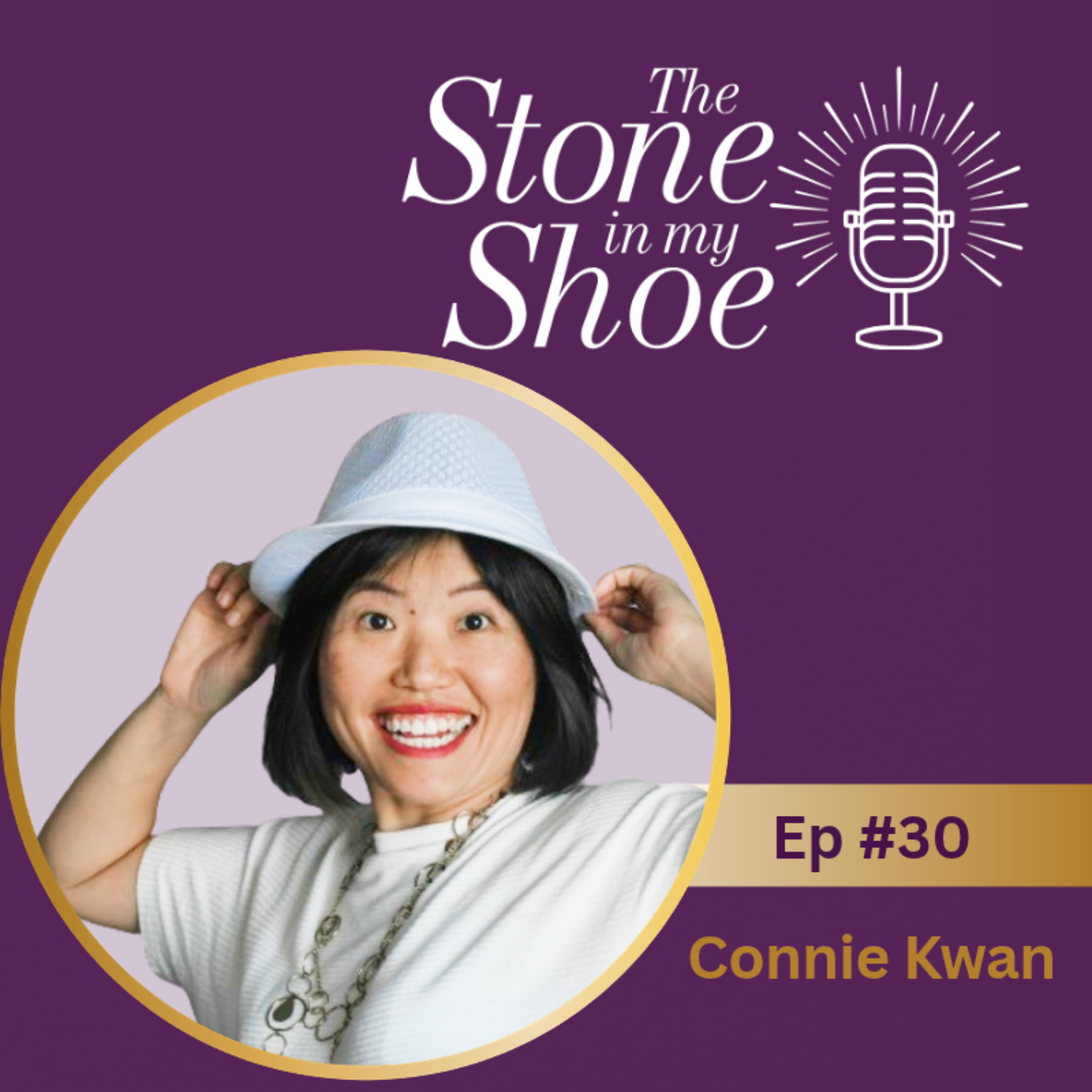
The Podcast · 11 September 2026 · 43 min
She Left the Job But Kept Grading Her Own Worth | Connie Kwan on Self-Worth & Identity Change
Listen to this episode
Chapters: tap one to jump to it
Why does your sense of self-worth disappear the moment there's nothing left to point to? Have you ever finished a day with nothing "produced" and felt strangely uneasy about it, like the day didn't quite count?
You will hear how a belief that your worth comes from what you do can start in childhood and keep running for decades.
You will hear what it looks like to still audit your own worth, seven years after leaving the system that used to do it for you.
You will hear why Connie says the real work was never a new career. It was identity change at the root.
Connie Kwan grew up in Hong Kong, where achievement was simply the language everyone around her spoke. After she immigrated to Canada she needed something legible to be recognised by, and she spent more than twenty years in a career that rewarded exactly that pattern with promotions, paycheques and praise.
Seven years after stepping away from corporate life to build something of her own, she's honest about what hasn't disappeared: the quiet audit she still runs on herself. We talk about the contradiction of being entrepreneurial while calling herself "a very low-risk person", and why she believes real purpose has no guarantee attached to it.
Connie is a former Silicon Valley product executive who spent over twenty years in leadership roles at companies including Microsoft and Atlassian. Today she writes the newsletter STORYHabits and runs Product Maestro.
It's a thoughtful conversation about self-worth, identity change and what it takes to stop needing proof that you were enough today, including what she means by "getting rid of my stone".
What you will hear
Why growing up between Hong Kong and Canada shaped Connie's relationship with achievement
How a career can reward a belief about worth with promotions and praise
Why identity change, not a new career, was the real work
Why she believes real purpose has no guarantee attached to it
What she means by "getting rid of my stone"
Sometimes the hardest part isn't leaving the job that measured you. It's learning to stop measuring yourself.
Read the full transcript
A worth comes from what I do. That's my stone. And that creates that deterministic system, that if you show up for this job, if you do these assignments, you will get this outcome. Mix the worth portion of that, very simple. I do these actions, I am rewarded with a symbol of my worth, whether that is a graded paper saying, great job, you got A plus, or here's your paycheck. Great job, you showed up and you did the necessary things. Those are very external motivators, external validations of my worth. And so I'm moving now to a stage
where I don't have that feedback, not in the same way. I have to be the energy behind getting that feedback. Hi, I'm Debbie Thompson, and welcome to the Stone in My Shoe podcast. Like a stone, we carry many things that quietly shape our lives as we walk through life. Through honest conversations and powerful stories, we discover the wisdom that helps us understand ourselves and walk a little more freely. And today I'm joined by Connie Kwan, a former Silicon Valley product executive, leadership strategist and founder who now helps high achieving people navigate identity change.
Connie spent more than 20 years leading products in Silicon Valley, including roles in Microsoft and Atlassian. Today her work explores the connection between identity, storytelling, and lasting change, particularly why achievement alone doesn't necessarily create fulfillment. At the heart of Connie's work is something deeply personal. The stories we tell ourselves about who we are and what makes us worthy. Welcome, Connie. Thank you, Debbie. Lovely to be here. Yeah, lovely to have you. And I'm excited to hear about your story, your stones, and also a little bit more about that beautiful image in the back of your screen with the anchor in the balloon.
But we'll get into that, the story habits, because story's telling is something that I love and metaphors as well, so I can see there's a beautiful visual. But before we get going, just so that we can ground it for the person who's listening, as she listens to you today, what do you hope she begins to recognize in herself? That we have the power to design the life we choose. And the story is the beginning of that path. Who are you in this season of your life and what feels most important to you right now? I've lived a life that society gave me as a blueprint, right?
Get educated, get a job, have a family, work the job, climb the ladder. And I'm transitioning to a more creative chapter in my life where I'm writing a book this year to publish and my life up to this point has more been driven by what's the outcome I get, right? I work a job, I get paid, right? There's a very clear outcome from that work that you actually negotiate ahead of time, that you know what you're going to get paid based on a specific output. And that's been in school, it's also the same thing where you're told these are the tests you need to take, this is how you generate an output of an A+.
And I've learned to thrive in that system of a very deterministic outcome from my work. And now I'm in a very different chapter in my life where the outcome is non-deterministic. I'm writing a book, I have no way of knowing whether it will be loved, it will be ignored. I don't know, there's a lot of uncertainty there. I know that my work is impacting people when I do it one-on-one, but would it scale? Would it reach number of people that I hope that it would reach? Would it give them the same impact that it would outside of the one-on-one conversations that I'm having? I don't know, there's a lot of I don't knows in this chapter of my life, which is both scary, it feels like jumping off the ledge, but also a little bit freeing in that I'm pursuing something
that is unique to me, that isn't, if I get a job, I can argue that, oh, I'm so unique they wanna hire me, but the reality is they have 10 other people sitting behind me willing to fill that seat and able to fill that seat. But this creative endeavor I'm doing, this book I'm writing, this particular narrative, this experience that I'm sharing with folks, including all the conversations I've had with folks that are embedded into the book is unique to my life experience, and I feel like there's something really special in that, which is not replaceable by the classic type of work. It's both extremely scary and also extremely rewarding
to get a chance to pursue life in this way. And so many things you've touched on there, coming from a story that society handed you, very deterministic, very clear outcomes to understand you can put the blocks in place and you know where you're going. And then literally jumping off a cliff, and it's not like you jumped off a cliff without a parachute or with some help. It wasn't like a 80 foot cliff, it was a small cliff unknown and there was a net, your education and so many things catching you, but there's this flow that you're talking about. There's this complete 180 shift from knowing the outcome to I'm gonna see what happens.
I don't know where this is going. And for many people listening, that's like, whoa, that's quite extreme. So I'm sure it didn't happen like that. And it was with steps, but it's beautiful and I can just see your individualism and your creativity and your authenticity. It's just shining out, which is beautiful. So thank you for sharing that with us. So let's go into this stone and then we'll build the story back up to where you are now and how you live your life. So if you had to name your stone, what would you call it? My worth comes from what I do. That's my stone.
And that creates that deterministic system that if you show up for this job, if you do these assignments, you will get this outcome. Mix the worth portion of that, very simple, right? If I do these actions, I am rewarded with a symbol of my worth, whether that is a graded paper saying, great job, you got A plus, or here's your paycheck. Great job, you showed up and you did the necessary things. Those are very external motivators, external validations of my worth, right? And so I'm moving now to the stage where I don't have that feedback.
Not in the same way. I have to be the energy behind getting that feedback. When I do one-on-ones with folks, when I do coaching, I get that feedback, but that is me going out and getting these even scheduled in the first place, right? And I have to decide what the milestones are. Oh, scheduling these one-on-ones is a milestone, but what if they don't get scheduled? Do I feel unworthy? Do I feel like I have not been productive? Maybe it's writing, writing sub-stack posts. I have a habit of now publishing once a week on my sub-stack, right? That helps me feel like I'm producing, but I can't, you know, there's a, the temptation is to say I published and then if X number of people read it or opened it, that's my worth,
but I've used that as a worth for a while. I've been in this transition for seven years, right? I have not worked in a traditional corporate job for seven years. I've held leadership roles as chief product officer at various smaller companies, but under slightly different arrangements so that I have this flexibility to jump off the cliff, but I'm not, I'm a very low-risk person, Debbie. I don't gamble. I find it hard to gamble. I just don't have that risk-taking personality even though I'm entrepreneurial. So there's a little bit of contradiction there, but I needed some time to explore what it is that I bring to the world and I finally decided like really fully committed to this particular idea. I had other ideas in the last seven years, obviously,
but now I've also made the shifts that is the, I would say the foundation underneath it. I think there's what the idea is, what I'm pursuing, and then there's the supporting infrastructure to make it possible for me to come back daily to do the work and that supporting infrastructure is getting rid of my stone. Absolutely. So let's go back to the beginning. This thought, this story, this part of your brain holding onto this, my worth comes from what I do. Where did that first began? And I'm curious to see where that belief came in, whether it was yours or whether it was inherited. Good for me. Yeah. It's probably a bit of both. It's hard to tease apart nature versus nurture,
but I grew up in Hong Kong. My parents, interestingly, always just wanted me to be happy. It was very clear that they're not measuring my worth based on my output, but I would say society as a whole was. So in a way they didn't have to because the society as a system, right? There's this idea that Chinese people, they work really hard, they're really good at math, all these stereotypes because there's truth in it. There's an expectation that as a child, your job is to get straight A's at school and that's what your parents would expect. And I always did
because I think, I don't think my mom explicitly said that you should, but she's a teacher and she spent a lot of time tutoring me and coaching me individually to help me to test well and to help me get those A's. And so there's a implied, non-explicit ask, but an implied, oh, I'm spending all this time with you. Obviously they're looking for something here, right? So I think the child figures that out on their own. So I think growing up, there's obviously more academic pressure in Hong Kong than in North America. So I spent my first 10 years there under that system. So it was the water that I swam in. And then when I moved to Canada, there, it became a different sort of challenge
because I had a language barrier. I was adapting to a different culture. All my friends, like all their TV references, I'm like, I don't know. I was a token Asian in my community. I was not in Toronto. I was actually outside Toronto. So all of those things then became an adjustment period. And because I already had that, that stone that I think, and I say partially could be environment, could also be me because I'm also a very, productivity is one of my pillars, right? Feeling productive, making a list and checking it off. I'm really good at it. I was a product manager. That's one of the skill sets. So I've just been traditionally good at it. I think people see it, they reward it verbally or otherwise. So there's this reinforcement of,
oh, you're good at that. So clearly, this is a thing you should be doing. So I think there's a natural tendency just from how my DNA is configured that I'm good at this skill and then the environment nurtured it. And getting the feedback, when you're good at something, and particularly if you're a new person in a new country and you're really good at that and you keep getting the accolades, as you said, this external praise that, oh, there's my worth, there's my worth. And then it all builds on each other and this is Connie. This is what she's really good at. And you don't question it, do you? Because it feels good to get feedback. You also, you feel valued, you feel as though you belong. So you've got so many of these basic human needs met
by this feedback that you're getting. But what seemed interesting is that this side of you has also helped you enormously in your career and what you've done. So as soon as they've occurred or bad, it has two sides to it. So tell us about the side of it that gave you this huge drive, ambition, hard work by the sounds of it and how that served you. Yes, I mean, we tend to see others and say, why aren't they like me in a way? But with us saying, oh, it's obvious that one should work hard and climb the ladder and try and get more out of life.
And isn't that obvious? Isn't that everybody's track? And then sometimes I meet people who don't have that or they're like, oh, whatever, I just wanna live the easy life and I fail to understand that. Because to me, it's water, right? If you drop into New York City or you drop into Hong Kong and you see the energy there, that's the energy, right? And so I think that kind of became my heartbeat, so to speak. It helped me, I never questioned it. For a long time, I never questioned this, just that's the way life is. And I think it helped me focus on moving forward and figuring out the next step and figuring out the next step and having the career that I have, having the life that I had. Again, I agree with you, it's neither right nor wrong,
it's just nature creates beings and then they interact in these ways and these are the outcomes. But I'm the one who got programmed to do, do, take action. And so I did that and the outcome has been positive for me and gave me the freedom to now explore other creative avenues. So you said you never questioned it and you were on this trajectory that most people would be going, oh, amazing. Connie's exactly where I wanna be. That's look at the life she's having, look at the job she's having, look at the success. But you weren't questioning it. Was there a moment or was your intuition whispering to you along the way that you just didn't hear? I mean, trying to know what shifted in you to go,
is this the path I wanna be on? Why am I doing all of this? Could you talk me through that? Yeah. And sometimes people talk about how much do you need in order to say goodbye to your boss, basically, right? And be like, I'm just gonna go live my best life. With the implied assumption that you hate your job and you're only doing it for the money, right? And I'm actually a little bit of both. I do love the job. I love being productive and be, but there are obviously days and moments where you're like, oh, I wish I didn't have to, right? I think that's true for everyone who loves their job. This is not always roses. The question people always ask, if you could do anything in the world when money is not an object, then what would you be doing?
And so I pondered that a lot. I was like, what is my number one thing? And my husband always pointed out, you love making money, but that has never been your number one thing. You enjoy it. I think it's the worst metric for me, right? But I enjoy freedom also, and I enjoy flexibility. So I made the shift, seven years ago, I made the shift of doing consulting independently because what I truly valued was working remotely. So I have that freedom. And this was before COVID. So it was before there's mainstream working remotely and now everything is flipping back. And so I started down that journey, I'm like, there was no remote job at the time. It was very hard to figure that out, but it was so important to me that I figure it out, that I managed to create arrangements where I could.
So I think I hit the moment where I'm like, I don't have to optimize for the payout anymore. And if I don't optimize for the payout, what are the things I want to optimize for? And how do I get the blend of things? Because up until that moment, I'm just like, that's the easiest metric, right? How do you get a bigger paycheck at a bigger role so that you can feel more important and get more worse points, right? It will give you worse points and you can absorb those like those are my worth points. But I decided, you know what, maybe I have different worth points. Freedom is worth something to me and time is worth something to me and creative pursuits is worth something to me. Having a legacy of some kind. Not that I'm writing the book for a legacy,
but that I have an imprint, something that it feels truly mine, that isn't me joining another company. And oh yeah, I worked at Alaskan, great, I went probably amazing. It's not my company, it's not my thing. And I think there is a worse to me of owning a thing that I can put my sandbox and say, oh, I made that for my own gratification, really. So I think these things started cropping up in my life to say, oh, maybe optimizing for the paycheck isn't the only thing I should worry about at this point. I've had enough of this type of thing and you know, we're more of the other columns now. So how do I balance it? Yeah, and it sounds like you just got curious, started thinking about the other things. What do I really value? And the answering that question, if money didn't matter, what would I do?
And then these other things, the freedom, the flexibility came in and looking at kind of balance. But what I'm also getting from you is this beautiful thing of I'm an individual and there's only one of me. And I wanna do something truly unique that speaks through me. And I'm getting goosebumps when I'm saying that and that speaks to the world and makes a difference. Because we're only here once and the journeyminers will pick the best of Connie. So this curiosity, you'll see a very, very curious person to change from working, look, I'm getting this accolades, going up the corporate ladder, getting all this external validation to pulling away and going,
no, there are lots of other things that are really important. Was that challenging? And how did the external world feed that back to you? Ah, good question. Was it challenging? Yeah, it's challenging. I also live in a place where when I run into people, when I was in Canada, people say, how's the weather? That's the greeting, yeah? Here is what do you do? Show me an impressive logo that you work at. That's what they're asking. Give me an impressive logo you're working at so that my eyes will light up and want to spend time with you. And if you don't do that, you see their lies dim and they're trying to get out of the conversation. That is the classic, you go networking anywhere here, that is the vibe, which is really hard.
If I'm trying to continue to live here and have friends and write to not be at, wow, the hot logo of the moment, right? And then I have LinkedIn bombarding me with, hey, we're hiring a VP of product, hey, we're having Shibara. We're having the title that I had before, all the things that I had before, it's constantly calling me back. So like I said, I'm seven years in, LinkedIn still pings me. I try turning those notifications off, but they come in anyway sometimes. And I still click them. And that speaks everything. That's like I am still addicted to that race and it's really hard
because there's so much validation and there's so much enforcement or culturally so much kind of keeping it there here where I live, that is really hard. You also asked how has the world responded to my shift? I would say I have to find different circles in order to continue feeling valued. So I started shifting to building my own community. So I have two communities that I've built and people truly value me in those communities. I joined communities where we are, where there are women in leadership who are going into their next chapter. And some are continuing their ladder climb,
but some are also shifting in the way that I'm shifting. And there's no disrespect for either scenarios. So in those communities, I feel more valued. I don't glaze over as soon as I don't give them a hot logo. So I have had to change my friends basically in order to be able to make this transition. And it's a new identity. It's a new version of Connie. And they often say the people you spend, the five people closest to you spend most time is who you become. And if your identity is changing, then the five people around you, apart from your husband obviously and kids, but the other people in the group to support you because your journey, we're all on this journey and you were there and now you're going there.
So I think it's a really important part to recognize that when your path changes, that we do have different people who support us because we can't do it all intrinsically. You're obviously an incredibly strong person. You've done a lot of self-work to get the self-worth from yourself. But at the same time, we need external stuff as well, not as much as perhaps you did many years ago. So I think that's a really important part for people who are listening, who feel as though their identity is changing. It is okay to change who you spend time with in your community and group because you're now on a slightly different path. You need a different set of walking boots or shoes because you're on a different terrain.
Exactly. Yeah. And as you are finding these new people to support you, do you find that, because you said you got LinkedIn coming in and this all part of you where this, you could get quick feedback how good you are, do you find that is becoming less and less of a pull for you? And how do you deal, how do you recognize it and deal with it so you don't get sucked back into that vortex as my question? As a high productive person, I think I just give myself other things to work on. So I don't have time for it. It's basically the answer. I try to, so it's a habit, right? There's a habit loop where I'm offered a better job.
Let's see if I qualify for that job so I can take it, right? That is the old behavior. So I'm rewriting that with, oh, no, you have projects. You're writing a sub-stack every week. Have you published? The next week has a schedule? Is it not scheduled? Go work on that. You also have a client. You can go spend time with that client. You also have, oh, I need to publish the book. And I haven't actually done all the steps yet of that. So I should go have a session with Claude and get that ball rolling. So I have all these balls that are in my to-do list and a huge backlog of articles. I have idea, like the stub idea but not having written it out yet, that every time I get that LinkedIn thing, I might accidentally click into it but then I'll, and it's getting better.
It used to click into it, then I'll click through to LinkedIn and I'll read the JD, even though I don't apply, just so it's almost like getting a hit from the old life. And now it's like, now I've gotten to, I scroll past it or I might click on the first click, open the email and just say, oh, they're hiring. Okay, close it because I've got things to do because my value, like going back to habits, right? Like I think of it as a habit, everything's a habit. And I think of anchoring it on my productivity, right? This is a distraction from this productivity that I'm focusing on, which is to publish the book, write the sub-stack, I have a podcast that I just launched. There's a lot of work in the list and that's all work that I have committed myself to.
So that work isn't any less important, it's just as important and arguably more important than this potential opportunity that is being thrown at me, which by the way, probably has 100 applicants and I'm already out of doing that. I don't have the, I have to ramp up if I want to do it. So it's not realistic. It's totally not realistic for me to follow that trail, but there's just a kind of a recurring trigger that I still respond to because of my old life. And it's what you said, you used your skills, that you are highly productive and obviously incredibly logical. And so the habit stacking that on a new set of habits. So using your skill, using your superpower, but just putting it into the different path.
And I think it's so true what you're saying about habits and what we do, who we spend our time with, where we think, what we focus on creates our reality and we really have to choose in every moment is this serving me rather than just taking the script as many of us did. I know that the script that I took when I was young as well was very similar to yours. It's what society expected. And only later on when you start to go, hang on, whose story is this? Yes. This is my life. What does worth mean to you now? Good question. Haven't explicitly defined it, Debbie. So this is a lot of speaking out loud here.
I think a lot of it is internal. How I feel that I have... It's a scoreboard that I can manipulate, right? I can choose what that means. I can spend all day fishing and I've communed with nature and that is, and I don't fish by the way and I never understood the fishing thing. But now I do. Now I'm like, you know what? It's an excuse to sit in nature and have something to do and feel like you're semi-productive but not and you're there and you might end up with a meal at the end of the day or not and that's cool, right? You got a chance to spend time in nature and you can say, oh, maybe my worth is number of minutes spent in nature. In which case you spend a day fishing
and you have wrapped up that worth like crazy or you can say, oh, my worth is producing 10 spreadsheets and if I spend a day fishing then I have zero worth that day. So we get to choose what that means for us which is a revelation. And then I think there's also the worth to the people around us and then they have a different scoreboard for us and for a healthy spouse relationship it's literally just my presence. Just me being there is worth to him which for me, like it's never on my own scoreboard just existing is a worth. It's not on my own scoreboard but it's actually on his and on my daughters and on my parents, right?
So I think there are worth points that, you know I haven't fully internalized and considered and they're friends, they're people who just they read my subsack, they're my audience and they're just happy that they're happy to get it. They're happy to read it and it's meaningful to them so I'm giving them, there's worth there for them of me producing this work but I never get it as a, it's not, I don't see it. So I just have to believe that it's happening because some of them will write back and say, thank you, I really liked your article but that's like 1% of them will take action on that. So I try to always appreciate people because I feel like people don't get enough feedback about their worth. I was just at the car dealership and of four dealerships
three of them were completely useless salespeople. I'm like, what happened to car sales because they used to be, they're very aggressive. Now they just take orders because car sales have completely changed but there was one guy at the Honda dealership and he was amazing. He was like, and he's a young guy too but he loved cars and he liked to tell us about he knew about Hondas and Lexus and everything. He's like, I used to work at Lexus now, I work here and he knew everything and I loved him and I saw, I made a point at them. You are the one guy who has helped us the most out of all dealerships. You are such a valuable person for this dealership. You don't even know. Your worth for your employer is unbelievable. You should know that. So I try to tell people because I feel like we don't, it's hard for anybody to know how their work has impacted others.
So I, maybe that's one of my own worth metrics. It's like, how can I help other people see their worth every day and thank them. And like every time, every chance I get, I'm like, I try to thank people for specific things. So that they know, oh, you have made an impact and this is important to me. And that was meaningful to me. So, yeah, maybe, you know, talking about this, maybe that's one of my worth columns, I don't know. That's beautiful talking through that because what I got from that is that worth is so individual, work can change. One day being in nature is really important. Another day is getting the sub-stack. Another day is being really present with your children, which I guess should be something that you're, you know, you know, every day rather than choosing. But it's about having so many different ways
of having worth. There is not one way and it can change. And some will have metrics, some won't have metrics. And I, it's almost as though you've just taken, you've almost flipped control and you've gone, I'm surrendering. I'm, and I don't mean surrendering as in giving up because that's the wrong word. Surrendering is a way of going into the world and going, I'm going to see what the world gives back to me and what I'm going to give. I'm going to be open. I'm going to go with the flow. I'm not going to try and control. And with that comes enormous strength and power and compassion and love and interconnection and so many things that previously you couldn't have put a score on.
Yeah. And I think it just from what I'm hearing is so much richness. There's this tapestry of such beauty and richness and a bit of golden, a bit of blue and a bit of sky and ocean and connection and love. And I think that tapestry you're creating of worth is magical. It is magical. Yeah. Just that we have control over what we decide is worth is magical. Yeah. And that way that you're changing and growing and how is that impacting your family? Interesting.
I don't know yet because my child is young. I'm hoping that it would give her some inspiration about what she can do with her life or she can have more choices. She hears me recording these podcasts, for example, which if I was in a corporate job I would never be doing I would be optimizing spreadsheets over there and optimizing workflow over there and products. But this is the fact that you and I get to sit and have this conversation is such a blessing and such a moment that I get to have because of the path I've chosen. And she hears them and at the end she's like, hey mama, I think that was a good recording. So she gets the exposure to my work. She would if I was working at home but it's like it's different.
It's different. She gets to see this side of me. And for my family, I think there is not income pressure. So if I was in an income pressure scenario I might have chosen this path because it's less income this path but I'm lucky enough to not worry about that. So that hasn't been a negative. My husband is supportive of it. And he, like I said, his main thing is he's just happy that I'm there, right? To have our life, to live our life together. So it's neutral I think for him. He's like, yeah, do what you love. I just want you to show up happy for me.
That's all he cares about. So as long as I'm happy doing what I'm doing and if I'm not then he'll point it out. He'd be like, I think you're kind of overstressed about this, is that what you really want to do? So yeah, no, it's been, and I feel very lucky to be in this situation where it has not impacted my family life. I have more freedom so I get to spend more time with my kid when I was in the corporate job. It's harder, especially if I go into the office then it's harder. And now we actually travel three months a year. So I would say that is a main change is that we do this long travel where we're still working and that's part of, and that can be done with a remote corporate job but a little bit harder because it's higher pressure. The kind of corporate job I would take
to feel like I have worse and to feel like I am advancing would be really demanding. So taking a less demanding, more flexible path lets me enjoy my travels when I'm traveling. And the other thing is that life is made up of so many different things, right? It's not just financial freedom, so sorry, not even freedom but financial part is one, connections is one, health is one. You know, there's so many things that we need to juggle as humans. And it's, from what you were saying is that you could have carried on and had this hugely, hugely successful career keeping going but then there are other things that you will have to forego as a result. Like nothing is free
and it's deciding what's important to you and some people might not have the flexibility of the financial freedom to be able to do some of these things but they can do smaller amounts. It doesn't have to be huge. It can be little things that change the balance of how you live and it's not throwing things out. It's perhaps some things taking some things off that side of the scale, adding some things on there and it can be lots of little things as you said changing your habits that suit you so that you get this balance because I think with that balance comes a sense for me anyway, a sense of peace, a sense of joy, a sense of ownership that it's my life and I'm choosing it.
I'm choosing it by design rather than going that's your life, I don't know what you think of that. Yeah, yeah, definitely choosing it. I think the easy indicator is when I see a meeting on my calendar or do I go, right? And that happens less for me nowadays than it used to and that's a big deal. And that's intuitive, isn't it? It's just a feeling, my body, my mind, that's a yes, that's a no and that takes time, doesn't it? Yeah, yeah. And it's not the thing is you never fully optimize it to be like, yay, every day is awesome. That never happens in the letter what path you choose. There's a book about that which is also the Buddhism philosophy which is that you choose your suffering
and life is suffering and you choose your suffering which sounds super ominous but when you unpack it, you're like, oh, nothing is cherry and you choose that to be that where the pain is less suffering for you is basically what they're saying. Just the thing where you don't mind the pain part of it because everything comes with pain as part of the package. So I'm like, that's very clever. And I feel like, yeah, I have, I'm in that moment right now for me. Beautiful. I just wanted to leave with a person listening, somebody who spent years measuring her value maybe by what she achieves work wise but maybe by what she gives to the family and does for everybody else. What would you like to leave her with today?
Yeah, I can definitely empathize. I'm a pleaser and I know a lot of pleaser and givers. So yes, I would say put the mask on yourself first, the oxygen mask when they drop out of the airplane. So whatever that means for you, put on yourself and then put it on the person next to you no matter how much you wanna give you gotta have your own oxygen mask. And if that's examining your worst table like how you evaluate worth, maybe the worth of someone else saying, oh, you've helped me, it's fully filled but something else is not fully filled. I don't think we all, I'm having this conversation and examining that now. Oh, what are, what is in my worth table?
And that's shifting every day all the time, not every day. Maybe every couple of years, right? It shifts. So I would examine that and just say put the oxygen mask on yourself first. And I can get that image of a worth chart and the fact that it's flexible and the fact that it has so many different parts to it, the being in nature, doing nothing, the watching the rain, the being connected to somebody and the fact that we can choose those some days different things are more important and to be curious and to be really curious where's my worth, why am I doing this? Does it make me happy? Does it serve me? Am I feeding my soul? Am I feeding myself? So thank you, that's incredibly powerful. Thank you for sharing that. Before we finish, is there anything else
that we haven't talked about that you would like to share? Did you wanna find out about story habits? Sure, and I will link it, I will link it below as well for anyone who's interested in that as well. Yeah, I'm working on the book Story Habits publishing in November and the book is talking about the steps that a lot of us skip when we pick up a new habit. So most of the habit books on the market focus on the how, right? They're saying, ah, you're gonna do this habit. Here's how you do it, make a list and put your shoes by the door and when your alarm goes off at five, jump into the shoes and start running. But we don't spend the time to examine why do we wanna wake up at five?
Oh, I read some book that says five a.m. club, ah, great, maybe I should try it. But that's, maybe I should try it isn't a strong enough motivator. And we skip the story to ourselves about why this habit matters to us, which means the habit doesn't stick. And then we get into the death spiral of, oh, I'm no good at this. I can't do habits, I suck. I'm never trying this again. Which is terrible for the next habit that we want that actually matters, right? So I'm writing this book because I believe this is an important piece that folks need a methodology to figure out. And I've worked with people in one-on-one settings
with this workshop for the last three years and it's been very effective. I've worked with people who had imposter syndrome, who are doing health goals, exercise goals, but also executive presence type, a lot of senior level folks who are trying to build executive presence in the boardroom, et cetera. And there are these habits in their mind, mindset habits that needs to get rewritten. And a lot of times the story completely changes how they approach it. It's like that thing where I'm clicking on the LinkedIn, right? I change the story of why I should stop clicking and suddenly, again, it takes a while, but it gives me a path out of it, out of that rut. And in the day and age now where everything's hijacking us, we've got all the social media stuff,
our devices, which we cannot live without because it's our wallet now, is hijacking us. Every app is trying to make us addicted and then every food packaging product, their main goal is to hit that bus point so that you buy it again and eat it again. Everything's trying to hijack our habits. I want people to have this tool. That's my main goal is that I want folks to design the life that they want. And, yeah. So I'm putting the energy into it. Yeah, and everybody's story is different. Our lens that we see the world in is different. And unless we understand the story and the habits and the beliefs behind what we're doing, because that's 90 to 95% of what we do is subconscious. And if we don't understand that what's driving us, how can we change anything? So thank you very much for sharing that, Connie.
I will link how anyone can get in touch with you below. Thank you again for your time. Connie, I really appreciate you being open and vulnerable and honest and sharing such really great ideas and visuals with everybody. And for the person who's listening today, perhaps it was a moment that you recognized something in yourself. And if it was there, stay curious because sometimes listening to someone else's story helps us see our own more clearly. So thanks for listening, everyone. Have a lovely day.
Want to know what your Stone could be?
Take the free reflectionKeep listening
 Choosing Yourself Over Belonging | Ramona Kossowan on Identity, People Pleasing & Finding Yourself6 August 2026
 Living Your Dream but Still Seeking Approval | Nyasha Ngwena on Identity, Self-Worth & Trusting Yourself9 July 2026
 I Couldn't Ignore It Anymore: Victoria Solomon on Self-Worth & Relationships12 June 2026