
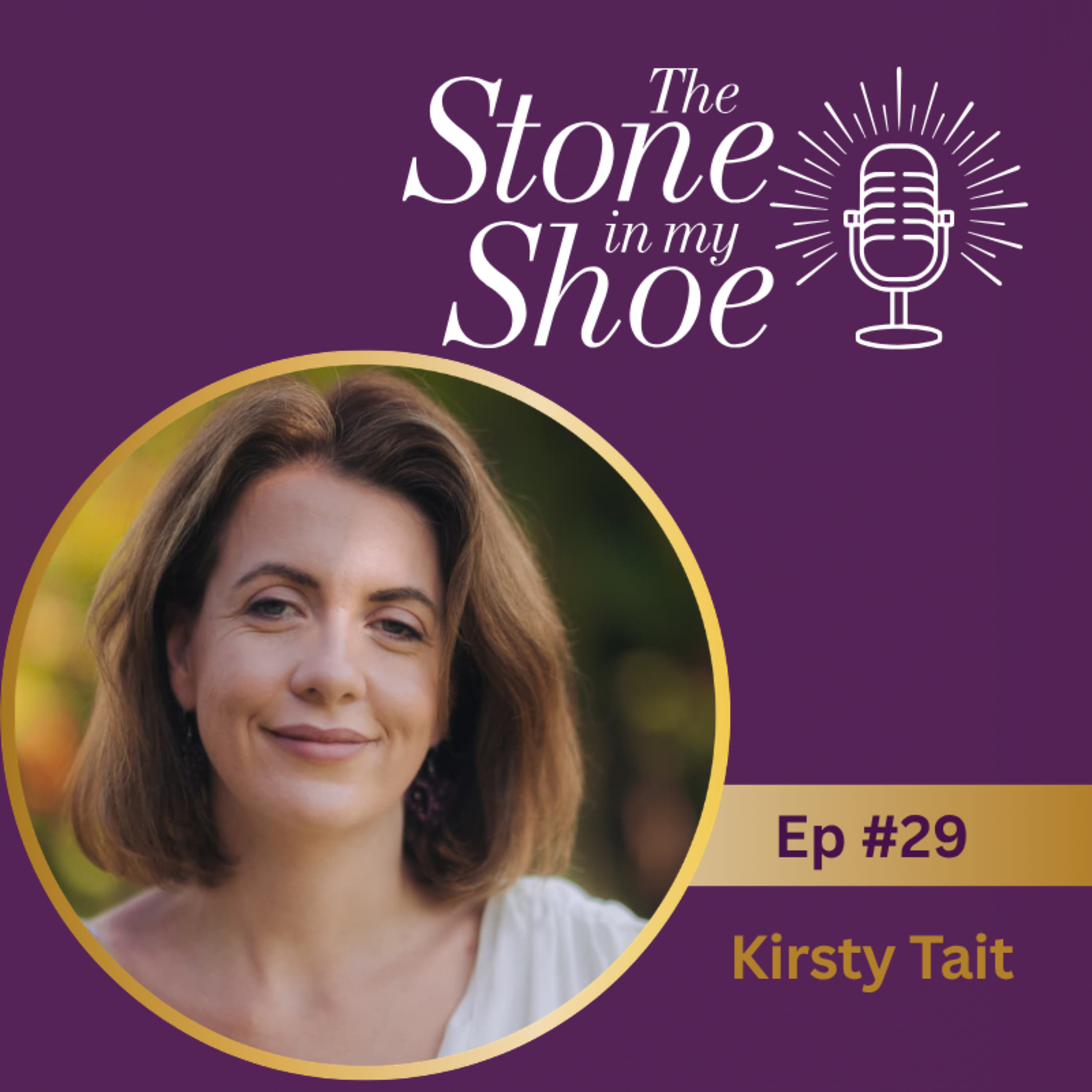
The Podcast · 4 September 2026 · 50 min
Why We Say Yes When We Really Mean No | Kirsty Tait on People Pleasing & Boundaries
Content note: this episode includes a discussion of suicidal thoughts.
Listen to this episode
Chapters: tap one to jump to it
Why do we keep saying yes to things we don't want to do, even when it leaves us feeling resentful and exhausted? People pleasing often begins in places so small we barely notice them.
You will hear why we say yes before we've even decided what we want.
You will hear how something as small as a hug can be where boundaries begin.
You will hear how Kirsty came to see that belonging was never something she needed to earn.
Kirsty Tait remembers a moment at a retreat that changed everything: "I didn't know I didn't have to hug people." That single sentence unravelled something much bigger, because she'd spent years letting people override her in small, easy-to-miss ways without ever understanding she had a choice.
Together we trace the pattern back to a childhood memory, through years of over-giving in friendships, and into the moment Kirsty finally understood that belonging was never something she needed to earn. She talks about being a chameleon and losing who you are, and about how alcohol was never the magic pill.
Kirsty is the founder of Confidence in Connection, where she works with the quiet, everyday ways we abandon ourselves in the name of being liked. She shares what helped her along the way, from stand-up comedy to small pieces of joy.
It's a thoughtful conversation about people pleasing, setting boundaries, self-worth and relationship patterns, and about what changes once we notice we've been carrying them.
What you will hear
Why we unconsciously say yes when we mean no
How a childhood memory can quietly shape a lifetime of people pleasing
The difference between being kind and seeking approval
Why setting boundaries often starts with something as small as a hug
How self-abandonment develops without us ever noticing
Being a chameleon: what it costs to lose who you are
Whether the fear of not belonging ever goes away
Why old stories can pull us back, even after we've changed
What Kirsty now understands about belonging and self-worth
Sometimes the hardest part isn't saying no. It's realising you were always allowed to.
Read the full transcript
in that retreat, there was an exercise about hugging and boundaries around hugging. This sounds ridiculous. And this is only two years ago. I didn't know. I didn't have to hug people. Like, I know that sounds crazy to some people, but I just thought it was polite. That was my story and my belief. You had to hug people if they wanted to hug. And the exercise was with Eric Hardos, who is an amazing relationship coach. And she was like, you don't have to hug people. You can set boundaries. You can say no. I'm Debbie Thompson and welcome to the Stone in My Shoe podcast. Like a stone in your shoe, we all carry things that quietly shape the way we
walk through life. Through honest conversations and powerful stories, we discover the wisdom that helps us understand ourselves and walk a little more freely. And today I'm joined by Kirsty Tait, an entrepreneur, bestselling author, speaker and founder of Confidence in Connection. Kirsty has spent more than 13 years working across recruitment, business and entrepreneurship, and she's a contributing author to the bestselling book Woman Gone Wild, the leadership edition. Having lived and worked and travelled around the world, Kirsty's own journey has led her to explore identity, belonging, success and perhaps the biggest question of all, who are we underneath everything we've been taught to be? Welcome, Kirsty. Thank you for having me, Dev. I
am so excited to be here and what a beautiful introduction. Thank you. It's always lovely to hear yourself being introduced and you're like, gosh, that's me. I have done so much. I'm so worthy. I'm so capable. And hearing it from somebody else, I don't know, how did that feel? It's still a bit of a hard one because you still don't realise it's you sometimes, and then you catch yourself and you're like, oh, yeah, it's cool things. And I'm trying to get better at really receiving that when people introduce me because it is such a beautiful thing for people to be able to witness you and for you to also witness yourself. I'm definitely getting better and I was fully engrossed in what you were saying, so thank you. And that's a beautiful thing you said receiving because I think so many women
were so used to giving and receiving is sometimes a bit of an alien concept that we need to balance the receiving and the giving. So thank you for bringing that up. Yeah, absolutely. And it's definitely a dance and a process and it's something I am personally working on and I don't think we stop. And it's a very interesting journey. And that is the life, though, when you can truly feel in your heart and really feel that love from others, you have more to be able to give. And I never used to understand the phrase about the aeroplane and putting on your mask first. I'm like, why wouldn't you put on your kids? And I'm not even a mother. And I'm like, why wouldn't you put on your kids? But they don't know how to do it. And they're going to be panicking because you're panicking. And the idea just makes so much more sense now. But
five years ago, it made no sense to me because I just couldn't grasp the concept of why you wouldn't help someone else first. Yeah, no, I totally get that as well. So before we begin, I'd love to ground this for the person who's listening. As she listens to your story today, what do you hope she quietly begins to recognise in herself? That's a great question. And honestly, it's that it's herself. And that is truly an individual feeling. And it's something that we don't necessarily allow ourselves to express. And half of the time, we don't even know who she is. And it's really starting to uncover
and understand that she does exist and she is there and she does have a voice. So if I can leave someone with that feeling of just starting to listen, just be that little bit inquisitive, I would feel like we've had a great conversation. I love the being inquisitive. One of the key words that I live by is curiosity. So my not curiosity, courage and compassion. And I think often it starts with just being curious because that is where the, you know, there's no judgment. It's like, well, that's interesting. And so many things that you've never thought of before are opened up to you. And as you said, it's a journey and it's an ongoing journey. But anyway, I'm not going to talk about that.
I want to talk about you. So before we get into the stone, where are you in the season of your life and what is the most important thing to you right now? I am in a really interesting season. I feel like I'm pregnant and I don't even know it. And I'm not in real life. But as like a concept of, and I have had the beauty that I created a really successful business. And then I realized I didn't really have the emotional intelligence to hold it. I didn't understand my body, myself. So I then went on a beautiful journey of discovering who I am, what I want. And now I'm coming out of the other side of that.
I have done it backwards, I think. And I got lucky in doing that way because now the world feels open and the world feels exciting and the world feels mine. And I think that this season is building, but building from foundations, having that experience and really building a solid infrastructure to take me forward. Okay, so building, building a business, building who you are, because you've got this beautiful foundation of having stripped back so much stuff of who am I and not going up the wrong pole as we say when you go up and you get to the top and go, oh, actually I chose the wrong pole to climb. And what feels most
important to you? And it might not be one thing, it might be a few things, but what feels most important to you right now? Honoring myself in what I want to do and not really listening to anyone else, which is hard in this day and age. We're on social media and within three minutes we've already seen 50 people's stories and how they're doing it and their successes. And I think it's become this loop of comparison. So I'm trying to get myself out of that and really do it my way and teach others to be able to do it their way because I don't have children as I just said. So my way might not fit someone for kids, but it's about helping people become curious. Exactly what you said. Curiosity for me is one of my
main strengths in helping people see that there is a different way. And it's usually just because we don't believe that there is, but when we can really start to open our minds and start to open opportunities, it is a beautiful way to start to see, okay, what do we want and what don't we want? So for me, the most important is freedom, but freedom in all aspects and how to create that within. So you're not feeling contracted when you're sending an email or building a business or trying new ideas or maybe you're in a job. It doesn't matter. It's about building that freedom within so that things don't stress you out if they come. So if you do climb up the wrong pole, you're like, okay, cool. Let's just slide back down and go for the next one.
I love that freedom, freedom within. And I also, you know, going back to the individual when you said it's an individual journey and this loop of comparison. And if you get caught in that, you lose who you are and you go, I need to do it like that. Oh, I need to do it like that. Oh, I need to do it like that. I need to do it like that. And then you're not you anymore. You're a bit of everybody. Yes. And then it feels icky. You can feel it. It feels icky. And it feels stressful. And there isn't that freedom within. Actually, you feel as though you're being beholden to other people and having to do it like them. Yeah, thank you for bringing those up. That's really important. So let's go to the stone. Let's talk about the stone you'd like to talk about
today. And if you could name it in word or a sentence, what would it be? So it's really interesting because I've been listening to your podcast and obviously I've known the podcast idea for ages. And I'm like, what is my stone? And then when you invited me on, I really had to sit with that because it's changed. And the other ones with more pebbles, they weren't the thing. And then when I was sitting with it, I realized it's belonging. And it's just what you're saying. It's about wanting to be with everyone and wanting to be a part of everyone. And I don't know whether that's because I'm an only child and I had to play with myself when I was a kid. But it was that need to fit in, that need to impress, that need to change myself to fit
into a certain group of people. And yeah, it made me lose my way. I don't necessarily believe that, but I believe that I was lost at the time and went down maybe a few different paths that if I didn't feel that need to get everybody to like me and that people pleaser and that need to be in community, that maybe I wouldn't have had those experiences. And the sense of belonging is so important because it's one of our fundamental things to belong to the tribe, right? Because without that, your survival many thousands of years ago depended on of being accepted by the tribe. So it is a very visceral need in human beings.
So if you look back on when do you think you started carrying this stone? Honestly, I think I've always been like that because I've always been that kid that wanted friends. I'm very social, very outgoing. So I always wanted to be friends with people. And I remember when I was thinking about this, when I was thinking about what to talk about, and this these group of girls and we were at a pub having lunch somewhere. And I remember there was like, it was back in the day when pubs used to have play parks and things like that. And I was like flipping over the bar. And this girl saw what I was doing and
she said, Oh, that's really cool. I want to do that. Can you show me how? And then I showed her and then she went back to her friends. And then her friends were like, basically really proud that she was doing this thing. And she was like, Oh, she showed me how to do it. And then they were just really horrible to me. And I was like, I don't understand why you're being horrible to me. And I still remember that. And it's just that wanting to fit in. It's wanting to be part of the girls or part of the boys. For me, growing up, it was being more involved with the lads. And I wanted to be in the lads group so much and for them to love and like me and just nurture me. And I think it's just been since being little, and I can't necessarily pinpoint a one piece, but there's multiple pieces where it's like, I need this and I need these people. And I just latch on to people in different capacities and really want to
be with them all of the time and share everything with them. And that's where I started to lose myself because I didn't realize how much energy I was giving out. I just, you know this, I just got blocked on WhatsApp. And it's still a recent thing. And I had 1700 open chats. I don't even know that many people. How have I got that many open chats? And I closed 100 a couple of months ago. So just even having that energy out there, that just open chats of communication, it's crazy. And we do this so much in our lives. So it's about coming back in and seeing why we need to, why we feel like we need to do that. Does that make sense? Oh, absolutely. And
I'm intrigued. I'm curious. Back when this was happening, you said from when you were a little girl and it built and you had the story and then you had this belief and then the story built on the belief, versions of it. What should you believe about yourself and about the world and people around you? In specifically to belonging, I felt like you always had to be who the other person was for them to like you. So I would have multiple different personalities depending on who my friends were. And it wasn't like I didn't have any friends. I've always had a lot of friends. I've been very blessed throughout my life. But it was maybe friends that shouldn't really been my friends
because we didn't really have that much in common. As I got older, it was like drinking friends, friends that just wanted to go out and escape life and not just drinking, get drunk, blackout, those kinds of friends and don't get me wrong. I had a lot of great times and they're all great people. But we were doing that together because we wanted to escape something. And I remember saying to one of my best friends, I was like, why did you used to let me drink so much? And he was like, Kirsty, you do realize I was always drinking with you? Meaning you aren't the only one going through it. And we get self obsessed sometimes and we're like, why didn't you help us? Or why didn't you do this? And when he said that, that was a big door and a big eye opener because you are collectively the people that you hang around with. And there's
everyone who is an entrepreneur who is wealthy will tell you are a product of the five people you spend the most time with. So if that's your season of life that you're going through, the likelihood is they're going through the same things. But at some point, when you become conscious of that, you have to make a choice to choose differently. And I think that is so important what you said about being a bit of a chameleon and thinking that you needed to be like other people wanted you to be. And so you had to wear lots of different hats. And in this process, I'm curious, which parts of you did you learn to hide or change or make smaller because you felt like you needed to fit in? Honestly, though, that I really struggled
when I started with the question, who am I, because I didn't know. And I didn't know about any of those parts really, because I'd been so my surname, Kirsty Tait, is that Tate State for so long, the party girl, the girl who was always up for a drink. I didn't know which parts of me existed. And don't get me wrong, I don't think there's any bad parts, but it's just about uncovering different parts in different seasons. And while those pieces were suppressed at that time, I don't even know if they could have come through fruition without going through that journey. So I don't necessarily see it as, for me, there was
individual parts suppressed. It was just more about understanding who I am and what I wanted and choosing those choices. Because I couldn't tell you what that version of me wanted in that moment, even looking back, because it was just that sense of being together. And I got that. So it's, but I got it in maybe where there could have been healthier ways to have that tribe mentality. And that's the thing is going on through parting, because it's fun, the feedback is immediate. You know, you're all going out the aim is to have fun. It's to quick connections. And, and you can see why people take that as I'm connected. Yeah. But, and maybe it's
the fun part that's being connected. But there are other parts of you that need different types of connection. But, and as you said, it's the five people you spend most time with. So if you're spending time with those people who get the connection that way, that's who the chameleon you're going to become, right? Yes. And then if you meet different people, there's going to be a different side of you. Until one day, I guess you go, who is the real Kirsty? Can the real Kirsty please stand up? Yeah, exactly. And you have to discover that person. It's not like it just suddenly I stopped drinking and I thought that would help me. And it really didn't because you don't know your identity. You have such an identity to this one thing. And then you change. And it's like, okay, who am I? And I, in the addiction world specifically, I don't think
that's talked about enough. It's not talked about the identity that you hold with that persona and that escapism, and then actually who you are, and how to uncover that. And for me, it's been a huge journey. It's taken me around the world. I'm very blessed in that regard. But it's also taken me to a lot of times just crying in my room and asking who am I and not really getting any answers. Because I think specifically more so for people who have like a perception about spirituality, they, or even spiritual people themselves, they think you're just going to get this line with God or the universal divine or whatever word you want to put in there. And you're just going to hear the answers. And that is not necessarily true.
Most of the time is like, okay, what do I want to do? And it's a co-creation in the choices that you make. And that version of standing up and who are you, a lot of the times it's knowing what you don't want. And for me, specifically with the alcohol, it was like, I wanted to do a year to see if I could do a year. But then after that, it was like, I needed to see what I was going to be like if I had a drink, because I don't think removing the problem is necessarily the best advice. Now, I'm not saying anyone who's going through alcohol, economic nurse or any an addiction process should go and have a drink. But it's I knew enough, because I've studied enough psychology to understand whether my root cause was transformed. Let's put it that way. So for me, seeing how I would behave with a drink,
I was further enough down my process where I could go through that, but I wouldn't recommend that for everyone on their addiction journey. I just want to put that out there. And I realized that I was nowhere near where I thought I needed to be. And that took me on another sober curious journey for six months. And then another journey of two years of sobriety. And then understanding more about my human mind, my psychology, where I feel the need to fit in, where I feel the need to just get carried away, where I feel the need to escape all these different pieces of the puzzle that make up who we are. And so during that journey, to strip away and then bring it back in and see if it is actually the root cause and then realize it's not the magic pill, right? Yeah. Thinking alcohol, okay, it was not the magic pill,
there was something deeper. So what else did you, as you were going through this journey, what else did you learn about yourself, about connection, and that could take you on to the next part of the journey? Because it sounds as though you did a lovely meandering journey through the world, through the woods and the trees and the sea and the ocean and literally. Yeah. So I would love, I'm really curious to know what did you learn about yourself and what personas, what parts of you were coming up? The piece that I took the most was the world is always speaking to you for you. And that is through everything that is through conversations like this, whether you're tuning in, whether you're having that conversation, whether it's a
specific sign that you're reading, whether it's through your patterns and behaviors, because your patterns will keep repeating until you break them. And there, your subconscious is extremely sneaky in the ways that it will show you that you haven't yet got to the level that you think you are. So for me, it was like the judgment, taking away the alcohol was then the judgment of the alcohol. And the alcohol is never the thing. There's many people throughout the world who have a glass of wine and they're absolutely fine. And it's no issue. It's not the alcohol. And it's not the alcohol's good or bad. It's your relationship with it just as it is with everything else. So for me, reading the world and really starting to listen to that
and how things interact with me and what it's bringing up in me is how I started to really uncover, am I okay with this? So for the audience, me and Debbie met at a retreat and at the first retreat of this set of retreats, so I ended up going and helping and working there, the first one I actually went to as a participant, in that retreat, there was an exercise about hugging and boundaries around hugging. This sounds ridiculous. And this is only two years ago. I didn't know I didn't have to hug people. I know that sounds crazy to some people, but I just thought it was polite. That was my story and my belief you had to hug people
if they wanted to hug. And the exercise with was with Eric Cardos, who is an amazing relationship coach. And she was like, you don't have to hug people. You can set boundaries. You can say no. And although there was some really transformative exercises through the retreat, for me, that was personally my biggest realization is that I had just been letting my boundaries being walked over for so many years. And I didn't even understand that I didn't have to hug people. Sounds ridiculous when you say it out loud, but it just wasn't something that ever occurred to me that I got to say no, if I didn't want to do that. So now, respectfully, if I don't want to hug someone, I won't, because why would I? I've learned that my energy is my energy.
And if I'm not feeling right, I don't really want to give you my bad vibes and vice versa. If I'm not really feeling you, I don't need to hug you. It's not a thing. And my love language is physical touch. I love hugging and I love a long lingering hug. But asking for permission and also giving yourself permission to say no was two of my biggest things that then I could put into other aspects of my life, but just never occurred to me through something so simple as a hug. And sometimes it is something that simple, that then highlights the fact that it's a boundary thing. It's, for years and years, you've allowed your boundaries to go. And you haven't either, you said asking permission and giving yourself permission. And
there's so many things that are tied to you. I'm just looking, I'm thinking if you're stoning your shoe and it is about fitting in. But one of the parts of this stone is kind of judgment in boundaries. And because it's never made up of one thing is fitting in. Am I good enough? Do I? Am I lovable? Are my boundaries in place? Judgment. So it's made up of a lot of different things. And it sounds like when you went through this journey, you were just starting to tap things and see what was making up this whole part of you and breaking off little bits and going, oh, that's interesting. I'm going to do more of that. Or I'm going to do less of that. Or I'm going to let that go. Or I'm going to get curious about that. When you started going on this journey and started questioning, what was some of the biggest, the hardest, because you said it,
it was amazing because you learned so much. But there must be times that were very challenging and going into dark places. I'm curious, can you talk to me a bit more about those? I think if anyone is in a dark place, first of all, just give yourself some grace. We all go through it. And there isn't anyone that can get us out apart from us. And I know it sounds cliche. And once we have that realization, though, it does become better. And we all know it's there. It's just, we like community. We like being with each other. We like people to handhold. You have to give yourself someone, you have to give your hand for someone to hold it and help you through. And I think that's the part we forget. We think we have to do it by
ourselves because, yes, you have to make that choice. There's always someone that will give you a handholding. You can just go on the internet and there's always people helping strangers. I have now programmed my algorithm that it's all good deeds and random good deeds to strangers. But that happens every day. Like how many times do you walk past someone and they just smile at you? And they're just that happy person. And you're like, what are they on? Because you want that. You want to feel like that. But if you don't allow yourself to feel just even a piece of joy for a moment, then you're keeping yourself in this vicious cycle. And that's what I realized. I was keeping myself in this cycle of negativity, of suicidal thoughts, of I don't even know depression. And it's not that depression doesn't exist.
But we're so used to our own pain. We're so used to our own suffering. And one of my favorite lines, it's a Bob Marley song, but it was originally quoted by Marcus Garvey. And he was a human rights activist in the 20s, 30s. And he says, emancipate yourself from mental slavery. None but ourselves can free our own minds, which was then put into a Bob Marley redemption song. But it's so true. And when we realize we've got the keys to our cage, life becomes more interesting. And that's for me where I started to read the world. I was like, okay, this is talking to me. Okay. I saw when I was going through my depression spell, I saw this quote from Jim Carrey. And it said, depression is your avatar sick of playing a character it no longer
wants to be. And I just saw it when I was doom scrolling on Instagram. And I'd been on Instagram for hours at this point. But that one message pierced me. It pierced me so much that I was like, this is for me. I need to listen to this. And when the message is, when the student is ready, the master will always show up. And I fully believe that. And I think that it's about allowing ourselves to just be open. You don't even have to do anything. Just be open that there is a different way. Just be open that there is more joy in your life. Just be open that maybe it does get better. Because if you just start to open the cracks, even just a tiny little bit, you can start to see things that maybe you've been missing.
You can start to notice people laughing. You can start to see maybe you can laugh too. And for me, one way I helped myself was sit hours on YouTube watching stand up comedy. Now you're not going to get many coaches to go and tell you that. And I would absolutely prescribe that to anyone that is feeling bad about themselves. Because if you can just start to feel that little bit of joy, one bit of laughter, that will allow yourself to relax your nervous system to settle in and just start to slightly open that there is more available for you. I love what you said there. There's so many things and I'm trying to remember them all. But the Avatar from Jim Carrey is amazing. Can you say that line again?
Depression is your avatar sick of playing a character it no longer wants to be. Yes. And it's getting to that point. It's almost where the stone in the shoe is going to be enough enough pain, enough depression, enough alcohol, enough trying to hide, enough staying busy, enough, enough. And at that point where you went, yeah, that's me. I need something different. Was it like, I don't know what it is, but I'm going to be open to see what I allow in. Or was it like, I think it's that now that I will learn more about that? Or was it a combination of just letting things in, meeting people, learning more, letting more things in? How did that unfold for you?
It was really a combination. And I think you've said it so beautifully there. Well, once you realize the stone is in your shoe, it's like, I need to get it out. That's it. It's irritating. It's annoying. It's always there unless you literally take off your shoe, look inside, tip it out. So it was a process and it's been a process. And it, this was five years ago. And it has taken many different versions to get to who I am now. And where I am now, I believe I've got three of the four Fs. So I'm not quite financially free yet, but I have time freedom. I have travel freedom. And I have mind freedom. And the last one, I think is the most important because
it's, if you keep telling yourself these stories, if you keep telling yourself the world is against you, you're always going to find evidence that backs that up. Your mind literally wants to find the proof that you are right. So if you keep telling yourself you're depressed, then guess what? The world is going to be seem monstrous. Everyone around you is going to seem depressing. The, you are going to find more reasons to be upset. You are going to find more reasons to stay in bed and watch Netflix. You are going to find more reasons to drink, whatever it is. So it's just about starting to look for confirmation, confirmation of maybe someone else did what I want to do. If you want to be a podcaster and create an amazing
podcast, you probably went and watched a podcast here or there. It's about, there's always someone that has done it before you. And it's about giving, yeah, giving yourself more confirmation that it exists. And I think also that the lenses you choose to see the world through, and you might not be able to switch glasses straight away. It might take some time to take those ones or put other ones on. But the Bob Marley thing says no one else can free our minds, but ourselves. But what you also said was really important is, yes, only us can free our minds, but we can do it with the help of other people. So with all the retreats you went on and then hugging excess, which exposed something. So I think it's also about being open and curious. And
you don't know what it is going to be. The avatar, the song lyric, the hugging, those were things that kind of unlocked something. And unless you're out there curious, you might never have known. I'm curious to go back. So now Kirsty has gone in. She's found herself. She's seen more of who she is. And as you became more yourself, that fear of not belonging, was that still there with that gone? It still definitely comes up. And I was just on a three day sales training this week. And I actually really realised how far I'd come because I see some people really wanting to belong. And it was really beautiful reflection to be for me
to just be sat in the corner by myself, like listening to the training. Because before it would have been more about who's on the training, who can I make friends with? Can we have a drink afterwards? I want to be friends with everybody where my main thing was to learn because the teacher is incredible and I wanted to be there for me. So it's definitely always going to come up. And we're social creatures. It's a thing. And this is how the world is built. Politics thrives off of this. Rightly or wrongly, it doesn't matter who you, what side you're on or who you vote for. It thrives on the need of there's always going to be you and you. And actually, it's when we start to realise that we're the human race, and not just the human race, the world, the plants, the animals, when we can look at it
at a collective, that belonging doesn't, you don't need to belong because you already belong. We already belong to planet Earth. We already belong to humans. We already belong to good people. And everyone wants to be good. I don't believe that people inherently want to be bad. I just think that things have happened to them and they haven't got themselves stuck, unstuck out of their programs and behaviours and their belief systems to believe that there is a different option for them. And that's because we're taught that there's not a different option. If you look at society, if you look at the environment, if you look at politics, if you look at the system, it's built in a specific way to not allow you to
even question that there is a different way of living. But if you find examples, you no longer have proof that option isn't available. One one example I want you to want to give your audience is what is the first thing you do when you go when you're sick? The likelihood is you're on Google and Google is going to have cancer when you're going to die. What about finding examples of people, even if you do get diagnosed with cancer, that have got through it? What about finding examples of yourself when you got through the flu or the cold or a disease that you've already had? If we literally went to our first thought of, I've had a cold before I'll get over it, it's going to have such a different effect on your body and your mind than
put in the worst case scenario there. So it's really being conscious of your thoughts and playing with them at every moment because you have the choice of the positive and the negative, but the negative, I think much energy man. Yeah, I think that's so important is to be consciously aware because if you're consciously aware you can go, I can choose this, I can choose differently, I can change things because as you said it's what you focus on, you get more of. If you focus on positive things you get more of them and the stone is going to slip backwards and forwards and when it does slip back and you feel like you really, because what you said was so profound is you already belong, you are a beautiful human, the chances of you being alive are
so infinite. Crazy. It's so crazy, like when you think of it, the probability of you being alive, if you really think about it you would just be so grateful for every breath you take. The fact that we're alive is unbelievable. Anyway, I'm not going there, but I've lost my train of thought because I suck, but it's how do you recognise that you are going back to the old ways of I need to belong rather than going I know I belong, I don't need to prove myself at all, I curcitate already belong. How do you recognise it and how do you go back? It's obviously just practice. Practice doesn't make perfection, it makes permanent and I just learned that from my sales training from Nick Stubb, shout out Nick. But it's true, practice makes permanent because it becomes
a habit, it becomes something that you just automatically recognise. Now you're not going to recognise it in every scenario, but if you need the practice, allow yourself to give yourself that practice, become curious. Why am I going to this event? What is the purpose of me going? I want to go and make friends. Amazing. So you know that you want to go to make friends, it's very different than saying yes, you haven't got the money to go, but you feel like you need to go because someone else has told you that it's a good event. There are very two different intentions to why you would want to do something. So until you can start to recognise it quicker, just exactly what we've been saying, be more curious, like why am I doing this thing?
Why am I doing this podcast? Why am I writing this book? Why do I want a new job? When I was in recruitment, I learnt a fascinating statistic. I think I've forgotten it, so it can't be that fascinating. Is it even 75 or 80% of people would rather look for a new job than ask for a promotion because they don't want to have the conversation and them say no. But they'll go through the process of writing up a CV, interviewing, finding a company, even if they're happy in their job, by the way, even if they're happy, but the only thing is that they want to step up, most people won't go for a promotion because they feel uncomfortable having that conversation
and it's not instilled in the workplace, so that's a common place to do. And it's the fear of rejection, isn't it? And the thing is about rejection, it's never the end of the world. You learn something from it and if somebody says no early on, maybe that was the best thing for you rather than waiting and waiting. And I think it's like anything uncomfortable. It's getting familiar with it, that rejection is not you're going to die at the end of the world, you're no good, you're not lovable because into fear of rejection, all these other stones, I'm not good enough, I'm not lovable, I'm not capable, whatever, it all fills in and I think you're absolutely right is what you said and
it's a hard one to grasp, Kirsty, is I already belong because of who I am. I am already good enough. I am already all of these things that as a child when we're born, we were all of those things and then our stories and things happened to us because we could just sit down to something, just know you're good enough, you belong, but it's just not that. Because it is that simple, it is that simple but it's also not that simple, yeah, I get it. It's simple but not easy because our subconscious is pulling us back to all these old stories, the stone in the shoe is there, it's familiar, it might not be helpful, maybe the journey you're on, your foot hurts a
bit or you can't climb that mountain because the stone's in your shoe. And I guess, I guess what I'm trying to say is that it's just stripping it all away and going, it is simple but it's not easy. But repetition is where the magic is because there's no silver bullet. Yeah, exactly. I'm finding out what works for you. Like some people love affirmations and affirmations are great but if you don't believe them, there's no point saying them, it's just wasted energy. So if for instance you want to become a millionaire, your affirmation might be I am a millionaire. Now if you have £10 in your bank account, this feels very far away. You feel
like you're actually lying to yourself and then doing yourself a disservice. Why not just change a couple of words? Why not say I'm in the progress of becoming a millionaire? Because everything that you're learning, everything that you're doing, it doesn't matter how much money is in your bank account, you're in the progress of doing it. So it's about finding a way that works for you. Some people love to listen to podcasts. Some people love to listen to audiobooks. I hate audiobooks. I have about 30 on my Audible and I think I've listened to about three. I love reading but I don't really give myself that much time to read. So it's one of those things. I love reading and I've still purchased 30 audiobooks because everyone's like, oh, audio is so much better. You can listen on the road. I don't take it in. I'm not going to listen to them or even
if I do listen to them, I'm not really going to listen to what I would like to. So you have to be really truthful with yourself because you have so much bullshit belief systems BS on your programme and you need to understand the stories that you're telling yourself. You need to understand that you believe it's hard to get x, y, and z. You need to understand that you need to belong to feel this way. Whatever it is, it's about being very truthful with who you are, very truthful with what is potentially coming up and you're not going to like everything about yourself and that's okay. We give ourselves a lot of excuses and just recognise them. That's okay. Everyone gives themselves excuses. Otherwise,
everyone would be multimillionaires in the world. So don't feel bad about it. Yeah. And I think compassion is really important. Once you've been curious, ends the courage to take those steps and then be compassionate. But I just wanted to know what does belonging mean to you now? And I know it's a journey and it might change in years, but right now, what does belonging mean to you? Belonging is feeling like you don't need to belong. It's very counterintuitive, but it's that feeling of there's eight billion people on the planet. Not one of us thinks the same or looks the same. Even if you're an identical twin, you do not have the same mind. So you're already individual and belonging is about expressing for me love in every way,
because the reason we want to belong is we want more love. So if you can truly feel that you don't need to belong, you have more love to give because you're not seeking it, but you're able to give it rather than trying to find it from somewhere else. So I think it comes back to that. I think it comes back to understanding that you don't need to feel a specific thing to belong. You already are, you already do. And when you can truly feel that you're in a place to help others feel that way and to help others feel that they're part of something, because you have the time, the space, the energy, the capacity to help them long on their journey by just giving whatever you are naturally there to give. And I feel like I went long-winded answer
to that. I really love that because it's counterintuitive. It's almost like what do you think belonging means? It means to go, I don't need to prove I belong. I just know I am. When I am, I can be so much more expansive. So with more me taking me, I do belong. Oh, am I good enough? Am I whatever? Let's just flip it. Let's put it straight back out and go, I already do belong and now I'm going to give this amazing energy out. And that's going to ground me in my belonging. Yeah, that's really beautiful way of looking at belonging. Thank you, Kirsty. So I just wanted to finish by speaking to the person who's listening. And perhaps she's spent a long time trying to belong, being who she thought she
needed to be. But there's a stoning issue. There's a niggle and she's no longer quite sure who she is. Where would you encourage her to start this journey? Everywhere. Try everything. Try things that you've never done. If you have a favorite restaurant, the likelihood we don't have a favorite restaurant, we have a favorite dish from a restaurant. Because if you have a favorite restaurant most of the time, people order the same thing. Try something new. Try putting different clothes together that are already in your wardrobe. Try a new recipe to cook. Try dancing if you've never
danced. Try a new project. Try a new book. Maybe you read nonfiction and you read all these self-development books. Read a fiction book. Read something that you would not normally read. The world is so vast and there is so many different things to experience. And the way to truly know who you are is to experience it all and to allow yourself to experience it all. And wear something that you wouldn't normally wear. This is a prime example. I bought it from a charity shop. It was £3. I literally walked past the window. I saw it and I was like, I need it because it was just something out of my normal comfort zone. It's this nice little floaty kimono. I just come back from Bali so I was feeling a bit Bali-ish.
But it was really something I would normally wear. And being in a charity shop, you can't even give yourself an excuse. Oh, it's too expensive. It was £3. Its silly little things are the best way to find out who you are. It's not about going to do another workshop. Although it may be. It's about more finding what do you actually enjoy? What brings you joy? It might be a new coffee flavour. It might be anything. It's just about allowing your expel to experience to find out what is actually good for you. And what sparks you. And what makes your heart feel warm and fuzzy. That's it. It's nothing complicated. And what I love about that is it's very low stakes. Going out and putting something together
that you already own or having a new coffee. And what's lovely about that is as you change things up, you will get curious. And the curiosity might ask a question. So it's not going to be the thing that there's never a magic bullet or a pill that does everything. I love the fact that it's just let's do something different. Let's get curious. Let's switch things up. And everybody can do that. Everybody can do something different. Challenging everybody who's listening is whatever you do tomorrow instead of doing the today. Instead of going to the same coffee shop, say try something different. Walk around the corner a different way. So I challenge you all to do that before we leave.
Is there anything else you would like to leave us with, Kirsty? I think just give yourself some grace. And as you said, compassion, it's a journey. And the beauty is in the journey. And I know it sounds cliche, but when you can truly feel the journey and truly feel in every experience and really invite in these new opportunities, you will leave feeling lighter. The anxiety will start to subside. The feelings of not being enough will start to subside. And one day you will be grateful for the life that you're already in, because you've slowly started to see the beauty in everything. You slowly starting to see the beauty in yourself. So Debs put it so beautifully. Just stay curious.
Courage, compassion, it is really a magical journey when you allow yourself to believe in magic. And it is. It's the journey, not the destination. Because the destination can change and maybe there are lots of differences, but it's the journey where whenever we go on a holiday, it's the serendipitous side thing that where the magic is. And yeah, there's all in one in everything. Oh, Kirsty, thank you so much for your time today and for your wisdom and for your honesty and your vulnerability. And because I think belonging is fundamental to many of us. And many of us will have this have the stone or part of a stone or maybe a stone that's unraveling who knows whatever we are. So thank you so much. And yeah, and as you finish listening
today, perhaps it was a moment where you recognise something in yourself. And if it was there, just stay curious. Because sometimes when we listen to someone else's story, it helps us see our own. Thank you so much for listening.
Want to know what your Stone could be?
Take the free reflectionKeep listening
 People Pleasing: When Love Feels Like Something You Have to Earn | Joni Woods19 October 2026
 I Had to Stop Abandoning Myself | Claira J on Mother Wounds, Self-Worth & Finding Your Voice17 August 2026
 Choosing Yourself Over Belonging | Ramona Kossowan on Identity, People Pleasing & Finding Yourself6 August 2026