
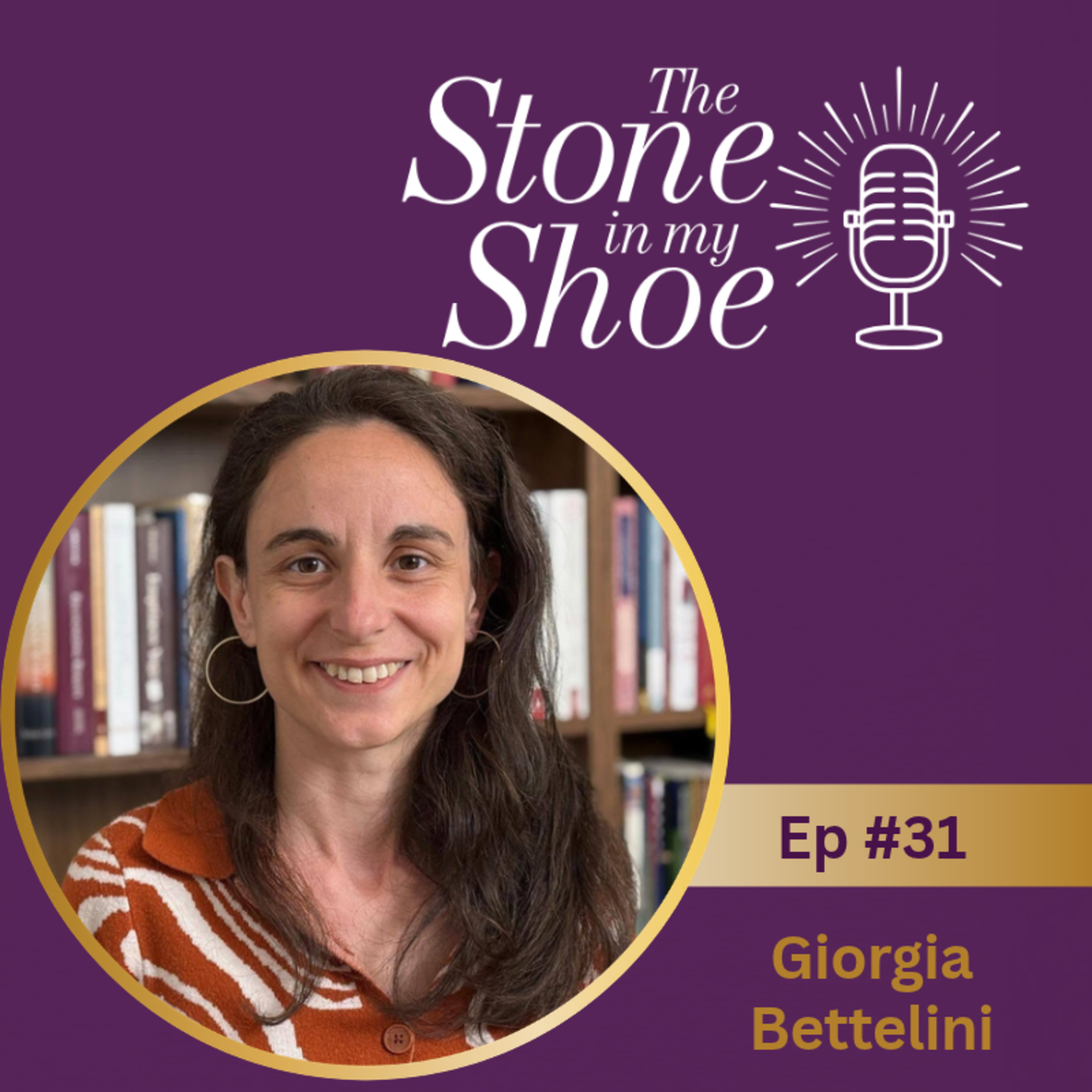
The Podcast · 21 September 2026 · 50 min
How to Change Limiting Beliefs and Stop Feeling Stuck | Giorgia Bettili
Listen to this episode
Chapters: tap one to jump to it
Have you ever felt stuck without knowing why? Limiting beliefs and subconscious patterns can quietly shape what we think is possible, even when life looks fine from the outside.
You will hear how a belief you never chose can quietly narrow what you can see.
You will hear why a thought can be yours without being you.
You will hear a gentle way to notice a thought and let it fade.
Giorgia shares how leaving Italy in her twenties began a much deeper journey: questioning the beliefs and expectations she had absorbed, recognising that her thoughts were not her identity, and learning to feel at home within herself.
Our conversation explores how beliefs formed in childhood or reinforced by society can remain long after they stop being useful. Giorgia reflects on meditation, life in Buddhist monasteries and the subconscious patterns that shaped her identity. Through mindfulness, self-compassion and curiosity, she began to relate differently to her inner critic.
Giorgia Bettili is a clinical hypnotherapist, dream coach and the founder of Lucid Mind Hypnotherapy, where she works with the subconscious mind, emotional patterns, sleep and dreams.
What you will hear
How limiting beliefs can narrow the possibilities we are able to see
Why a thought can belong to you without defining your identity
What it can mean to question expectations you never consciously chose
How mindfulness and self-compassion can change your relationship with difficult thoughts
Why small, repeated shifts can support personal growth and greater authenticity over time
How a career change or other life transition can raise deeper questions about identity and purpose
A simple daily gratitude practice for building a different pattern of attention
If you've been wondering how to change limiting beliefs, why you feel stuck in life or whether the rules guiding you are really yours, this conversation offers a thoughtful place to begin, with curiosity rather than judgement.
Read the full transcript
breaking up all that pattern that you learn in childhood or from the society, that you need to do something that you study for, you need to stick with it. If you change, then you're going to laugh behind. A lot of people around me at that time, they were just telling me that I was crazy. So you need to break all that self-limiting beliefs, judgment that come from the outward world, but we pick it up in our childhood. So for me, was I relearning to open up the possibilities that every time I would have these self-judgment thoughts, I would just leave it like that. It's not my thoughts, it's something that it is my thoughts, but it's not me. Hi, I'm Debbie Thompson and this is A Stone in My Shoe.
Like a stone in my shoe, we all carry things that quietly shape the way we walk through life. Through honest conversations and powerful stories, we discover the wisdom that helps us understand ourselves and walk a little more freely. And today I'm joined by Giorgia, who is a clinical hypnotherapist, green coach and founder of Lucid Mind Hypnotherapy. As you can hear, she's originally from Italy, but in her 20s, she left a familiar country behind and she went on a journey into understanding the mind, consciousness and what it truly means to feel at home within yourself. And this journey led her to spend years living as a Buddhist in Buddhist monasteries and retreat centres across Europe before training as a clinical hypnotherapist.
And today she combines evidence-based hypnotherapy with dream work, helping people break free from emotional patterns, quite looping thoughts and reconnect with themselves through the subconscious mind. Welcome, Giorgia. Thank you. Nice to be here. Yeah, it's lovely to have somebody whose subconscious mind is something that I'm so fascinated about, but hypnotherapy and your journey through working in monasteries is something I'm really looking forward to. But before we begin, I just want to ground this for the woman who's listening. As she hears your story today, what do you hope she quietly begins to recognise in herself?
So by listening my story, I would like to help people to understand that sometimes in life we feel stuck and we feel overwhelmed by our situation. So in my case, I had to physically leave my place and go for a journey, a life journey. Now, we don't have to physically move if it's not what we want to do. The important thing is that we shift our belief system, our subconscious pattern, and we find that place feeling at home inside ourselves. So that's what I would like to show people with my story really. So the important thing is that if something's uncomfortable, something's not working,
it's not about physically moving away or changing your job or changing whatever it is, but it's more about looking at your subconscious thoughts and looking at where those are and how you can reframe and work with them. Yeah, it's how we relate with the event, how we relate with what's happening to us. So we are not necessarily changing the outside world. Of course, eventually, because we are changing the inside world, our subconscious, our belief system, our thoughts, how we relate with our thoughts as well, then eventually, magically, but it's not magic, it's just logically, we select subconsciously
different outcomes in our life. So it's so interesting to see that when we do some work inside, automatically, the reality changes outside. It's surprising how even people, how we relate with people, we change ourselves first and I have people come to me and say, that person changes as well because what we are doing, we are changing this pattern and somehow the person noticed or simply we just, we are more able to deal with that, that seems, to us, it seems in a different way and people perceive that, people start, so the relationship changes as well. So that's very important. And I really love that, that it's so powerful because the change happens inside of you. So you have, there's so much power that we have
inside and when that happens, the external world changes as well and we see it in other people in situations. I love that, that's very powerful. So before we get into your stone, who are you in this season of your life and what feels most meaningful to you? Okay, like as you introduced me earlier on, I'm a clinical hypnotherapist and dream coach. So at the moment I'm running my business on the name of lucid mind hypnotherapy and I work with people, I specialize in sleep and dreams. So that's my big thing, so particularly the dream side. So dream side means that we work with the dreams, not only understanding the mini dream work, resolving nightmare and also I specialize
in lucid dreaming that helping people to become lucid in their dreams. On the clinical side, of my work, I work a lot with the sleep issues. So insomnia, not being able to fall back to sleep when we wake up in the middle of the night. But of course as a clinical hypnotherapist, the potential of clinical hypnotherapy is quite broader than that. So of course I work with people with habits, solving an unreservedful habits, fears and phobias, weight management can be pain management as well. So it's quite broader if clinical hypnotherapy and that is the clinical side of my job. And so I'm based in sorry, I'm based in Derbyshire, but I work mainly online. So what feels most meaningful to you right now? If you could just sum that up in a few sentences.
So at the moment, we are always in a journey, right? So we shift the continue. So it's so funny that you asked me that because recently in the last month I'm like really going into belief belief system and changes and beliefs changes. So as a hypnotherapist, we need that we are I'm registered with a professional body. And as part of our registration, we need to continuously learn new things. So it's good to. So in this moment in my life, I'm like training more and more in belief, the coding and changing and shifting. So I feel like it's quite important at the moment because I notice how at the end, a lot of our issues is because subconsciously we have pick up some beliefs that at the time when we pick them up, it might be
in childhood, maybe later on in life, they made sense in the moment. But the problem that we carry on and that belief system that was used useful at that time is not useful anymore. So we need to shift it. We need to upgrade it. We need to do something with that. We need to change it. And unfortunately, because it's a part of the subconscious is difficult to access it. So we need to use that's why I love hypnotherapy, because it helps us to access that deeper deeper state that usually when we just speak about, it doesn't emerge. We need to do a little bit more work on that under the surface. Yes. And that's incredibly meaningful
because if people can see the belief that's work. And as you said, it has to be it's subconscious. It's not conscious. You can't use your thinking mind. But if that's in a relationship with it and your understanding of it can be changed, so much of how you see the world, you relate to the world, you see yourself can change. And that's incredibly powerful and and can happen once you have access or once you bring the subconscious into the into the, I was going to say, into where you can work with it. That's incredibly very quick. And it's not years and years of trying to talk therapy and think therapy. It's we're going in. It was a belief that was made
and neuroplasticity. We're going to change that belief. And that's incredibly powerful. Thank you. Yeah, that's nice that you mentioned the neuroplasticity. We keep changing. We are in constant changes. So it's good to know that because if we are aware of that, we know that we can change it. That's the good news. Okay, so it's not something that we pick up and will be forever. We have always the potential to just change our habit, change our pattern. And it's about familiarity with new way of thinking, familiarity with new way of behaving. And the mind is flexible and it can learn a new way. So that's very important to highlight. Yeah, and I think that's and it's so powerful as well. But the thing is so many of these thoughts and patterns and beliefs are subconscious. And so they need to be brought into the light,
which is where your work is so important. So we're here to talk about your stone. What stone would you like to talk about today? And if you could describe it in a few sentences, how would you describe it? Yeah, there are many stone images. Let's speak about that. Yeah, the story that I want to break was like when I felt stuck, when I was living, I grew up in Italy, as you can hear. And I was feeling stuck a little bit in my life. There were a lot of expectation. And I felt also imploding where I was. I felt like sad. I felt stuck. And what the stone is really that I was identifying with this feeling with my thoughts,
I was narrowing my my possibilities. And some and in some somehow I didn't feel at home where I was because of my pattern. Okay, so I had to live in my case, I had to physically live and do some many experiences. And those experiences broaden up my my way of thinking, I learned new things, I learned how to approach in a different way with my own mind. So that would be like the the stone would be like being identified with that feeling with the thoughts, not being able to see the wider perspective. So go back to that you were in your early 20s, weren't you?
Yeah, middle 20s, middle 20s. And being in that space where you're stuck and sad and identifying and you said not seeing the big picture but having quite a small view of the world, that's a very brave thing to leave your country. Did you have a plan? Or did you just go, I need to get out of here. I'm gonna just jump off the cliff and see what happens. It was a little bit of the cycle. It's not something I recommend. But in that moment, I felt like I didn't have much of a plan. What I did, I remember the first step, I start to look for a volunteer place is something like just to get me out, something that I would have a place to start with, at least the first few weeks.
And then from there being able to travel a little bit more and explore. And then once you start, it's interesting because then you meet other people, things happen to you around you. So there are always more possibilities. But I had to do that jump, like it's a jump off the cliff you need to do at one point. As I mentioned before, you don't have to do it physically. Sometimes the jump is just to take your time for yourself and say, I'm going to change it. I'm going to ask for help, for example, just to go to therapy or finding someone who can guide you or help you or just push you into the shift. And then you know that you can do and go on alone. That's already brave and is something that we all can do. But in my case, I had to do that.
I felt like I had to do that. I had the possibility being young as well, not much responsibility to do that in the moment. So I don't regret. It was a useful thing for that time to do. But of course, I couldn't see the usefulness. I could see just the sadness and just the crying to get out of there. So it was a little bit maybe of a kind of escapism somehow. So it was the starting of a journey, but at the same time, you could see also as a escapism, like you want to get out of the situation. I see it in a positive way now because I learned so much. That is always learning. Like in neuro-linguistic programming, we say there is no failure that is always feedback.
So you just reframe and never use that negative word failure because it doesn't exist. It's yourself judging it as a failure. But if we see it and we learn from everything, then there is absolutely no failure. Always feedback, always going on, always learning something new. And what's interesting is back then, I'm assuming you didn't know about the subconscious mind and all this work. So in that case, probably the way of getting out of the situation to be able to see things differently is to actually physically have different people in your life with different beliefs, different thoughts, different outlooks and challenged the way you were looking at the world. And sometimes when we're in familiar places, and particularly if we're feeling small or
sad, we tend to, I don't know, even make our world smaller. And so you're even less challenged unless you said you go out, you get help or you look for answers. So that was a brave thing. And this 26 year old, 20, mid 20s, Giorgia got out there and met these other people. And what did you start noticing about your thought patterns, your life at when, at what point did you learn about the subconscious mind and those things that affected your career? Yeah. So I just need to do a little bit backward in the sense that, yeah, it was a jump but something that always followed me all throughout the journey, whatever it was bringing me was that just before leaving, I was in a bad codependent relationship. So I said,
one of the reasons I left was really to get out of someone that was like always there. So it was important for me as well to cut really in a abrupt way the relationship. But that person with all the negative memories I have about the situation, there was something really good about it. He gave me once a book by the Dalai Lama called the Art of Happiness. So I, when I received that book, I wouldn't even open it. I was so close mind is like is not something I'm going to read. I kept it on my shelf for two years before being able to open it. But when I finally opened, I realized that someone was speaking what I was looking for. He was speaking about a happiness, groundiness, a centerness that we can find in
ourselves independently of what's happening outside. So there is something higher, something more higher, more independent in the sense that we are empowered to decide how to relate with outside events. So we can be happy in any way. And it's so interesting because the teacher appears when the student is ready. So often we've all been given books or introduced to someone or you've gone and thought I'll do some therapy. And when you're ready, the teacher just appears. So when you got that book, were you still at home or did you start reading that when you, so you started reading that before you left? Yeah. It was just the edge of leaving. And I remember that then the few months before
leaving, I was still at university and was going around to all my colleagues asking, are you happy? Are you happy? And the majority of people never asked that question to themselves. And that's why sometimes we just go in autopilot in our life. And at one point in our life, we reach the breaking point. And that breaking point is so important for us. And my breaking point was there. That was the big breaking point for me. But of course, life is much more complicated than just one breaking point. There are different events in life, but there is always a point where we turn around. And for me, what that, but it was interesting to see that around me, people start questioning as soon as I ask that question, people start thinking, I've never thought about that. Am I happy? And that was my questioning
a lot before I left. And that I want to mention because from there, from that book, then of course, because you asked me, when did you start looking for the subconscious? That was the point of turning because I started putting more awareness and more, more interesting, more interest instead of the outside world. I turn more inside. So I start my meditation practice. I start to look at pattern. And with the meditation, automatically you start looking at your mind. So the subconscious as a term came into my last much later, but the inner work started there. So that was the turning point that started. And when you started doing your meditation and seeing the patterns,
what did you learn about yourself? So I learned first of all, you learn something important that we are constantly identifying ourselves with our thoughts. That's how we grow up. That's if nobody teaches us, that's how we think, how we go around in our lives. We are our thoughts. That's what we do automatically. When you sit down in silence with no distraction, so you need to cut everything and you're just there. At the beginning seems like, oh, what am I going to do? But slowly the noise outside subsides and then you are left with the noise inside. You realize that your mind is not silent at all. There is quite a lot
going on. Maybe you're like, I'm bored. Oh, there is so much to look inside. I don't get bored. So what were your main thoughts that were coming up for you that you were starting to, you know, to say why I left and why I needed to leave and my identity, what I identified with and breaking that down? All these thoughts, my thoughts, have that been passed down by my family, by generations from society. What did you discover about yourself during that time? It's a process because it's a process that lasts over 10 years. It takes time. Some people start meditating and they want the effect like that. Meditation is low. It's not more hypnotherapy help you more on a shift and it can be very quick. Meditation is something that goes parallel with it. I always recommend, even if I don't personally teach it,
it's something I always recommend because it's the stable, it's the stability. It gives you stability. In all the shifts you do, then it can give you stability. So it's difficult to see, to say now, what did I learn straight away? It is changing during times. The beginning was just ability to every time I felt something, I just stayed with the feeling without the extra judgment. So if I learn to be where I'm going to go, or at the anxiety, or not having a place, or the judgment, the inhibiting, a lot of thoughts. Yeah, I'm thinking about the pattern that I learned at that time. It would be more about opening possibility. So it was breaking
down, breaking up all that pattern that you learn in childhood or from the society, that you need to do something that you study for, you need to stick with it. If you change, then you're going to laugh behind. It depends on your background. We have all different backgrounds, but in that case, living like that, a lot of people around me at that time, they were just telling me that I was crazy. So you need to break all that self-limiting beliefs, judgment that come from the outward world, but we pick it up in our childhood. So for me, was I relearning to open up the possibilities that every time I would have these self-judgment thoughts, I would just leave it like that. It's not my thoughts, it's something that
it is my thoughts, but it's not me. I would just leave it and just fade away because if I don't react on my thoughts, then there is no follow-up. There is no... Yeah, and so while you were doing this, because you left Italy and you were very sad, you said lots of crying stuff, and when you went and you met all these people, you saw that there were so many different beliefs and ways of doing it, you started meditating, started learning about this stuff, you started looking at your beliefs. Did you feel you were much happier quite quickly? It took a few months. Yeah, that's pretty quick. Yeah, it's pretty quick. And it is increasing. I feel like it's much increasing. So now, with the mind I have now, I look at myself now, we're talking about more than 15 years ago, I look myself back down there,
and the mind, I would never be able to come back at that sadness mind, because the sadness now go away like that. You have much more likely because you can disidentify, you know, that is something that it will pass. So I think the powerful thing is stick with it, because the change, we will see it after years, after when you come back to your home country and your friends tell you, you change, you're a totally different person. And that one, and you don't realize yourself because they change every day a little bit, every day a little bit. And because you are emerged in your life, you don't see it until someone from outside, from your previous mindset that you met in your previous mindset,
meet you and actually tell you, you change a lot and that a lot you didn't realize before having a feedback from someone. So I would say that is something, yeah, that is difficult to realize how much you change in the moment. So I can tell you now that my mind is totally shift. There were some times where I really realized, oh, I don't react like before, that for sure, but you realize in every single situation. So depending on what's happening, it's like, ah, in the past I would do that and now I don't do it anymore. So you need some event and some life feedback. Yeah, and I'm not the way you said there's no such thing as failure. Everything's feedback. And it's getting really curious about
your thoughts with no judgment to go, oh, that's interesting. I was really irritated by that. What is this around that's making me so irritated? Oh, because I'm feeling disrespectful. Why am I feeling disrespected? Because, and it could be something that happened when you're a six year old kid and you're then every time you're respected, you then react like that. So it's incredibly powerful. But what I was really interested is when you left Italy, and you were sad, felt like you'd been left behind all these beliefs that perhaps weren't yours, but come on to you through through living. What did you think you were really looking for when you left Italy? If I could, if you could take yourself back to that 25 year old self, what were you looking for? So I was looking for two things. There is a search for this
happiness inside that now I discovered it was possible because someone was speaking about. But this happiness was also meaning like a place where I would feel home, right? I would feel well. So that happiness is feeling well. And in my mind would be like a home, a place to stay, a place to be stable and happy, because I had to live where I was before, right? So in my personal case, there would be like also a physical place, almost like. So I was pushed by finding the right condition, the right place, the right people. And that was part of the journey. And I had to learn that there is no such a thing. So that eventually the home is something that you find inside. And when you find inside automatically, like we were talking
earlier, automatic also the outside become home, because you can be anywhere and feeling well. So of course, there will be some situations that are better for us. We are human. Of course, we want friends around. If there is some toxic friendship, we want to get rid of it. There are all useful things to do. But eventually, whatever happens, life can happen. We know that. So it's good to build up something internal, something that we can rely on, something that is there all the time and depend only on us. There is no external circumstances that can attack this state. That's so interesting, isn't it? How you will go. The happiness was always the catalyst, that book. And then you went searching for happiness. And it's
an amazing question to ask people, particularly in your mid to 25s. People don't even think about it. Am I happy? And then thinking that home is a physical place and actually realising it's something that we create inside ourselves. So looking back now, how, what does home really mean? Oh, yeah. So what does it mean? It means if we want to, I guess it will change a little bit for everyone while we can say our place of safety, where you can come back to it. Yeah, I think mainly safety and a place where we can come back to it. Now this same, yeah, sorry. No, I was going to say that that's really intriguing safety and come back to
because that is very physical. But we can take that into our minds as well. And that's what I'd love to explore with you is out of the physical world, but into that description into the internal world, if you could explore. And that's the safety, right? Because if we think, okay, some people has got really a safe external life as well, but a lot of people has got the struggle. So we need to understand that safety, if we start to rely on safety outside, it's very, it's not really stable because it's going to change. Life is keep changing. You rely on a job and then attend, you rely on a relationship and then attend. So why we need to rely on something external? Yeah, it can reach our lives. It's really good. But it can be good, at least for
out at last. But eventually, what is the place where we come back? We come back internally. We can come back in our stability. And that stability is how we relate, is build up upon how we relate with external circumstances relating that safe space inside, inside us. So when I say that place to come back, it means that whatever is happening around us, physically, externally, even sometimes in our mind, the thoughts that are raising thoughts, or it can happen, a strong emotion, where I'm going to come back. I'm going to come back in a quiet spot, in a place where I can watch. I can watch my mind, I can watch my emotion, I can watch my thoughts from a
stable place. So it's looking at something that is really grounding. It's not always easy, because sometimes we just carry it out by our thoughts, our emotion. Life events are pretty strong. It can be like major or it can be minor. But eventually, if we have that sentence here to deal with everything. Yeah, that's really interesting what you were saying as well. And being in a place that's quiet and calm, not judgmental, because I think myself talk, and I'm sure many women are the same, and men and everything. The way we talk to ourselves, we wouldn't talk to our best friend or our friends like that. There's so much judgment, there's so much disappointment. There's so many expectations. And even when you
do something amazing, how often do we really stop and celebrate and go, gosh, I'm so proud of you. Not what you did. You overcame all those fears. You did it anyway, even though it was really hard. And yes, there were parts that didn't work out the way you wanted to, but you learned so much. That's very, we don't do that very often. So having a safe space where no matter what's happening externally, we've got ourselves to go to uplift us, to love us, to be kind. And that's really beautiful. We're creating this beautiful place in our minds. Yeah, and what you mentioned as well is very important. Maybe we can highlight that because you said, okay, we need to have that space. We can create the space. We can also create
the familiarity to be able to come back to it over and over during the day. It's not only the five minutes meditation in the morning, but it's like throughout the day, habituate our mind to go back. But we cannot do that all the time. Sometimes we are in the middle of life and we need to react. So being able to look at your mind, our thoughts, how you said we speak to ourselves, change how we speak to ourselves so that hypnotherapy can help a lot because we change that continuous self-think, self-thoughts. We all do that. But instead of being judgmental, unresolved, full, maybe sometimes even negative, we just shift them and we create more positive of these self-thoughts, continuous thinking, continuous thought. It
is still happening. We cannot stop it, okay? But it's better to shift it in a more resourceful way for us in our life. And one way I always suggest is like something that I heard people doing when they do something wrong. They say, oh, I'm so stupid. Never say that to them. Even if you think about it, don't say it out loud because it's just reinforced the thoughts that you can just let it go. So if there is a thought, it's okay. I'm stupid. Let it go. But if you react also with your actual voice, you're just reinforcing the judgment on yourself instead of saying, it's okay. Instead of saying, I love myself. You could use it and reinforce it out loud. And I really love what you said there, that it's continuous. It's like going
to the gym. You're not going to go to the gym once, pick up some weights and then be fit. It's something that you commit to. You go whatever it is three times a week. You do your program. And then when you get used to that, you up the level. And I think that a lot of people are looking for a magic bullet, a one-off thing that can help them just go from A to B. And it is the small 1% you were talking about, the little changes every day. And the magic is in the consistency of these new habits and new things that we bring into our lives. And it is so. But at the end of a year, 1% a day because of compounding is exponential. It's huge. And so often we want the 25%. And the thing with the 25% is it's very hard to do
consistently, if not impossible. And then when we don't reach it, we get so down on ourselves. With 1%, the rest of us can reach 1%. So it's a far more compassionate way of making a change, isn't it? Yeah. Yeah, definitely. And we know our, yeah, I always, even with my hypnotherapy clients, I always, we do work at the subconscious mind, but I always tell them, what is the conscious bit you want to do? Okay. So we are supporting each other on both sides. So there is the subconscious work that can be quite quick. But then you need the conscious part that helps with all the change. What are you actually doing physically? Something practical? What do you want to help your subconscious with? Because if your subconscious
feels supported by your daily action, then it's going to work much better, much quicker, is supported. It knows that the change is supported. Okay. So there is a work on both sides. And like you said, it can be 1% can be 10% for you. If it feels right, if it feels easy, if it feels something that you can do, then it's okay. And another thing you said, that is something inhabit changing. I find everyone, everyone does it. So we set a goal. And we set higher goal. We said, we need to do every single day. And then one day we miss and we go down and we said, Oh, I lost it. That's it. I'm done. I fail. But there is not the failure because what I always say is that when you change habit, you need to look it
in a wider graph. So you don't look day by day, but you look it in three months time. So in three months time, if you miss one day, it's nothing, right? So that day, Oh, I miss one day. I felt ill. Something happened. So I missed that day. But tomorrow we start again, because my plan is seen now in three months time is in a broader perspective. So that's very important when we want to change habit to see ourselves like that. Yeah. And I think that's the thing is to see the big picture, not to see the individual events as a failure, but to look at the journey like any journey we do, we're going to stumble along the way, we're going to perhaps fall, we're going to go up and down. It's never a beautiful straight line and being compassionate with ourselves on
that and go, that's about the journey. Oh my gosh, what did I learn there? That wasn't failure. I learned so much about myself and being kind to yourself and not going back to those old scripts of, Oh, I failed at everything. I'm not good enough. There you go. I was going to set this goal and I didn't do it off to day three. There you go. I'm useless. Whatever the narrative is. Yeah. Fascinating. I don't know much about hypnotherapy, but I can see the getting into the subconscious mind and actually the dreaming as well is to be able to go in there and bring it up into the light and then work with it quickly because subconscious is hard to bring up sometimes, isn't it? Yeah, we're always busy. So when we are busy externally in our more conscious mind,
the conscious mind is more like the planner, the logical thing is the one that is more predominant in the daily light, daylight, daylight, daily life, daily life. Once in the night, the conscious mind fall asleep, it then disappear and then the subconscious mind can come up. And that's why I'm very interested in dreams because the subconscious mind can tell you all the things you need to tell you through dreams. It's quite, they can give you quite a lot through dreams because there is no conscious mind suppressing anything, it's just coming up. So working with dreams, we use metaphors, symbolism and try to match what those symbol mean in respect to our daily life because it can give quite a lot. It can give hints inside
where to work, what to address, suggestions. So it is a great tool if we can use it. And yes, eventually what we want to do is bring a lot of the subconscious material into the consciousness somehow. Like you said, you want to shed light to it because the more we are aware of what's going on, the more we can change it and the more we can stop falling it into the autopilot and start shift and say, no, I'm not going to do that now. I see it, I'm not going to fall again for the same pattern. I'm going to change now. So looking at it, is the first step. That's meditation, it helps a lot and that's why I always suggest if you have your own meditation, keep going because that is always parallel to the work that you can do in
therapy. In therapy is a little bit quicker because we can shift some emotion, get stuck and sometimes even meditation, it can take 20 years to shift that stuckness. So we want something quicker and I wish I could have learned about hypnotherapy earlier, but that was my journey. It took me 10 years to discover it and that's part of it. When you're ready, you will show what's happening, so you will find it. And so hypnotherapy work with more like a stuck emotion and can be quite quicker. It doesn't take all the space that meditation can do all the, because meditation build that stability that in hypnot, in three sessions, hypnotherapy, you cannot get. You can get the quick shift, but then the stability, you need to learn
yourself how to maintain it and that I think meditation can help you a lot with that. In hypnotherapy, we shift in the sense that we go in the subconscious and we go into the belief system, into that emotion that probably has been stuck there for a year and somehow in similar situation in life, it come up. It come up as you learn, as we learn when we were kids. So when we were kids, we learned something, maybe from parents, maybe from teachers, some authority figure, someone who taught you, taught us to react in the way, we pick up a belief system somehow. Everyone is different, so we all do it in a different way. It doesn't have a big trauma. It can be just an event that somehow has influenced us in a certain way and we
learn. And unfortunately, sometimes we get stuck into that learning. So somehow we react in our adult life, like those kids, the same kids. But now we are adults, so we need to relearn that belief system, change it into something that is more useful, something that is more adult, that is useful for our adult life. So that helps. So that's what hypnotherapy really helped with. Yeah. And I think that's often, unless the stone in the shoe or the thought is really affecting your life in such a way that it's painful. A lot of people don't make any changes because they don't understand the subconscious thoughts below that, the beliefs where it's coming from. And so things are uncomfortable, but they're not that bad.
It's not when you had to leave home because you were so sad. It's just uncomfortable, a lot of feeling. I'm okay, but I'm not, if you were to ask me a question, am I really happy? I'd be going, yeah, six out of 10. What do you say to those people? They haven't had a big T trauma, big trauma, but why is it important that they find out these subconscious thoughts or what all these belief systems below them? Yeah. Why should they change those habits? What's in it for them? But I think we are touching some deeper belief in the sense that then it depends on the person. What is your aiming life? What you want to, what is that when we will end our life and you look back, are you happy? How you live? That's the point. It's like to reach a state where you
look back and you don't have regrets really. So what I would say is pushing ourselves a little bit out of the comfort zone, it makes us realize our full potential as human beings, whatever it is. We are all different. It can be something totally different for each of us, but it's always stepping out of like you said, no, it's not too bad. Yeah, it's not too bad because you are in the comfort. What about if you step out? If you step out, you need to face fears that you maybe is comfortable not to face. You need to integrate that what is called, what that young call dark shadow. So those parts that we don't want to look, we have this zone ourselves. So they
are left in the subconscious under the carpet, but actually, eventually we come up somehow. So I don't believe that we can forget because the subconscious doesn't forget it. The subconscious pick up everything is constantly picking up information. And somehow, even if you consciously, we cannot remember events, we cannot remember some situation, the subconscious keep everything, store everything. So it is still there. So somehow, I would say to these people is like, I don't want to put this here, say, I will come back. But it's more like the enthusiasm to see, do come explore your full potential, integrate all those parts so they can be transformed,
they can be integrated. And so you are more a whole being really. And then I love that because it's about, yes, if you're comfortable, what's going to make you do it, get curious, have the courage to get curious, see what it's like to push yourself, ask yourself this question, am I really happy? Am I living authentically? And we might go, no, I'm actually not happy. And then I've got to unravel some things in my life, which might be uncomfortable. But fast forward, you're looking back on your life. And you go, wow, that day when I made that decision to do something about it, I can now look back at my life and say, no regrets. So I think it's looking at, as you said, the big picture, looking backwards and forwards,
and also being in the moment as well. It's been able to, the juxtaposition of being able to hold the future, the past, and what if, what is our potential? Yeah. Yeah. And like you said, so you mentioned also something good like the curiosity, curiosity can be a good drive as well. So it can be our spiritual life, because everyone's got maybe some spiritual meaning behind their lives. It's always something that is driving us curiosity to see what if. And in general, express our full potential because there is much more probably, like our mind is so infinite, right? That we have so much to explore. I could talk to you for hours, but is there anything we haven't talked about that we should have talked about before we finish
off? No, I think, I think we talk quite, quite in depth. The only thing maybe I want to conclude just to give a maybe exercise or a tool to people who are listening is like that we can shift our daily habits. Like for example, if we are in a poor thinking mode, or we feel like down, we feel like complaining about our situation, there are ways we can practice easily. And this what is I called the trio gratitude practice. And I have a practice for free on my website. If you go on the shop side, there are free resources as well. And I always give that for free. And it's super easy. And that probably because it's too easy, people just dismiss it.
And it's just every day, you just look at three things you are grateful for. Every day, when we say the 1%, three things only, every day, every single day. And I did this practice myself. This is not meditation. It's literally taken from hypnotherapy, but is a daily practice. And it tells us to shift what we are selecting. So the beginning is a little bit difficult because it's like, what am I going to choose? We can choose simple things. I have food today. I have a roof on my hand. I have a daughter, whatever it is. And then slowly you can add more things or even repeat the same one. It doesn't matter. The important thing is that every day we do that shift. And then after months that we do
that 1%, so we realize that we are actually less complaining. We feel more grateful about many other things without even thinking about it. It just went into our subconscious pattern. It's just automatic. So we did a little bit of effort, just build familiarity. And then this is building up a new pattern. So this is how we use our mind and shift. So that's a good tool maybe for people who are listening and they want to try themselves. They can start them with this simple. Oh, gratitude is huge. If ever I'm feeling just a bit down or a bit sad, I just focus on gratitude and it just takes me out of there to look at what I've got. So instead of focusing on that, my focus is completely different. And I see the world differently
and the world sees me differently. And it does take me literally three things. Three things I'm grateful for. I find that phenomenally powerful. Thank you so much for sharing it. Anyone can do it. And you can do it throughout the day to just bring yourself shift, just shift where you are and shift how you're thinking. So before we leave, I just want you to speak to the woman listening. So if she's sitting with this quiet sadness or something she can't quite explain, what's what are your parting words to her? I would let her know that I hope that this is inspiring in the sense that she can see how the potential and it's only momentary. So this situation is momentary first. Learn that even if it doesn't feel like it feel
like it encompassing everything, every aspect of your life, it actually is going to pass like everything else. Okay, everything is going to pass. Everything is going to change. Nothing stay. And then as I mentioned, I actually would really recommend to make an effort to start doing this practice. I really recommend because it does take an effort, particularly when you are in a sad mood, when the sadness is quite strong. It's difficult to do that first step. I know that. But doing and forcing yourself for the first few days, the first week, then you will see the shift quite quickly and then it become more automatically and that help to shift from the state you we are to more positive, more resourceful, more grateful.
Grateful is always great because it opened up a possibility. So in that moment, you feel sad, stuck, but by shifting your attention, you are shifting, you're opening up possibility. So slowly, you can see another side of your life that in this moment, if the emotion is too strong, you cannot see. Okay, so that yeah, I would recommend. Beautiful. And that's, as you said, so simple that people overlook it. They're looking for some complicating. It seems so simple, but it's so powerful. And the power is in the simplicity, but not just the simplicity, but they're doing it regularly. It's the 1%, that's where the magic is. Roger, thank you so much for your touch and I will link all your websites and how
to get hold of you in the below. So if anyone wants to get in touch with you for the hypnotherapy or the dream, the lucid dreaming, or if anyone's got an issue with insomnia or any kind of sleep issues, please, please reach out to Giorgia. And I thank you for your time and for being so vulnerable, so honest and sharing your story with us. Thank you. It was a pleasure to be here. Thank you. So as you finish listening today, perhaps there was a moment where you recognize something in yourself. And if it was there, just stay curious because sometimes listening to someone else's story really helps us see our own as well. Thanks for listening.
Want to know what your Stone could be?
Take the free reflectionKeep listening
 She Left the Job But Kept Grading Her Own Worth | Connie Kwan on Self-Worth & Identity Change11 September 2026
 Choosing Yourself Over Belonging | Ramona Kossowan on Identity, People Pleasing & Finding Yourself6 August 2026
 When Your Body Holds an Unspoken Truth | Lina Lambertini on Healing, Identity & Embodiment23 July 2026