
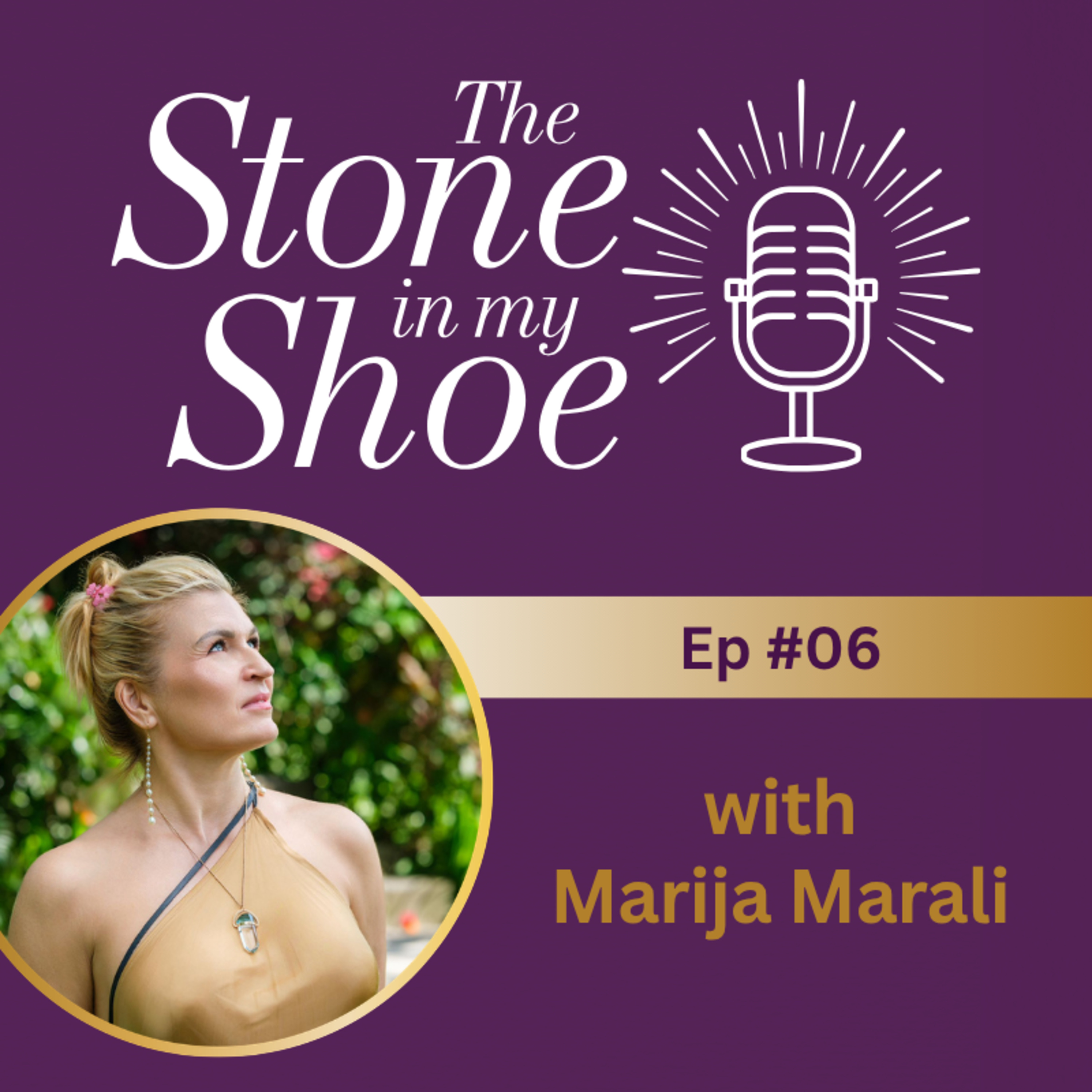
The Podcast · 18 March 2026 · 42 min
When Success Isn’t Enough: Maria Marali on Burnout, Tantra & Reclaiming Your Body
Content note: this episode includes a discussion of an eating disorder.
Listen to this episode
Chapters: tap one to jump to it
Outwardly, Marali had built the perfect life. A successful corporate career across Europe. Financial independence. Achievement. Discipline.
But Inwardly there was Shame. Disconnection. An eating disorder. Burnout so severe her body refused to get out of bed.
In this deeply honest episode of The Stone in My Shoe, I sit down with Marali — certified Tantra teacher, breath worker, and leadership mentor — to explore what happens when high achievement masks deep inner tension.
From growing up as a twin in Lithuania, to carrying guilt after her parents’ divorce, to developing bulimia in her teens and chasing success in London, Marali shares the invisible drivers behind her ambition — and the moment her body finally said no.
This conversation is not about sex.
It’s about integration.About weaving together the masculine drive to achieve and the feminine capacity to feel.About understanding that burnout is not weakness — it’s intelligence.
If you are a woman who:
• Achieves easily but feels disconnected from her body• Has built success but feels something is missing• Struggles with shame, perfectionism, or “not good enough”• Is tired of living neck-up and wants to feel fully alive• Is curious about Tantra but unsure what it really means
This episode will resonate deeply.
In this conversation, you will learn:
• How childhood guilt and “good girl” conditioning fuel overachievement• Why eating disorders and coping mechanisms can be survival strategies• What burnout is really communicating• How suppressing parts of yourself strengthens them• What Tantra actually means (and why it’s not just about sex)• How to reconnect mind and body after years of disconnection• Why true intimacy begins within
Marali explains Tantra as “weaving together” - the integration of masculine and feminine energies within us. Not rejecting ambition. Not rejecting softness. But allowing both to coexist.
Because success without embodiment is exhausting.And healing begins the moment we stop fighting ourselves.
If this episode speaks to you, subscribe and share it with a woman who needs to hear that burnout is not failure it’s a doorway.
This conversation is honest, grounded, and deeply liberating.
🔗 Connect with MaraliWebsite: tantrawithmarali.comInstagram: @tantrawithmarali
Read the full transcript
Hi, I'm Debbie Thompson and this is A Stone in My Shoe, the podcast where we explore how midlife can become the most true purposeful and fulfilling chapter yet when we choose to follow our inner wisdom. Today's guest is Maria Morali, a certified tantra teacher, breath worker and leadership mentor who works at the intersection of power, intimacy and embodied success. She built a successful corporate career across Europe, outwardly she had made it, inwardly the cost was burnout and emotional disconnection. Today she mentors executives and couples who have mastered strategy and structure yet crave deeper connection and aliveness. Her work bridges psychology, tantra, nervous system regulation and relational intelligence,
guiding leaders back into their bodies, their truth and their erotic vitality. Morali, welcome. I'm so happy to be here. Thank you Debbie for having me, hosting me. Oh, it's a pleasure. I'm so looking forward to hearing your story. There's so many things you've done, so many bridges, so many things you're bringing together. But before we go into your story, I just want to frame it for the woman who's listening to this. When she finishes this episode, what do you hope she will understand differently about herself in terms of connection, intimacy? I think, I hope, the key takeaway is that life is not static and things keep changing
all the time and no matter how much we're longing to get intimate with the other, with life, intimacy starts from within. So the more we get to understand the processes and it's so little that we get to know about ourselves like 5% they say, right, from the psychology perspective. So I hope that would be a takeaway. Let's go. So it starts from I and then the world starts opening. Oh, that's magic. So who are you? I know you lived in Lithuania for a while, you've lived all over the world, you've had a corporate career across Europe.
You now guide leaders into their bodies and their truth. If you had to describe yourself, what would you say? That's a good question. I would say I'm an ever changing woman, bringing, bridging the masculine. I come across a lot as this high achieving, high energy human being. And I think that started from the fact that I was born as a twin. So I have a twin sister. And there was always a deep yearning, deeper need in me to prove that between the two of us we're not the same. I remember people pointing at us at the streets and saying, you are the same, no, we're not.
So I always wanted to put more extra energy to look somehow unique. Now realizing that it's so deeply ingrained in all of us, we are born so unique by nature. It's given to us. And then I remember when I reached the age of nine, my parents decided to separate. That was such a hard moment of my life at that time that somehow I put this shirt of guilt and shame, no matter of the fact that it has nothing to do with the child when parents decide to separate now.
I understand that yet I started to build my life with more tenacity of I have to be good enough and wearing this obligation through life creates a lot of tension. So this inner masculine power was almost suffocating me. I really did not give myself a permission to relax, to do things that I really was dreaming of. Although my mom, she actually was a wonderful woman. She always told us, you always go and study what you want, not what you have to, because back then it was very popular to send their children to some prestige universities no
matter whether they wanted to or not. I think today is still the case. And I was lucky that mom said, no, who do you want to become? And I said, I want to study psychology. And so I went to study psychology and philosophy, ethics back then. And now it's serving me along the way because it gave me such a deep understanding of all the facets of spirituality. I was studying not just the philosophy, but also religions, all sorts of religions. And back then I thought, why do I need to know that? But now I work with people with all religions and the tantric aspects, the tools that I
use are non-religious. And people still find it hard to define what does it mean to be spiritual or religious? It still comes into the same bucket somehow. Sorry to interrupt you there. That's interesting what you said. This very masculine being good enough and going back and studying whatever you wanted to. Because often when it's very masculine, it's something you would go and study, something that had a real outcome, something really measurable. And yet you went and studied something that was to do with the mind and understanding the mind. So that is quite a dichotomy. Yes, I think my mom back then, no matter how much I felt not good enough.
From our early age, you know, mothers, there's so much intuition in there. She wanted to support me and my sister. We were since we were young, we loved to paint. We love these kind of expressions of ourselves through non-analytical ways of being, I suppose. And so she saw that and she said, well, do whatever you like in life. Because in her experience, she was sent to a university that she never wanted to go. And she never became, she was dreaming to become a surgeon. Never happened in her life. So, so I think she was just witnessing this play of wants and play of shoots.
Whilst, of course, supporting this responsibility in us that, hey, education is very important. So my sister went into arts school and I went to study psychology. And so what I think, can I just go, sorry, do you mind if I go back and just ask that to the nine-year-old you when your parents got divorced? And you felt so responsible and, you know, then something was wrong. Perhaps not with you, but with you were not good enough. And somehow you could have done something differently. How did, and so what happened was this achiever came in. How did that serve you?
And then how did it not serve you later on in life? What, how did it manifest and show up? That's such a good question. I, I know that it served massively in my studies. I was, I actually graduated as one of the best in, in, in my class. So that really was an excellent way of being back then. During that time on, I think I was in the first year or a little bit even earlier, I started to develop in my teenage years, basically, an eating disorder. I was always very aware of my weight since we were young with my sister.
We had the tendency to put on weight when you were a child. Today, I, today is somehow people look at it in a more simplistic way when the child is a little bit choppy. Back then I felt that everybody was pointing fingers at me. And I never had boyfriends when I was younger. I was super shy, although I looked outgoing. I looked so lively and because I was trying to perform to be the best. And so eating disorder became my inner devil, the punishment. It was this strong, powerful punishment mechanism I developed for myself for not being good enough,
I suppose. And for many years, I was suffering from this illness, not knowing how to overcome this, because where I'm coming from in Lithuania back then, it was not fashionable. It was not normal, shall I say, to go and ask for help from a psychologist. A therapy was not a thing to do. Later, when I moved to England, to London, I started working here. Then I found a therapist and I remember seeking therapy for me was devastating. Psychologically, I thought I'm so broken and even so more ashamed that I was crying, even dialing the number.
I remember I found something in the internet, feeling that nothing can cure me. This is unacceptable. And then later through the years, as I started practicing deeper yoga and Tantra meditations, I understood that I'm so lucky to develop this friend. And eating disorder, I was bulimic for many years, happened to become my friend. And only when I accepted this illness as a friend, I had a niece. And I understood that through so many years, this illness was leading me to where I am today. Just a couple of questions. I wanted to ask you that. You developed this
eating disorder in your teens and only got help when you got to England. How old were you when you first got help? I was 10 years later, approximately. I was in my 20s. No, a bit more, 15 years later probably. So that's a long time to live with this part of you that was punishing and shaming you for not being good enough. At that point, were you aware of what was happening? Because you've done your psychology degree. You had some knowledge about it, which is interesting. Could you see it for yourself? Or was it a real revelation when you went to see the
counselor? Well, when I was going to seek help at that point, I look at it as a disease, as an illness. Having said that, it's a secretive illness. It's something that a human being, usually a person, most commonly does not talk to anybody about. Because it feels not normal to eat and then get it out. The person who never came across with something like that would never understand. If people find more common to talk about alcohol or drug addiction, eating disorder is still something strange for people. I remember a friend of mine telling me
later when she learned about my problem, she said, why is this so difficult? Just don't eat. If only it was that easy. If you've got a problem with health, just don't drink, don't gamble. It is so obvious. What did you learn about yourself during this work that you did? What did you unravel? How did this empower you? How did it change you? Well, it's an excellent question. The most interesting thing is that for so many years of counseling, it would not go away. That enemy at that time as I saw it for so many years, that something that I wanted like a patch, take off me. The more I was trying to take it off,
the more it was holding on to my whole essence. None of the therapy helped until I found Tantra. Only in Tantra world I started to become aware of what is going on. I will always remember one specific moment of my life after I was already in Bali. I left to Bali in 2019. I was already practicing and teaching yoga professionally at that time. So I remember coming home after one retreat. It was a retreat for women. We had a massive amount of meditation going on there. I came home so happy. It's a statically
happy state of being. My full body felt alive. Yet when I'm overwhelmed, I tend to overeat. It's just another pattern. There's many patterns that we develop. I remember that at that moment something clicks in your mind that you're seeking for this friend again, whether it's a glass of wine or a fix, basically, of something is being needed. I remember in that moment, I realized that I became angry because, hey, I'm working so hard to get it over with. And yet it comes back at me. And that moment, I remember hugging that on the part of me.
The moment I accepted that it's also me, this part of me was seen and accepted. And no longer shamed. And no longer shamed. But a very important part of you, that needed to be nurtured, because what they say is what you resist persists. And this happens so often. We try and hide these parts of us, things that we don't like about ourselves, the shadow sides. And so we try and push them under the carpet, ignore them, and they just get louder and louder and louder. And I think this is a really important message for everyone, is to embrace all parts of you. The stuff, the parts that we love, the parts that we're really
proud of, but also the shadow sides. Because that's who we are. We're human, right? Yes, I agree with you. And in Tantra? Yes, can you tell us a bit more about Tantra? Because a lot of people don't really know what Tantra is. They've heard of it. So can you just, yeah, tell us more about how it works, what it does, and how it really helped you? So many people still think that Tantra is sex, or equal, all about sex. It does have a sexual aspect in it. But from Sanskrit word, Tantra translates as weaving together. That's one of the translations. And when we weave, we work with energy of masculine and feminine within.
So we start from our own being. So we really investigate what is this tenacity in me? What is this goal seeking in me, being the masculine energy? And what is this energy of playfulness and non-doing and beauty? And how do they weave together? And who am I with all of that playful dance as a human being? Because that reflects then to the outer world. So that's one of the meanings of Tantra. Another meaning of Tantra is really, as I translated, technology. We use technology today in a form of our mobile phone, to explore and understand the outer world, everything around us. We go into CharGPT and it tells you whatever you need to
know. So we always seek for that technology. However, there is one of the profound universal laws that states that the world is created as above, so below, as within, so without. It's a universal law. We cannot change it. It's just like we cannot change night and day. We'll keep happening. So according to this universal law, if we only keep seeking using technology to discover the external, it will never be fulfilled. The human being will never feel fulfilled because the internal world is not understood fully. As within, so without. We're creating our world from within. And so Tantra is that technology.
For more understanding, it's a whole embodiment. It's the mind and the body. Everything is connected. Yes. And in Tantra, we really, simple ways. In Tantra, always we explore sexuality. So all the lower chakra, sexuality has to be explored, love and spirituality. And all of that sits in our body. All of the energetic flow of these three sit in our body. So we can only explore that through breath, movement, sound, meditation. And this, you've been probably, you remember exploring the dance, the breath, and all of that is part of us. So in another words, we use
ancient techniques or technology that was offered to us by sages of India, Tibet, China, today in daily life. So we can actually explore the consequences of our inner world, how it reflects in the outer world. I hope it makes sense. Yes. No, thank you. That's great. So this was in 2019 that you came across the Tantra. You were doing yoga before that. And you were doing therapy. But it was Tantra that was really the thing that changed you and not changed you, but it was the thing that I suppose opened up this new world about accepting this part of you. But in before that, because that's 2019, before that you went and you had a decade or more of, you know, a corporate
career spanning all over Europe, a high achiever, but burnout. Can you tell us a bit more about that? So the eating disorder came with you, this shame and this guilt and this part of you that was punishing you. What was the side that was I suppose leading you into this career, fairly leading corporate career and the two working together? And what was the outcome for you? Well, most of the time, as I see myself and I see others who I work with today, majority of time when we achieve or want to achieve something is projected by the social world.
What is considered to be normal socially? And so we start to develop this necessity for more material wealth. It's considered to be a success if someone has wealth, or even when someone says, oh, he's a successful person, people would by default think, ah, he must have a lot of money, right? So same here, I came to London and I did have a successful career in sales. I never wanted to go into sales, it just happened to be. I was very good at it. And because I wanted to be good enough, as I started to believe this is the way to prove
that I'm good enough. So the money was the measure for me back then. I wanted to buy my own apartment. And I struggled to find a boyfriend. I struggled in relationships because of that deep sensations of shame. I could not really fully open up to myself and to the other. So my relationships were very on the surface whilst I was continuously chasing the money. It was the most important thing for me because the more I would receive, the more my inner radar of enoughness was feeling kind of at the highest scale, like, oh, okay, she is fitting. Because it's also so important no matter where we go, we want to fit the environment. And living in big
city like London, you have to fit the environment of really having lots of money. So did this money, so obviously you were very good at sales, you did financially very well. And you thought that was going to heal that wound or make you feel good enough or enough. Did that happen? And if not, how did it make you feel? Well, it's only so relative if it happened or not. In my view of things, I did buy an apartment on my own. I didn't have extra help for that. And so I believe it's huge success on my part. After I bought that apartment, two or three years later, I burned out. It's just one morning I woke up and my body refused to get out of bed, no matter what. I was
completely healthy. I just could not. I was staring at the ceiling saying, I cannot. So I called the doctor and that same day I received medication. I was told I need to get off work for three weeks and antidepressants were on my table. And it was again a big fall for me into the aspect of deep shame. How could I? How dare I? Yet my body said no. And this is what I see so often today in high achievers. The more a human being approaches life neck up, so constantly just through the mental way of living, the more disconnection with the body
happens. In my example, it was exactly the same. We were almost like separate entities where I was neglecting my body. And even more so, I was punishing my body all the time. That's how I felt that eating disease is this punishment. And so when this happened, it was this wake up call. What do I do? How do I connect the two together? How does that even work? Right. Sorry to interrupt you. Just a quick, you said a total disconnect of your brain and the body. And you woke up one morning going, I just can't get out of bed. So there was no signs before that or were there signs that you just weren't listening to that your body had had enough? Usually, well, in my case, I can say it's lack of
happy feelings. It's usually it's lack of something like lack of aliveness, lack of ecstatic feeling. Now, in my case, and again, I see it very often today, people seek to feel happier, to feel more ecstatic for external things like alcohol, drugs very often. In my case, I was never into drugs, but I really enjoyed my alcohol. So and the more I would indulge into that, the worse I would feel the next morning. So it was this silent conversation with myself knowing that something is off. But I'll keep doing that because everybody does. And so, what else to do? A type of story. Yeah. So I think it's often the way there are, you know,
looking back, there are stones in your shoe, and there's a little prick going, this is not good for you. But it's not often sharp enough. And because, as you said, you get used to a certain life that you just keep going. And it's only often only when literally you're flawed, you can't get out of bed or your body literally gives up that you actually have to take stock and do something. And very often it is even worse. It gets to cancer. Yeah. It gets to some serious illnesses. People break legs, hands, get into the accidents or have autoimmune diseases. So I was so lucky that in my case, it was just a burnout. Let's put it this way.
And in fact, it took me almost three months to get out of it. It took time. And when you were at this burnout, because you were, you know, successful, you had set these goals. And again, the shame came up, I'm not good enough. And you had three, did you say three months that you were took you? Yeah. What were you feeling at this point? Because, you know, you talk about as though it was, you know, a great thing that happened to you because you were so lucky it happened then. Can you tell me how you were feeling and how you got from the shame of the whole thing to actually, this is a good life experience. And I'm glad this happened to me. It took a long time to get to that point. Usually, the more we're self aware, the more we get to witness
the gratitude about things that are happening. Now, because most of the information that we receive during the days is in subconscious mind, right? So that's what the modern psychology suggests that our brain, our mind is receiving, well, according to the latest science about over a million bits of information every second. We only can digest about 120 bits of that information. Can you, the gap is huge. It's less than, it's less than 1%. It's a tiny tiny. It's incredible. So where is the rest? The rest is in subconscious. What does happen in subconscious? Well, that's where we create those defensive mechanisms or mechanisms for survival.
So because this information keeps coming, keeps coming, keeps coming. What do we do? First of all, my body needs to survive. This is the instinct. And back then, the instinct really was so prominent that my body said, stop too much. We cannot get into anything else until we start to feel safe. So many people today, and I see so many of such people in Bali, who when I talk in my private sessions or classes that I lead, people come with exactly the same thing. They say, I am pausing my life for a month or two, because I don't understand what I'm running with all of this. What's the point of all of that? And so I needed that time
to really deeply understand what is the point of what I'm doing, who is running behind me and chasing me for all of that. So when I started looking into subconscious and, and I'm a big believer that meditation and witnessing is the only way to do that. There is no other ways to really, yes, people are using hypnosis. People are using plant medicine today. And I have tried all of that. And this gives only a momentary shifts. If really someone wants a prolonged way of understanding what's going on in my life from the subconscious way of witnessing this, meditation is the only way. And it doesn't have to be this boring way of sitting with your eyes
closed and like people perceive it as I have to close my eyes and stop my thoughts. Well, no, this is not how it works. We should not stop our thoughts, right? So there are so many methods of meditation that we can apply. And I'm teaching meditation by the ancient book called Gigan Bhairav Tantra. And in that book, there is 112 methods of meditation. And one would ask, why do we need so many? Well, because we're so unique. And these 112 methods are more than 5000 years old. And the sages were saying already back then that some methods are designed for people back then. Some methods are designed for the current people and some methods
are designed for the future. And every human being will find their own method because this you probably, I hope you would agree, every human being comes with a different capacity. Our soul has so many different experiences beforehand. So we really need different things. So there is no one fits all kind of journey. So these people who are coming with you, you're working with now. So after leaving sales, going through this awakening, connecting with your body, finding Tantra and realizing what a powerful thing it had on you, helping other people. The people who come in, what kind of, do they come in with the same
things as you where their bodies are absolutely exhausted? Are there so many different ways? And what results do they get from using the Tantra meditation that you were talking about? So I often have people coming with this deep emptiness, deconstruction, this time of their life when they would achieve a lot. And they say, hey, on paper, I suppose to be the happiest man of my life, the happiest woman, I have money, I have houses, yachts, whatever I always wanted to, but I don't feel alive. My sexual energy is very low, libido is very low. I constantly
feel anxious. And I don't, alcohol doesn't help or external things don't help. How much more can I buy? So I feel better. And so that's their realization most commonly when people say, there's more to it, there's something more to that. And so we start usually by stabilizing the nervous system. So yes, of course, sometimes there are cases when a person is deeply depressed. So to stabilize, they do take medication for a very short period of time. I'm a very big believer that there are ways to restart your endocrine system
by breathwork alone. If you really consistently applying ancient Tantric meditation and breathwork, pranayama, there are incredibly simple methods, your whole body reshuffles, it just needs consistency. And so people start feeling this erotic energy. Well, you know, very often Tantric is considered to be this sex cult. The reason why sexual energy is applied in Tantric teachings and will work with sexual energy, because it's life force energy, the human being life is being created using this energy. So we don't call it sex energy, we call it life force energy. When this life force energy is reignited, opened, because we are
containing it all the time, it's just somewhere deep inside of us being asleep. Then it gives birth to so many ways of being. And in Tantric teachings, and I haven't seen that anywhere else, we work with emotional fluidity. I haven't tried to cure myself to so many ways, right? Emotional fluidity is the way to understand not more about your emotions, but also that emotions are like whether they come and go. So it's about acknowledging that the emotion doesn't have to be long. If I'm depressed, I'm forever depressed. No, this is the wrong way of approaching it.
When we learn to witness the emotion, go deep into that state of emotion, it dissolves so quickly, that liberates massively. And that's all within us. Yeah, that's all within you. And when these people come in feeling, you know, this disconnection, this having everything on paper, but just this emptiness inside. And this is a hard question to answer. And I know that because how long is a piece of string? How long does it normally take with the work that you do to turn things around and to bring more joy and spark into their lives? You'd be surprised, not so long. So yeah, people would think. I start with one month
and after one month, so usually it's a four weeks container. I work online a lot. So within first four weeks, there's huge shift already, but it has to be dedicated work together, right? So I give homework, a person has to practice. Sometimes people come and say, oh, I cannot fit something into my daily agenda, travel, or I do this and that. And I say, well, this is the whole point of tantra. It doesn't have to be a standalone practice. We are all born tantric. It's just learning to become more aware of what I do and how I do it. And then that changes the entire perspective of life. And so after four weeks, the shifts are really already happening. Then we go into three months and so on. It depends what people want because
tantric teachings are never ending. I recently was working with a couple. They came specifically on their honeymoon for a private retreat with me. And in their case, it was not to resolve something that needed resolution in the painful type of way. It was about they were as a couple together for many years and then they decided to get married. And so for them, it was about deepening the world of each other through tantra because very often, and I do work with couples a lot as well, especially couples who are together for a while, the biggest pitfall people tend to find in a couple is that we know each other so well.
So what to do? The arrows is often no longer there in the way or the spark that it used to be in the first year together, for example. So we start from acknowledging that, hey, you change every single day. So I really apply conscious communication techniques. I apply really subtle techniques of touch, self-awareness. Very often people want a very quick, I want to do a quick massage and so the sparks and I say, no, no, no, no, no. No. The slower we get into the process, the higher the arrow's erotic energy is. And so
it's controversial. It's kind of contradictory. Contradictive, in fact, very often. So to get hold of you, it's TantraWithMirali.com. I'll link everything below if anyone wants to in touch with you. And the Instagram handle is TantraWithMirali. But I just wanted to finish off because we're running out of time and I'd love to talk to you about this. And I'm sure most of the women listening were going, I need to know more about this. You know, this sounds fascinating. You know, particularly as women in middle age have been married for a long time. You know, anyway, moving on. For the woman who's listening and who feels successful but
emotionally disconnected, what do you want her to know? I would love her to know that less is more, that allowing herself to pause, to slow down her life will open the permission for way more opportunities. She becomes a magnet like honey when she allows to fully settle into a feminine flow of non-achieving. Achievement and goals is a masculine trait. And women are pushed to become men today, especially in business. So it's about collaboration. That's what women are excellent about. Maybe you would agree with me. Sometimes when we go to
a shopping and if I go alone, I'm like, how do I look in this new garment? I come out of this dressing room and I ask another woman and she goes, oh, maybe this one and that one. And this collaboration starts. It's not a competition. Women tend to believe we have to win all the time. No, it's about other traits as relaxation and men are longing for that. It's this slowness, this permission of just be like that beautiful flower. The flower never asks, am I beautiful enough? She just knows I am. And that's it. So I'd love women to really remind ourselves a bit more that we are beautiful just by birth. We're born for pleasure,
beauty, and that's how we really make the change in the world. Beautiful. Any final words before we go? Final words. I would guess because we've spoken about your audience before and it comes to my mind. No matter where we are today and no matter how one may feel today, it's good to remember that life is a life. There is no way we can stop whatever we feel if it's good or there is no way that if something feels really sad and heavy, it's going to last forever. It's about witnessing the moment as it is and acknowledging
with full gratitude that gives us peace, pleasure, and deep liberation states to move forward. That's beautiful, Morali. That's beautiful. And what a philosophy to leave with and all the emotions accepting every part of ourselves. So accepting every emotion that comes without getting caught up in it, just witnessing and seeing it and allowing us to be all the parts of ourselves human and that's incredibly empowering. Thank you so much for your time. Thank you so much for everything that you do and liberating this joy and vitality in people has got to be
such an amazing thing to do. So thank you. Thank you so much, Davia. It's a huge pleasure being connecting with you on different parts of the world. Enjoy the journey and we'll speak soon again. Thank you so much. Thank you. Bye.
Want to know what your Stone could be?
Take the free reflectionKeep listening
 Reclaiming Your Body in Midlife - Terry Tateossian on Trauma, Weight Gain & Self-Sabotage26 February 2026
 Why We Repeat the Same Relationship Patterns | Dr Judith Swack on Unconscious Beliefs & Self-Worth21 August 2026
 Living Your Dream but Still Seeking Approval | Nyasha Ngwena on Identity, Self-Worth & Trusting Yourself9 July 2026