
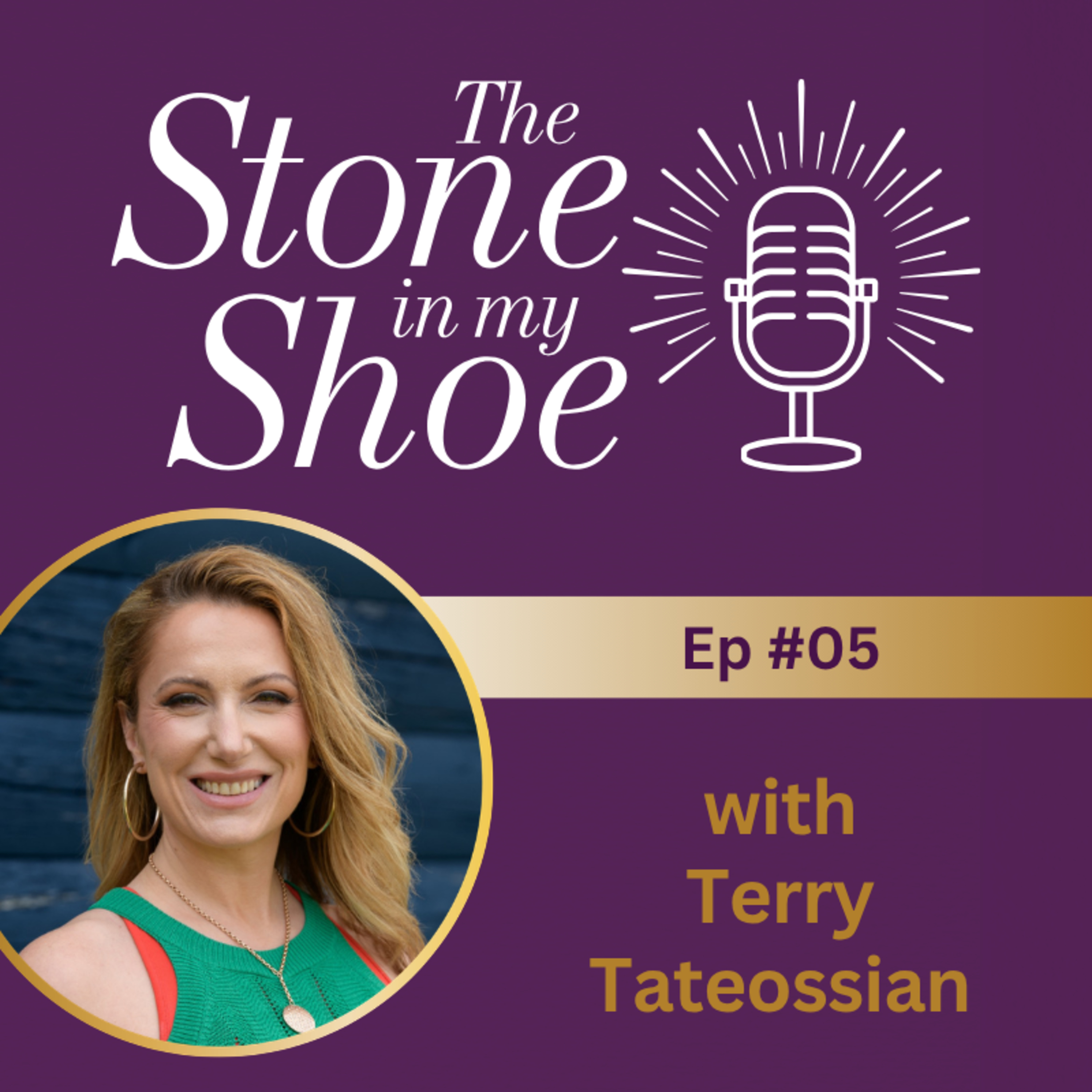
Episode 5 · 26 February 2026 · 44 min
Reclaiming Your Body in Midlife - Terry Tateossian on Trauma, Weight Gain & Self-Sabotage
Content note: this episode includes a discussion of an eating disorder.
Listen to this episode
Chapters: tap one to jump to it
Why is it that you can show up for everyone else… build a career, raise a family, carry responsibility… but when it comes to yourself, something unravels?
In this episode of The Stone in My Shoe, I sit down with Terry Tateossian , founder of THOR and host of How Good Can It Get, to explore the hidden patterns behind self-sabotage, emotional eating, and high-functioning burnout in midlife.
From defecting Eastern Europe as a child to building a successful life in America, Terry learned resilience early. She became disciplined, determined, capable.
But there was a cost. Despite outward success, she found herself disconnected from her body, emotionally overwhelmed, and eventually gaining over 80 pounds. What she uncovered wasn’t laziness or lack of willpower. It was survival wiring. Unprocessed grief.
Inner “voices” formed in childhood that were still running the show.
If you are a woman who:
• Can achieve for others but struggle to stay consistent for yourself• Feels embarrassed that you “should know better” by now• Reaches for coping mechanisms when grief or stress hits • Suspects there is something deeper beneath your habits • Is tired of quick fixes and wants lasting change
This conversation will resonate.
You will learn:
• Why high-achieving women often self-sabotage when it comes to their own health• How trauma responses can look like ambition and drive• The real link between grief and emotional coping• Why suppressing inner patterns makes them stronger• What true long-term transformation actually requires• How midlife can become a reclamation rather than a decline
This is not a weight loss story. It is a story about awareness, nervous system healing, identity, and becoming the conscious leader of your inner world.
If this conversation speaks to you, subscribe and share it with a woman who needs to hear it.
Read the full transcript
Hi, I'm Debbie Thompson and this is A Stone in My Shoe. The podcast where we explore how midlife can become the most true, powerful and fulfilling chapter when we choose to follow our inner wisdom. And today's guest is Terry Tatiosian, founder of Thor, The House of Rose, a wellness community for women over 40 and the host of the podcast How Good Can It Get? Terry's life has been shaped by resilience and reinvention. Born in Eastern Europe, she defected with her family at a young age and rebuilt her life in the United States. After building a successful career in tech and raising a family, Terry found herself in her early 40s, feeling disconnected from her body and energy, and eventually gaining
over 80 pounds, for those of you in the UK that's 36kg, despite outward success. What followed wasn't just physical transformation, it was a reclamation of identity, vitality and belief about what midlife can be. Today she helps women over 40, redefine aging, rebuild strength and realise that their most important powerful chapter may still be ahead. Welcome Terry. Thank you Debbie, thank you so much for having me, I appreciate it. Oh, that's a pleasure, lovely to have you on. So before we go into your story, I just want to frame this for the woman listening. When she finishes this episode, what do you hope she understands differently about midlife,
about her body, her energy and her potential? That no matter how hopeless it may feel today, and no matter what your mind is telling you that your trajectory is going to be, and whatever the fears are that it can be reversed, it can be changed, it can be flipped 180 degrees, and you can face the future with hope, with clarity, with joy, with opportunity and a very positive outcome rather than thinking of the worst case scenario. That's a very powerful introduction and something I think so many of us would love to be able to achieve.
So I've shared your bio, but I just want to take the listener just a bit beyond your credentials. What chapters of your life have shaped you the most deeply, whether it's daughter, the immigrant entrepreneur, mother, business owner, and how would people closest to you describe you with a spotlight on? I know that's a lot of questions, but I just wanted you to give the listener a few of who you are. Great question. So from my perspective, the times and stages of my life that shaped me the most were most definitely being a mother and being an entrepreneur and what that required, the diligence, the consistency,
the determination, the stability, all of that, right? Giving it everything that you have, it literally requires that, especially when you're doing both things at the same time. You have to really want it in order to make any kind of impact on both ends. And I used to hear all the time back in the day, like, you can't have both. Women can't have both. You can't have a career and you can't have a family. And so I was determined. I was really determined not to be a statistical number in this saying because I wanted to have both and I believed that it was possible. And I didn't understand that there's always a price, right?
So I had to pay for it. It was an invoice. There's a bill that comes with having it all. And the bill really was my health, my own identity, my own perception of myself, how comfortable I was in my own body. There was a disconnection that took place. And so I did end up gaining a lot of weight and that made me very unhappy in my 30s. And so that was one part of what shaped me. And then the other part that really, really reshaped me was finally understanding and realizing that a lot of the choices that I made were trauma responses, right? A lot of my behaviors and my habits, the way that I thought about things, how I approached
my own health and my own personal being was a trauma response that dated back, poof, all the way to infant hood, right? And a lot of those things were really outdated. They didn't really serve me anymore, but they were still hanging around because I was not aware of that. And so when I started the journey of trying to reclaim my life, reclaim my body, reconnect with who I actually was. I had to face those, I call them the boogeymen rather than demon because they just kind of pop up out of nowhere when you least expect it and really make friends with them. I had to have conversations with them. I had to really go back and heal those parts of myself that were still bleeding in a sense.
You know, they were emotionally still bleeding, but because we're so busy living, we're so busy doing all these things, we don't have time to go back and have that conversation with ourselves. Thank you. Thank you, Terri. It's so true and so often we don't see those boogeymental later on in life when something happens, usually a stone in the shoe, something very sharp and painful and you have to go back and address them, become friends with them, have chats with them. And I think that's a big thing that many women don't see as part of the whole journey. But before we go on to the trauma response from your infancy because that's probably the beginning of the journey. How would people closest to you describe you when the spotlight's off?
Oh my gosh, Goofy, prankster, I like pranking family members. I'm a little spontaneous. I like to just pack up and go. You know, I just want to go travel, go do stuff. I'm either super introvert or super extrovert. It's one or the other is not really in between and I oscillate between two. I don't know. I mean, you know, probably a pretty disciplined person, consistent and determined. You know, I show up every day. Yeah, that's that's the important one, isn't it?
So let's go back to earlier childhood, you know, defecting from Europe at the age of 11, living in a refugee camp and starting in a new country at the age of 13, that's no small chapter. You know, what it does to your nervous system, survival being the strong one. How did that experience serve you and perhaps later be a disservice to you? Yeah, so how did it serve me? So I mean, I learned that I could do anything, right? So a lot of people fear moving to a different country and finding their way, right? And I didn't even know that was a thing to be afraid of because I did it.
And I was with my parents, obviously. I wasn't really doing anything on my own, but I just kind of went through that entire experience as, you know, kind of like, hey, you know, this, this is what's happening, you know, I did miss my grandparents. I did miss my family that we left behind. So that was difficult emotionally. But other aside from that, you know, I just kind of grew up thinking that I could do anything. I could pack up and go live somewhere else and create a life. And I can start a business, no problem. And I can make that work and I can, you know, study a different profession and I can do that. And, you know, kind of a gave me an open mind in a sense.
And then later on, it was detrimental for the exact same reason because I thought I could do anything. I thought I could do it. And sometimes, you know, you can, you can do a lot of incredible things. People can do incredible things. That is, if they address some of those blind sides that come out of nowhere sometimes. So those boogeymen early on that you were taking into adulthood, how would you name them now? Oh, yeah, I had a personality trace for them. So I had, I had the little girl, right? So there's a little girl that was afraid and she was felt abandoned a lot, right?
She grieved her past life and things like that. I had one that was kind of like a gangster, you know, and it was, you know, she was just a badass. She just, she, she didn't care about anything. She just got it done. That's who you called. Okay. If you did something bad and you needed to get out of trouble, that's who you call. Yeah. And then, and then I had kind of like the poo poo whiny party party, you know, party pooper in there who was kind of a negative voice that would say, well, who do you think you are? You know, what makes you think that you deserve these things?
And, and look at you, you know, you're, you're, you're just some regular person, like just sit back down. You know, and then they would sometimes switch roles around, you know, just depend, dependent on the day. And then I had the one that was the super nurturer. And she would be the one that would make me feel like, oh, you deserve that entire jar of Nutella tonight. And you know, you worked so hard today. Why don't you have the whole pint of ice cream? Here you go. Right. And so that, that was generally the patterns that I was noticing of the, the types of moods and emotions that would
come in. So when did you start noticing these boogeymen and thank you for describing them so well, because I'm sure all of us can relate to, to one or all of those, but when did you start noticing them come into your life? Because as you said, when you're younger, it's just who you are, you don't even think about it. Yeah. Great question. So I had no clue. I had no clue that I would kind of go dark, you know, I would go unconscious and I would let one of these guys take over every now and then. Right. And so when I started noticing and becoming aware of them was when I started my way loss journey, and when I started
trying to get back to back in shape, and I had very clear goals, and I knew exactly what I had to do. I, all I had to do was follow it. And I had a coach who's top notch professional. She knew what she was doing. Everything she told me to do the first couple of months, it was working beautifully because I was able to follow it. And so if I, I knew logically that if I stayed on this path and I follow this strategy, I would get exactly what I wanted. I would be exactly where I wanted, get exactly what I was looking for, look exactly actually better than I was imagining, but I couldn't stick to it.
I would, I would fall off the wagon every now and then. Sorry, Terry, was this unusual for you, for someone who had been such a high achiever and, you know, these parts of you where I can do anything and I can achieve everything in the fact that you were, you know, committed and hardworking, was this a real surprise to you? I was mortified, mortified. See, the thing is, maybe those personalities did show up in my business life, but they didn't stop me in any way, right? Or that I thought, right? So because the price wasn't my success, the price wasn't my family, the price I paid was personal, right?
And so they showed up when I would try to do something for myself, they would show up when, you know, I was reaching a little too far in terms of, you know, feeling good, right, about me as a person, as a woman. And so that's when they would sneak in. And so I didn't really have to struggle or battle them up until that point in such a way, because they just didn't, didn't show up, right? And so I started noticing these patterns and I was like, wow, that's incredible. That is absolutely incredible. And how embarrassing. And you know, this is the voice that was showing up, like how embarrassing, you know, you pride yourself on being
successful, fairly intelligent, ambitious, all these things, but you can't stay on track in this one area where your little heart desperately wants so badly to succeed, you can't do it. But you can do all these other things that benefit everybody else. But when it comes to you, you can't stick to it, right? And so that really woke me up like, wait a minute, something's happening because I just can't seem to get out of my own way. And that's, that's so, you know, so interesting. Because so often we get the subtle feedback, we get
the messages, but it's not until it is so painful, so detrimental to your health, or your mental, you know, physical or mental well-being that you actually take stock of what is going on. Can I just ask, when you said you couldn't stick to the program on an actual doing the stuff, what couldn't you do? Well, you know, it really, it depended. It was dependent on what was happening in my life. So if I, let's say I was very consistent with my nutrition. And so the plan that I was on, and I still am on, so 13 years later, I'm going to be 50 this year, 13 years later, I am still on the same nutrition plan. And that's what I teach my clients.
It's a very consistent type of way to eat, right? So there's a number of protein, an amount of protein that you have to consume per day, a certain number of carbs and fat, and they're divided up into five meals. And it's called macro-based nutrition. So based on whatever the goal is at the time, sometimes I was looking to gain weight, sometimes I was looking to lose weight. There's a certain number of carbs and fat and protein that I needed to hit. So I was very consistent for a certain amount of time. And then I would fall off the wagon or let's say I would be very consistent with my communication with my coach. And then I would go away for a business trip and just fall off the face of the earth,
not respond to messages, not check-in, just completely disregarded, right? Or let's say I would, I'd be very, very consistent going to the gym for let's say three months. And then one day something would happen and I would be like, I'm not going today. And that day would turn into two, three, four, five, a week, two weeks. And it's like, whoa, what just happened, right? And so these kinds of things would happen once in a while. And then I would have to sit within and really ask myself, why? Why? Why are you behaving in this way? And where is this truly coming from? And is it a belief that you're just not entitled to this outcome? Do you believe somewhere inside of you that you're not going to succeed?
So you might as well just sabotage it as early as possible. And now that's a really interesting one, isn't it? Because listening to these voices, because they so sly, aren't they? And they hide as someone trying to work in your best interests. And they've got to keep themselves alive. Did you get help with a professional coach once you realized something else was going on? Or did you do this work yourself? Because this is deep work that takes a lot of digging. Yeah. So what my coach did notice, and she's not, she didn't diagnose me or anything like that. She did notice that I would start binging
after something traumatic would happen in my life. And so when I started noticing the pattern, it was usually related to grief. So that particular emotion would trigger this avalanche of coping mechanisms, right? And a lot of us use different things, right? So I was not just using food. I was using alcohol, nicotine, food, whatever was socially acceptable that I wasn't going to get thrown into a rehab, right? Because that whole God forbid that would happen, right? So like, but there's other ways, right? So there's behaviors, there's habits, food, nicotine, alcohol, and so on.
And so I started noticing that grief was the main catalyst. So if I lost somebody, somebody moved away, you know, somebody switched jobs and wasn't working at my company anymore. Or, you know, something personal related to losing somebody, missing somebody, grieving somebody. And so that would throw me into this storm of emotions that I didn't necessarily know how to handle. And so when I traced that back, you know, I did have a traumatic event. I had a few traumatic events in my past that evoked that type of grief, right? So then any time the grief string in my emotional guitar would get
touched even slightly, it, you know, revered all through my entire being. Like, oh, this is happening again. And so whatever my mind had to do to squash it was what it was trying to do. So when I made the connections, I started noticing like, wow, wow, that's incredible, incredible. So just being aware of the emotional eating and which is what my coach suggested. She said, I think you have an emotional eating disorder, but which is an eating disorder. And then that opened up a whole can of worms. I was like, what the heck is that? Like, I've never heard of such a thing. That's a thing, you know? And so I started digging into it because I was really curious.
I wanted to succeed. So, you know, a very big part of me wants to succeed. And so I am willing to do whatever is necessary to figure out where are the obstacles? You know, what do I have to do to clean this up so that I can move forward? And so that's what I started noticing. I did talk to an emotional eating therapist for about three months. And we just didn't connect on what my goals were because the approach with that was that what I was trying to do was unrealistic, right? So the therapist was, in a sense, I almost feel like enabling me to think
that what I was trying to achieve, the 80 pound weight loss was not realistic. And so it was kind of pushing me away from tracking macros. Tracking my protein, tracking the number of calories. Because a lot in a lot of therapist circles, that's considered disorder eating as well. And that's very interesting because, you know, many people who get help for, you know, whatever it is, whether it's eating disorders or some kind of grief or whatever it is, often say that the first therapist is not the right one for them. And then they often throw the baby out with the bathwater saying, oh, therapists don't work. And I think it's really important to take the time and find the right person to support you.
And it's OK if the first one is not the right person and trust your gut instinct. And if it's two or three or four, keep persevering. Would you agree with that? Oh, absolutely. I mean, the amount, the number of cases where the first try wasn't a success. I have so many stories on that. And then if you kind of, if you give up at that point, you never actually get to the result. And, you know, the same thing with weight loss, right? So the first time, second time, third time, tenth time, 20th time, every, all those times that I didn't succeed, but it took going through that entire journey in order to find the thing that did work. So, you know, therapy is could be very similar.
You know, it's just hard to hear from another professional person that, you know, maybe this thing that you're trying to go for is unrealistic. And so I went off on my own. You know, I did a lot of reading, a lot of studying, a lot of research. There's lots of YouTube videos out there on how to do some of these, some of this work. And it's just a willingness to kind of face it, face it on your own. Process it, give yourself enough time and space and the dignity of going through the emotions so that you can lay them to rest in a sense. So, Terry, you, you know, fell off the wagon a few times, realized it was something that
you had to address. How long did it take you to do that? Mmm, you know, I know everybody wants me to say, Oh, it took me 30 days. You know, that's what all the programs say, it takes 30 days. No, it really, it wasn't a light switch for me. You know, these things, they run so deep under the water, under the surface that it takes a constant awareness and it takes, it really does take years. And I, I can't even say that I'm finished, right, because those things don't go away. They're always going to be there. And they're just a part of who we are.
And I'm grateful, grateful for them. I'm not looking to silence any of these personalities or voices or thoughts or identities, right, that are part assimilated as part of our humanity. Um, because doing so would actually defeat its purpose. So what I realized is by trying to get rid of them, I was actually encouraging nuance to come out, you know, because they were feeling suppressed and they were feeling unheard and they were feeling abandoned again, right? And so I had to learn how to accept, accept and be content with whatever it was that's going on and make sure that they stay close to me, right?
So yeah, no, I hear you because I have a lot of chats with my pop personalities. We have many chats and some have been reassigned. Some have been buddied with somebody else just so that, you know, they're not quite so powerful. So and I think you're absolutely right, saying it is a process. It's like peeling an onion. And what, uh, you know, what you resist persists and you might think you sweep it under the carpet for a while, but it will come back and it will bring some buddies with it as well, because even if you squash that one, um, I guess what I'm trying to say is that it is a process, but for the person listening, did you get some feedback quite quickly to keep you going?
Because it's like any, any long journey, as long as you're getting feedback that's going, yep, you're going in the right direction and the effort in the, you know, the is worth it. What was that like for you? Yeah. So for some of them, I figured out workarounds, right? So for, uh, the nurturing one that wanted me to eat everything because it made me feel better. And if she just wanted to make me feel better, I realized that, hey, she doesn't really care what exactly I eat. It's not exactly, it doesn't have to be full sugar, hog and dogs, Ben and Jerry's, whatever, like full gallon of ice cream. She doesn't care what it is. She just cares about how does it make me feel.
So let me get ahead of it, right? And so let me create my own ice creams and I did. I created protein ice creams that were 280 calories instead of the 2000 calories that I was usually consuming. And then I realized, oh, wait a minute. Like I can work with this. I can figure this out because I'm the boss. Okay. I'm the boss and they're going to have to abide by what we're all going to decide as a team is the best thing for us, all of us, right? And so she didn't, that that personality didn't really care as long as my nervous system was calmed down and it helped me to, you know, bring down the heat in a sense that I was potentially feeling that day.
For example, the inner child one, the one that felt abandoned, that one was actually pretty easy to understand once I figured out what it was looking for. And it was looking for me to keep showing up, to keep my word, to do what I said I was going to do, to not quit, right? To, to stay there and to say it's okay. That it's okay that we feel this way. It's not shameful, right? It's not embarrassing. We can cry. We can feel whatever it is we want to feel and everything's going to be fine. Nobody's going to turn their back because you're embarrassing them. I'll stop crying. You know, so that I kind of started feeling that one out.
And then the teenage rebel one, that one was a little rough. She was, she was a pain in my butt. Was she the most challenging to, to work with? Yes, yes. No, that, that one, she, she, she really did some numbers on me. But you know, the, the benefit of, of going through this work is that I learned how to deal with my own teenage daughter. And now my teenage, my son is going to, is a teenager as well. Um, and so it gave me a lot of tools because I kind of role played that internally. You know, so the more, the more I restricted and the more I punished myself, right?
Cause, uh, we have that tendency to do that. We go to the gym as a punishment. We go on a diet as a punishment. You know, we do all these things to punish ourselves. The more I did that, the more the teenager got really mad. And she would go in the opposite direction of what I was looking to do. And so I realized like, I got to work with you. You know, I have to work with you to not feel punished, to not feel judged, to not feel criticized, uh, because eventually you're going to grow up and you're going to be an adult. So, you know, let's have a really good relationship. And so I, I kind of internalized that aspect of myself as well and kind of became my own parent, in a sense, um, as a teenager.
So it was a very interesting experience. Yeah. I mean, that really is, cause often people, you know, talk about their inner child, but with you, you know, it was this, this inner teenager. Um, and that was, uh, um, what I was going to ask, actually how it benefited, uh, you know, all this work that you did, which is you said took years and it's, it's layers and it's still ongoing. But before I ask you how it benefited your, your family, which you've just alluded to, um, once you started doing this work and realizing what was going on, how quickly did the weight and the journey speed up rather than being like that, falling off the wagon, getting back on? What happened after that? All resistance just dissipates and evaporates.
And all of a sudden, you know, it doesn't happen instantly. Um, you just kind of increment, incrementally and progressively, it starts to get things to start getting easier. Like you're like, Oh, I didn't fight with myself internally for three hours before, you know, I actually got to do this. I just kind of got to do this. You know, the thing I wanted to do today, I actually got to do it. And there wasn't that much conflict internally. It was not a lot of resistance, you know, maybe a little bit, but not, not anything like what it was before. And, um, things just got smoother, easier. I had more energy. I was more like a bead. I had more interest in other things because I wasn't constantly in an
internal conflict internally. And so once, and it's very gradual, right? You just kind of wake up on that and you go, wait a minute. This, wow, this is really nice. Because I think that getting that feedback is so important. And then once you get a little bit of it, you, you, you get some more and then more, you know, if you journal or if you look at the, you know, process three months later, the, the, the shift is enormous. It's the little consistency, one percent per day that all, um, you know, adds up and, and, you know, people go, look what you've done. It's magic. Well, no, it's not. It's showing up every day, doing the work and, and the rewards come. So that's, absolutely. And now what I do is I proactively go in my own mind.
I proactively go and I maintain those, uh, connections or those conversations with the parts that I know, because they're, you know, they're parts that I don't know still. There's parts that I haven't even presented themselves yet. I'm sure. Um, that will come later because we're constantly evolving, right? And so, uh, the ones that I do know that are hurt, uh, that need a lot of attention, I will proactively go and have little conversations with them or talk to them and say, you know, you did such a good job today. I'm so proud of you. And I can tell that they're very happy. And so I, I try to reinforce just like a teenager, I try to
reinforce the positive behavior so that I get more of it. I mean, it's literally parenting yourself. It is literally parenting yourself. Yeah. But, you know, the benefits. So you then, did you lose the weight that you wanted? Did you get to it? Cause you said you had some very specific goals. Did you hit those goals and how, sorry, just how long from when you started to when you hit those goals? Yeah. So I blow way past my goals. So the 80 pounds was way more than I ever believed I was entitled to lose. I actually, uh, weighed in less than what I weighed in high school, which was in my mind impossible that, you know, that's, that could never happen.
You know, at this age, you're, you're going to look better than you did in high school. And sometimes I look at pictures and my body composition is much better. I have a lot more muscle mass and my shape is very different because I never worked out back then. And so, um, I blew way past my goals. Uh, you know, whatever I imagined would be the best case scenario. It was way better than that. And then not only that, but, um, my hair got better. Um, my eyesight improved. Okay. How strange is that? Um, I haven't had a cavity in five years. I'm, and I'm going to be 50 this year. I don't wear glasses. I don't take any medication. I'm not on HRT. I did not use any GLPs.
They didn't have them 13 years ago. I, um, I fit into a size four. Um, and I feel better than ever. So, you know, energy wise, I feel great. Uh, do I feel like aches and pains and things like that? Like a little bit of arthritis here and there and, you know, stiffness in the joints, I feel that I am 50. So I do have those kinds of things, but nowhere near the trajectory that I was originally on at 210 pounds and being five foot three. I was pretty diabetic. I was having panic attacks, anxiety attacks, uh, abusing alcohol, doing everything in, in the direction that was not going to lead in a good place.
So it wasn't really about the weight loss. This was kind of rebuilding your, your life, you know, finding your identity, finding your coping mechanisms, you know, shifting from punishment, as you said, to a partnership with your body. And that's incredibly profound. So I know you had discipline, but it sounds like compassion played a very big role in this as well. Yes. And that, that was, I think, the missing element you nailed it. Mm hmm. And I think that's often what we as, you know, women do is we don't give ourselves enough compassion. It's the should ofs. Why didn't we? Couldn't you do better, um, you know, expectations of you?
And, um, I guess the final question here is what surprised you most during this transformation? Mm hmm. What surprised me most? Oh my gosh, I, I, I loved working out. I loved it. I, uh, I was very surprised at how strong I actually was and how I, stronger I kept getting. And so when I started working out, you know, lifting weights, powerlifting, bodybuilding, um, you know, I didn't have any particular expectation, like, oh, wow, you're like super strong. I didn't know that. And then over time I was like, wait a minute, is this normal? I had no clue.
I had no clue. Um, but for my size and age, I'm, I'm like a, like a freak, basically, uh, in terms of how strong I, uh, have become. And, um, yeah, that was very surprising to me. And, you know, one of the regrets that I have is, um, because I never explored, uh, powerlifting ever up until I was, you know, almost 40, uh, what life would have been like if that was my thing. You know, if I had started earlier and maybe become a powerlifter and then those kinds of things, I'd be, I'm very curious, you know, that's just part of it. A parallel life. And, you know, the more you hear about it, the more you hear strength training for middle-aged ladies is,
is so important. There's so many podcasts on that, but that, you know, is something that's really stuck with me. Now, um, just the ripple effect. This is not just benefit. I can see, you know, at 50, you look amazing. So much energy, vitality, um, you know, just dealing with your, you know, your inner children, your inner teenagers, your relationships with you. I'm like, there's so many benefits to, to what you have done in every aspect of your life. Um, how did it affect, I guess, uh, not just your family, but your wider community and your outlook on, on life and your, and your leadership and how it spills out into the world? Yeah, it's contagious, right?
So when, uh, someone, let's say in my neighborhood, they've known me 20 years and they've seen all the stages, right? They've seen the super overweight, depressed, anxious, busy, overworked, all things turn around and change all these things right in front of their eyes. It's, it's evidence, right? It's evidence that they can do it too. And so that's, you know, that's what happened, uh, literally it's, uh, you know, people would see me and they were like, they, they're like, who are you? I would show up to a friend's gathering or a family function and walk in and people that I've known 20 years will be looking at me.
That hadn't seen me in a while. They'd be looking at me like they don't know me. And I'd be like, hi. And they were like, what, who are you? So imagine the drastic change, right? Not just an energy, uh, but just the, the, the spirit, the aura and then the physical, uh, appearance were all different. And so people would ask me like, what did you do? How did you do it? Show me, tell me. And, and that all trickles into their own family, right? And so my kids watched all this whole thing happen. They understand the importance of proper nutrition. They go to the gym, uh, both of my kids go to the gym. Uh, you know, everybody's kind of in tune that we have to take care of ourselves on, on all these
different levels. And so when a woman starts working with me and she changes her life and actually it becomes contagious in her household as well. So her husband starts working at her children and so forth. So it's very rewarding. Oh, absolutely. And it's the ripple effect, right? Changing one person and then they change, you know, two people's lives, four people's, you know, it's exponential. So that what, if you could name, uh, in a sentence or a word, what legacy, uh, you're leaving for yourself, but for your family, your children, what would that be? Hmm, what legacy that, uh, if you want something, you can get it no matter what, as long as you're willing
to do the hard part. And the hard part is never obvious. The hard part is, um, very private and very internal. And it's mostly in our mindset, uh, because I believe that we live in a realm where we can manifest anything that we want. And so the only thing that's a constraint for us as humans is our own belief systems, our own mindset, our own, um, energy, in a sense, that we put into our work and into our goals. Yeah, that's beautiful, beautiful. And say for the woman listening who feels disconnected from her body, here's what you're saying is inspired by what you're saying,
but doesn't know where to begin. What's step one for them? Yeah, so step one would be to really define what is it that you want? What is the vision, uh, that you're looking for? How do you want to feel? Right. And so a lot of times, uh, women tell me, well, I want to lose 20 pounds. Okay, so that's great. But what exactly are you looking to feel? Right? What is the, um, emotional prize that you're looking for? Let's start with that and then work our way back to what is it actually going to take to get there? Because it may not be 20 pounds. It may be five, right? And so, uh, what is the feeling that we're looking to embody?
And how do we get there? And then kind of work your way back. You know, my advice is always, uh, something that I avoided for many years was to hire a coach, ask for help, hire a therapist that aligns with your vision and your ideals and what your goals are. That will help you, uh, navigate that journey, right? Someone that's either been through something like that or is, uh, skilled and has the authority to help you. But that, that would be the two things. Yes. Beautiful. And Terry, how can people get hold of you? You can find me on Instagram. How good can it get? That's my motto. And on my website, thehouseofrose.com. Beautiful. And just before we go,
any parting words that you would like to say to the lady listening? Hang in there, ladies. Beautiful. Terry, thank you so much for your time, for your inspiring story, for your vulnerability, for your honesty. For the fact that it's not a quick hack, the fact that it's a process. And, you know, from what I'm hearing from you, your goal was one thing, but what you got was just way more magical. And not only did it affect you, it affected your family, it affected, you know, friends around your communities. And this ripple is having a huge effect on getting health and, you know, vitality and happiness and joy and all the things you're talking about into the world. So thank you for being you
and thank you for coming on today. Thank you, Debbie, for having me and thank you for everything that you do. Thank you.
Want to know what your Stone could be?
Take the free reflectionKeep listening
 Living Your Dream but Still Seeking Approval | Nyasha Ngwena on Identity, Self-Worth & Trusting Yourself9 July 2026
 I Thought I Was the Problem | Amanda Gorman on ADHD, Self-Blame & Learning to See Yourself Differently1 July 2026
 Performing Strength vs. Living Truthfully | Riham El Hawary on Burnout & Midlife26 May 2026