
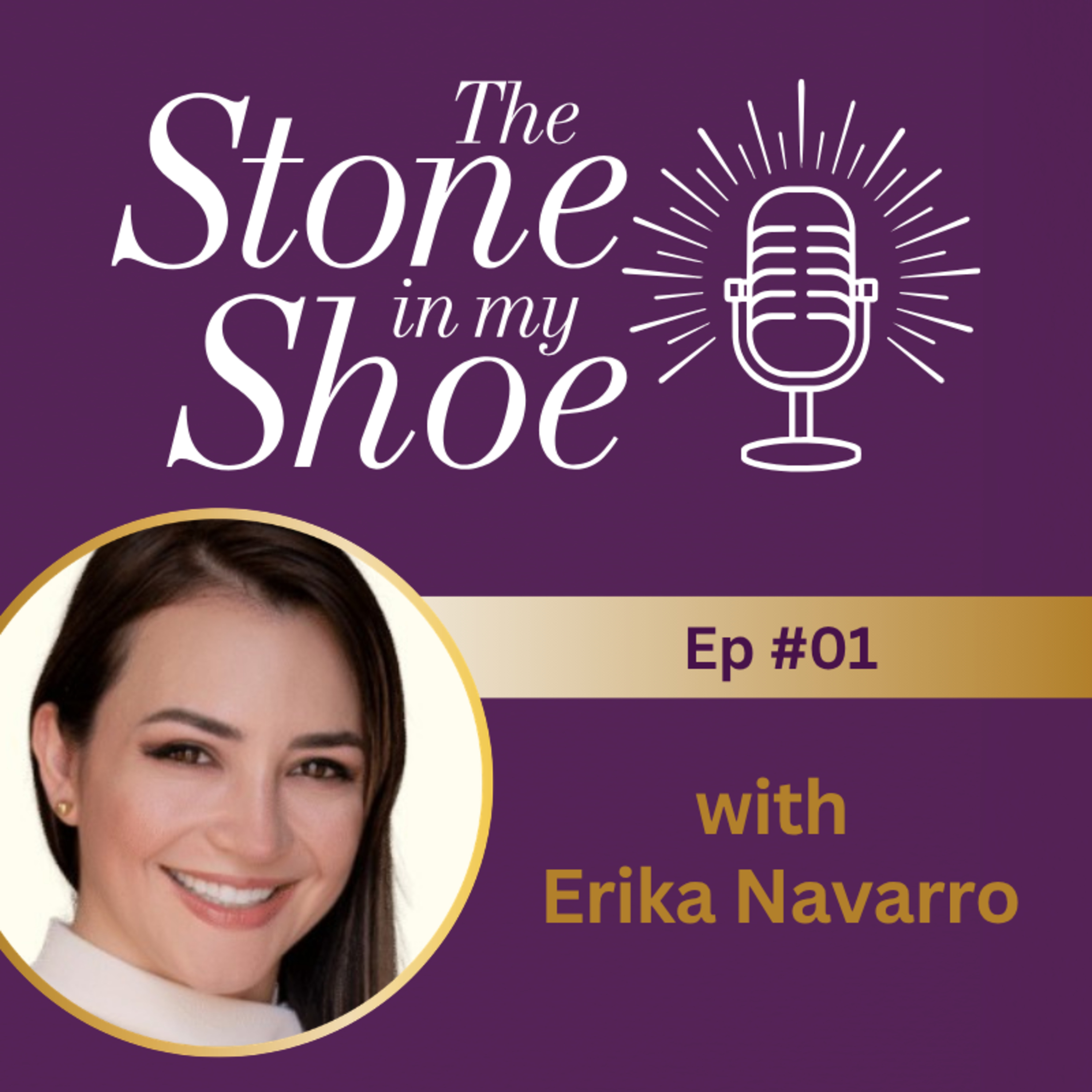
The Podcast · 12 January 2026 · 47 min
Burnout and Survival Mode: Listening to Your Intuition and Moving From “I Must” to “I Want To” | Erika Navarro
Content note: this episode includes a discussion of sexual abuse and domestic violence.
Listen to this episode
Chapters: tap one to jump to it
What happens when being the strong one starts to take a toll? Erika Navarro talks about burnout, over-responsibility and survival mode, and the whisper in her body she finally chose to listen to.
You will hear what living in survival mode can look like when you're high-functioning on the outside and disconnected within.
You will hear how Erika moved from "I must" to "I want to".
You will hear why you don't have to wait for a crisis to choose something better.
For years Erika lived in survival mode, high-functioning on the outside but disconnected within. As an immigrant with no network around her, she knew the theory of what a woman should do, yet she faced real life alone, and she carried the belief that it was all on her shoulders.
It wasn't until anxiety, burnout and exhaustion brought her to a breaking point that she began to listen to the whisper in her body, and chose a different way. She talks about what it was like when everything fell apart, about feeling held, and about moving from doing to receiving.
Erika Navarro is a licensed Marriage and Family Therapist from Colombia who used to work in Los Angeles. She is also a mother and wife, and the founder of Healing Souls by Erika, where her courses and support blend nervous system healing, emotional wellness and somatic practices for women and men.
Together we talk about letting go of over-performing, healing cultural patterns, honouring your nervous system, and the freedom that comes when you stop trying to hold it all together alone. Erika also shares how she shaped her programme around fewer women and more depth.
What you will hear
What burnout and over-responsibility can look like when you're the strong one
Why high-functioning can still mean disconnected within
What anxiety, burnout and exhaustion can be telling you
How stress and cortisol can make it hard to think clearly
Listening to your intuition and the whisper in your body
Honouring your nervous system, and embracing softness and rest
Healing cultural patterns around being strong
Moving from "I must" to "I want to"
If you've ever felt like you should be coping just fine but deep down something doesn't feel right, this conversation may feel like someone saying it out loud for you.
Read the full transcript
Hi, I'm Debbie Thompson and this is A Stone in My Shoe. The podcast where we explore how midlife can become the most true purposeful and fulfilling chapter yet when we choose to follow our inner wisdom and intuition. Each week I speak with women who followed a quiet nudge or a push and chose curiosity over convention and created a life that feels more aligned. These stories are rich with wisdom, reminding us that midlife can be a powerful doorway into what's next. And I'm really excited to introduce our next guest and that's Erika Navarro. She's a licensed marriage and family therapist based in Los Angeles, originally from Colombia,
and a mother, wife and entrepreneur. Erika's life has been shaped by immigration, early responsibility and learning to be the strong one from a very young age. For over 18 years she supported women and couples through trauma anxiety and relational patterns and life transitions. She's known for her grounded, intuitive presence and today she's here to share her story of redefining strength, listening inward and stepping into a new season with clarity and softness. Welcome Erika. Thank you Debbie and thank you for that beautiful presentation. It's amazing to hear your story from another person. It's always like, oh my gosh, it's like a big reminder of who you are and it's always
good to always remember who you are and where are you coming from. Yeah, absolutely. That's wonderful to have you and all the way from, are you in Colombia now? Yes, I am in Cali. This is South America. South America. Wow. Our time zones, because I'm in Australia, Brisbane, so our time zones are a little bit interesting at the moment. Yeah, like 15 hours difference. Like 15 hours difference, exactly. So Erika, before we explore the stone in your shoe, can you tell us where life finds you now personally and professionally? Well, personally I am in a very good moment now. I have my husband, my son with me, so this is like the biggest treasure that I always dreamed of, being like the easiest path to get to that point because I also got
married 10 years ago, but we separated at some point. So the fact that we are together is very important to me and I feel very happy with that. And professionally, I think becoming an entrepreneur and having my personal brand and having the Healing Souls project is like a big shift in my career because I've been working in the mental health field for 18 years and now that I can, you know, be my own boss, it's like, it's a big thing and I'm very proud and happy because it's not easy, but it's happening and I feel super happy and proud for doing this. Brilliant. And I presume Healing Souls was one of the outcomes from the stone in your shoe, listening
to that voice and then creating it. 100%. Beautiful. I mean, if it wasn't because of my trauma, this wouldn't be my reality today. Beautiful. So I'd love to hear more about Healing Souls, but we'll wait for that because what we want to hear now is what was the stone in your shoe that, you know, could have been a quiet nudge that you ignored, it could have been a falling off a cliff, but the thing that whispered to you or shouted at you, saying that the way you're living no longer fits. So perhaps you can talk us through that. I think I had no one stone but like a million rocks. It was like a lot. I think like one of the biggest things that shaped the person I am today was being
sexually abused when I was six years old. That was the biggest thing because at that moment I didn't understand what happened but as soon as I finished high school, I realized when it was starting like, what would you want to do? You want to go to the university? What do we want to do? And it was like, well, I want to be a psychologist and everybody asked you the first day that you go to the school, like, why do you want to become a therapist? And I said that is because I want to understand the brain of a perpetrator. I wanted to know what happened in somebody's head to do that to a child. So that was my first thing and that was the I feel like the trauma that created
everything for me that gave me a purpose. Wow, that's a that's a huge one. And you know, for some people listening, you know, for somebody like me as well, it seems like not just, you know, truckloads of stones in your shoe. It seems like a knife going through and cutting your foot off almost. So, you know, to say that, you know, that gave you the strength and the reason for me is astounding. And can you tell me because for some people that would be the thing that cuts the foot off and then there's no moving forwards. How did that work for you? Well, for several years, I was in this state of shock.
So you because at that age, you don't know what's going on. So it's kind of like you are not sure that really happened or was a dream or was some type of something that your brain created. So it took me around five years to put a name on that trauma. I didn't know what happened until I saw the news. And it was like, oh, OK, so that's the thing that happened to children. And that was the thing that happened to me that created all these nightmares because it was several nightmares that I had for several years. And but it was it was actually the same nightmare that I had over and over and over, but I didn't understand why. And it was with animals.
It was with frogs. And it was like, I didn't understand. And when I was 11, I was watching TV with my parents and they always watched the news, like the TV news. And and I was like, OK, mom, dad, I have something to tell you. This happened to me. And you guys were the next door. And I didn't say anything because I was in shock. Now I know that I couldn't say anything because I didn't know what to say. I didn't know, like, how to explain that. But it was so disgusted, like ashamed, because I felt for so long that it was my fault and I did something wrong. Wow. So, I mean, you then went into psychology
to try and understand public perpetrators. Well, did you, before that, get some healing or was this doing the psychology part of the whole healing process? I started going to therapy as soon as I informed my parents about that situation. So they understood, OK, there is something that you want to work on. What do you want to do? I was like, OK, right now I'm not ready for that. But like two years later, I signed up for therapy. So I was like, OK, I was in therapy for like about one or two years. And then after I pursued the bachelor in psychology in my country, and after that, I did a master's degree in forensics.
So I started working in different jails and I started like working specifically with perpetrators. Wow. OK. So that goal that you wanted happened and did that give you what you wanted? Because that's what you were looking for. Yes. And as soon as I found my responses, whatever I needed to learn at that moment, I said, like, you know what? I don't want to work in this. I don't want to work in jails. I don't want to do this anymore. I had what I needed. I am fine with that. I have my answers so I can move on. And I just started like, OK, let's do family therapy. Let's work with the adults so they can have the tools, the skills to prevent that to happen to their children.
So I didn't want to work with children. I wanted to work with the parents who are the really ones that can actually prevent that to happen to children. It's an interesting journey, isn't it? That they're two stepping stones along the way, quite separate. But the one was needed to get to the second one. Exactly. So I emigrated. I was like in my country, they're doing different type of jobs and doing different things. I work in jails. I work in the social settings and everything. But I was a single. So I wanted to get married. I wanted to have my family. I wanted to I always dreamed of having a son like a child or a daughter or something.
So I was like, OK, it's not happening here because I'm always working with extreme poverty, always working for the government. So my clients, the population that I was serving to, it was always not a good fit for the future prospective husband that I wanted to have. So I ended up meeting my husband who was living in Los Angeles and I moved out and I was with him and I moved in with him. And yeah, I started my my life with him. And there I started another master's degree and that was in marriage and family therapy. And that was definitely the next step in my life and pursuing a different perspective in my career. And that's the thing that I'm doing right now.
OK, so how long were you doing the work in South America? And then how long were you doing the work in Los Angeles? So I was working in my country in Colombia for about 10 years in the mental health field. And I moved to Los Angeles and I worked there for eight years. So it was like like 18 years total. But for those eight years, I had the opportunity to work with the office of refugees also working with children who experienced sexual abuse, like a lot of like trauma. So that was the first thing that I did in North America. And then I when I got my license, when the moment that I started like working on
on the actual marriage and family therapy, so I started working with the adults. What? Brilliant. And so you're doing this, you've got a lot of experience. And was there another stone in your shoe? What what what happened? Marriage. Marriage happens. Yeah, that could do it. I think that that was the the biggest test because being becoming an immigrant, not having family around, no, my culture, my food, my friends, you know, like your network that supports you, like when you need it the most, because it's not the same when you are abroad, you cannot just oh, I'm fighting with my husband.
So I'm going to go to my mother's house. That's what people do in my country. They go to their mothers every time that they have a fight or something. So I was like, OK, if I have a problem with my husband, I can't do anything else than staying home and waiting for everything to calm down and fix that. So a lot of things didn't get fixed. So that was really interesting from somebody who's in the industry and does this and understands it. So what did you learn about yourself in this in this process, you know, living, living it? It is amazing, like when you work in the mental health field and you know a lot of things. And then when you have to face reality by yourself,
dealing with life, dealing with your personal challenges and not having in that moment the tools or the courage to do something about it is so intense. I think like something that saved my life was meditation because I was just so stressed out about being so lonely and powerless sometimes. So I found yoga also ancestral medicines and I started working so hard on self care. And to me, that was the thing that helped me to kind of survive when I didn't have any other tools. And then when I realized that everything that I was doing was wrong, that it wasn't working.
So then I decided, OK, I'm going to go back to my country and we will figure this out. Wow, so that's a big thing to to leave your husband to move to move back. But for those ladies who are listening and I'm sure many I've been married for 33 years. So, you know, I I hear you and I've been an immigrant as well. And many times I would have loved to have left and went to my parents house, but that wasn't an option. And you navigate through. But for those, you know, you'll you were talking about self care. And I think that's so important. And that's so often what mothers or wives, I should say, mothers and wives we don't do because we're so often caring for other people. Can you just tell the audience just a bit more about your self care
and what it did for your nervous system and and your ability to cope with things? When you are in a survival mode, you can't think clearly. It's like you have to, you know, your masculine part takes over and you are just providing, doing, doing, doing, doing things because you don't know better. You think that it is in your shoulders, the whole responsibility of your life and other people's lives. And you become this rescuer. You become this person that feels like nobody else can do the things that you need to do and you can't delegate things. And when you have a child, it's even worse because it's like bigger the responsibility.
So you have to do everything. So when he discovered that. There was there were those tools that I can I could use. And when I started using them, like going to these ceremonies and meditate, doing meditation and finding this different self, this bigger, higher self, I felt like, OK, I'm not alone. This is not, Erika is just this little bug here and God is, you know, so big and huge that I cannot worry so much because everything is in a divine order. So I felt like maybe, yeah, everything feels like falling apart and I have no control about things.
But I felt like I was supported. I was held when I found that, you know, like I reconnected with God and it felt like through meditation, through these spiritual practices, I felt that energy and it felt supported. And I felt like I had to do that more. So the second and I'm just asking you this, when you say God, because people have so many different ways of looking at God, you know, some people, particularly Catholics or Christians would, you know, the God that we know through Christianity. But other people look at God as this universal power and how do you how do you see that? I see God like the biggest, hider power in the whole planet, in the whole world, the whole universe.
And I see religions as paths. And I feel like you can choose any path because it's not possible that only Catholics can go to heaven or only Christians or only Buddhists. It's like everybody can go to heaven, but they just choose different paths. And I see that everybody is different. Every path is different. I feel like some paths are more difficult, more restrictive. Other paths are more like, you know, flexible sometimes. But at the end is about you and your relationship with the God that you think that exists in your mind so you can communicate the best way that you can. So that's how I see it. So your second stone was the marriage and doing all this work,
self care, you know, finding feeling supported by, you know, God universe and and everything is OK. So this weight from your shoulder could be lifted. So rather than being in this flight or flight mode of very masculine, do and doing, doing to actually go into your heart a bit more to receiving and to finding out who you really are. And so this new part of Erika emerged. So can you tell me what the effect was on you and your family and your therapy and everybody? When I came back to my country in Colombia, after I left my home in Los Angeles, we had a beautiful home
there, like like a resort type of house. So I'm sharing this is because that type of dream that people have, like, oh, the pool, the house, this beautiful thing in LA, you know, like Hollywood. That was not what I needed. That was not what my my child needed. He was two years old when I decided like this is not the life I want for him. And as a mother, I felt so intensely that he needed a happy mother and it was not. And it was like, I need to be happy. I don't have a clue yet how to become that happy mother he needs.
But I was a hundred percent sure that he needed that. I was meditating a lot. And the only thing that I saw in my meditations was you need to be happy. And if you don't find a reason within yourself, find it with your son. So he gave me the strength to say, pack your bags and go back. Because you would have needed a lot of strength for that. And, you know, that's another stone in your shoe is I need to be I need to be happy. I need to find that. And I'm sure many people listening going, what you're moving from LA, from this house, you know, what looks like a dream life back to, you know, to Colombia and to the unknown. So was there a lot of resistance from people?
And how did you deal with your own inner resistance to that? I think that I had to. Create my own noise counseling system. Like, because when you ask for people's advice, you will hear a lot of things. I had to stop listening to people. I had to start listening to myself. What do you want, Erika? What do you need? And when I when I was able to really listen to myself, I realized that, OK, do what you need to do to protect your child, to protect your heart. So I went to my country and I had to realize that memory was a big challenge at that moment.
But I also had a family of region that was facing a lot of challenges, financial problems, mental health problems. My husband, who happened to be an alcoholic, he had a car accident, a motorcycle accident 20 years ago. So my sister was living with my father and my mother, who was a cancer survivor twice, and they were in the same apartment. And I went to live with them in a very small apartment, three bedrooms. So it was a very difficult thing. So it was even more intense in other ways. So I was like, I don't know if this is the right thing or it's not. But at the end, I was like, no, this is the right thing, because I was just on my knees praying to God, like, this needs to change.
And my faith in that moment, I cannot say it was because of the this path or the other religions or whatever, but it was just going to any possible retreat, any possible type of therapy. I did everything. I did massages. I did yoga. I did psychotherapy. I did catholic retreats, everything that you can imagine of. I did them as God, like all the things. If you call me at that moment and you said, like, Erika, drink water with lemon, because that helps you with that, I would take that. Like, I was looking desperately to fix whatever was happening in the moment. And after all my prayers, after all the therapy, where I found the real
treasure, which was basically creating this new mindset, this new woman. I feel like I'm not the same person that left LA two years ago. So it was a very intense journey. And that was the best journey in my life that even led me to Bali, because I was like, if you ask me, are you planning on going to Bali for a retreat? I will laugh because I didn't have the time, the resources or anything to do that. No, no, no. It was not in my plans, but because of that journey, because of the challenges, because of the trauma, I was able to see everything different, even my husband.
So interesting. So many things to unpack there. And one of the things I wanted to ask you about was this listening to yourself and this intuition. And for some people, you know, they're quite connected to the intuition and they hear it, they might feel it. Everybody has a different way of they might get a thought, they might get a vision, they might get a feeling. What was it for you and how did it, did you trust it? Know that you're going in the right direction. And as a result of trusting it, did it grow stronger and stronger so that you went, yeah, I'm going to do this. I'm going to do that. And you kind of knew the next step every, every moment.
Many signs, because I was always asking for signs. Like show me that this is the right thing, because sometimes I don't know if I can trust myself enough, but I was seeing the signs. One, and you're going to maybe laugh, one simple, very visible sign. It was my body shape. Okay, tell me more. So I was very big. Yes, overweight, but it was not because I was eating a lot or I had anxiety and it was eating, emotional eating, nothing like that. I was just getting bigger and bigger because I was just retaining liquids because of the stress, because I couldn't just let go
things, let go feelings, let go people. When I started doing my detox, emotional detox, it was my body changed a lot. So it's the way that I have now is exactly the same that I had 10 years ago. So getting this mind body and really understanding the connection, is this something that you understand before this transformation, how it connected your mind in your body isn't how your body speaks to you, or is this something that you learned along the way? That's funny, because you're in the process that I'm doing the process that I was dealing with a lot of depression when I was feeling so stuck in my life when I was living in LA,
working in production and doing different things that were not aligned to my purpose. I decided to pursue this training in bio decodification. So I learned a lot of somatic work and tools and to understand specifically how your body process emotions that are not released and how that becomes in illnesses. So I understood that illnesses are just the solutions that your body found for emotion that you your body couldn't process that you didn't let go. So I started like having this, you know, hints, signs, clues that something is going on and something was happening in my body, but I didn't find the connection yet until I started experiencing the transformation in myself.
And I was like, wow, this is real. My eyes, if I can show you pictures of this Erika three years ago, I, my eyes were like very small, because I was so inflamed, my face was so like big. And it was because of the things that I was dealing with at that time, I had two jobs. I was doing the hours for my license in California. I was also working in my husband's company, also working in a wraparound program in LA. So also being a mother of a infant. So a lot of things. And yeah, I did it. I don't know how I survived to that yet, but I was just trying to do self care, self care, self care, self care
until I was able to say, OK, enough. I have to do something different. So for you, it was almost with so many things happening in your intuition and your body trying to communicate with you, but just not, not connecting the dots yet. And then for many people listening, it's almost like you fell off a cliff, like, you know, you, you got burnout, you know, depression, and you almost had to exit your life to be able to take the time and the space to look at things differently so that you could go on this healing journey. Because sometimes when you're stuck in the space that's causing it, it's very difficult to see life from a different perspective, isn't it?
It's so difficult to see anything when you are releasing so much cortisol, because you can't see, you can listen, you can't even smell things. It's kind of like you are just so blocked. It's like everything is so blurred. And then you can't, I mean, you can have the best therapist ever talking to you, but you can't see the solution. It's because your cortisol is so big in your brain and you can't think. And that was me in that moment. So when I started doing my journey, my, my transformational journey, it was amazing because I was just crying and crying
and crying and screaming and releasing and, you know, moving my body and releasing and releasing and releasing. And my in that moment when my husband would, you know, call for my child's needs or whatever. And I would say, like, no, I'm going to a retreat. I'm doing this. I'm going to therapy. And he was like, OK, so that means that I should do the same. I was like, no, that's your problem. You would decide if you want to do that, but never do that for me because I cannot be that person. I cannot be that reason. And he was like, no, no, I'm going to do it for myself. So because I was doing that work on myself, he started doing something similar. So he went to therapy. He went to Reiki. He tried different holistic things.
So when he came back 10 months after he was showing signs of, you know, different behaviors and he was like a most present father for my for my son. He would never play with him. And after that, he was playing with him. I was like, OK, that's different. And he was like setting boundaries with him. And he was like different. And I was able to see that. And because I was now more clear, I was able to also open up with more compassion for him. Yeah. And that's interesting. So this journey literally trying everything. How long did it take? And what were the and I'm sure some things work really well
and other things not so well, but it's all part of the journey and you don't know if you had to summarize, say, three things, if that's possible, that were the most profound for you. And how long did it take? Spirituality, that's the biggest thing. Connecting with God in the way that I found, not from a religious perspective at all, but just listening to myself and connecting with that consciousness that I call God. That was the first one. The second one was actually becoming more disciplined with my self care because that was always the last thing that I would do. Always putting everybody first. But when I put like the priority, my self care
and I started doing everything that I had to do, like exercise, like therapy, like, you know, like attending myself, even doing just skincare routines, that type of things, whatever it was, self care for me, that was the second thing. So first thing, spirituality, spiritual practices, second, self care. And the third thing, learning to receive. Yeah, because you said that in the beginning is just having to grow up so quickly, hold this huge thing on your shoulders and think that that's how it's supposed to be. And you're the strong one, you know, as a therapist, as well, you're holding so much for so many people. And I think so many women as well are such givers and we're not very good at receiving.
Wow. And that means making peace with my feminine side. I didn't know how mad I was with feminine. I didn't know that. And you can see, like again, it's physical. If you see pictures of me a few years ago, it's like a different me, not only for my body shape, but it was not, you know, the colors that I use now in my clothes, the way that my hair, like my nails, like all the girl things, that was not there. And now I feel like I am so passionate about that. I feel like that's part of my receiving.
That's part of my feminine that I want to cultivate more because the more feminine I feel, the more open I am and the more kind I become. That's interesting, isn't it? So the feminine being just living more from your feelings and your heart and your intuition. And I suppose, particularly in a society that we are where everything is driven by results and outcomes and logic to be able to allow ourselves and then receive it is quite profound. It is. And a lot of people don't really realize that becoming more feminine and making peace with your feminine side
means also being open to receive in all areas of your life. Like you can't be abundant. You can't receive money. You can't grow a business when you don't know how to receive. Wow. And so this whole process took how long? Moving back from LA to Colombia and then doing all this work that you did. They're very hard job that I did. It took me about one year doing all the work. And did you find what you were looking for? Because the starting issue was you need to go and find, you need to become a happy mom. Did that happen? Absolutely.
Once I learned how to become a woman because you cannot be a mother if you are not a woman. So I had to become this woman that loved herself, that loved life, that found joy in life. Because everything's so gray, like gray, gray, not white, not black, just there, like life was just okay. One more day I have to do this, I have to work, I have to provide, I have to, no, no, no. I want to. So shifting from I must do things to I want to do this because I'm passionate about this, changes everything. Because I was working a lot.
I had a job that was, I had 40 clients that I had to see every week. And it was not happy with that. It was a lot of clients, but it was so exhausted. So when I started like working on this project with a success with purpose program that I created, I used everything that helped me, all the services that I received. So I put them all together in a program. So I just started like working, okay, I'm gonna select only the women that really want to transform their lives the way that I did. So they don't have to go through the whole journey of doing all the things that didn't work, the things that did work.
No, they can just find the finest tools that I feel like helped me the most. So when I created the program, I started working only like, I mean with less women, with less amount of clients, but in a most intense and more relaxed and more peaceful way. But also with a real transformation because I was not working from a place of scarcity or a place of like, I need to do this, I need to have this hour so I can get the payment for this hour. No, I was like, okay, I'm gonna get paid so I can be with somebody like their shadow so they are not alone and I can be more present for them
and I can be more myself and I will give them everything I am so they can push and do whatever they need to do. Not to survive, but to create the life they want, the life they need, the same way I did. Do you know that's incredibly powerful because there are a few things that I'm getting from that. And one is that pain often becomes people's purpose and you have to almost go through the fires of Mordor if we're looking at Lord of the Rings to understand what it's like to actually live that and also then climb out step by step all the modalities will help because it's never a quick fix and people often just wanna go to the one, the pill, the magic pill, but that doesn't exist.
But without you doing that and really understanding what it's like, it's very difficult to do that. But then the second thing I'm hearing is although you're still working with women, your purpose has changed and now with that purpose, even though you're doing long hours, it's the work that is energizing you rather than draining you. Would that be correct? 100%, it's so different because now I'm not working just to get some money back. I'm working to create the consciousness that as women, we all need to be happy again because we all have that, but we forgot. And when we are working from that place,
from that consciousness, everything is different. I mean, money will come just natural because it's not something that you just need to chase, to hunt, it's something that will, because it's like when you do marketing for anything, people won't buy the thing that you are selling, people will buy you. And you are authentically living and being you, so they will, as you said, the receiving, you trust that the right people will come in and you can't be there for everybody. And the ripple effect from this is huge. So where do you see healing souls going and what's your big mission and view of where it's going?
So many women like me struggled a lot with the relationships, repeating the same relationships with different names. So it's like today I'm with John and John is like that, but then I'm with Liz and Liz is the same. And when I'm going with, you know, like same things, a lot of domestic violence, a lot of abuse, a lot of like challenges, but with the same ones with different people. So my goal was, okay, we are repeating patterns here. So how can I fix that? How can I get to the root of those patterns so I don't have to repeat it? So with the somatic work, with the trauma work, we do a lot of healing here.
And then after that, the main thing is, okay, even if I'm repeating and I see the same pattern with my long lasting marriage, how can I stop that thing? And how can I see myself differently so my partner can see me different too? And then as what happened with you, he then went, gosh, things are changing because you can't change him. But then he took the steps, not because of you, but because of him. And then he changed and that's, and the ripple effect of this is enormous, not just on you, on your son, on your family, on your parents, on your community, you're on the world, it's wonderful. Congratulations. Thank you. It is amazing because now I feel
that I want to expand this because if I was able to do that after all the stones that I had in my shoes, so I feel like, okay, everybody can do the same, 100%. So I feel now that if I found the formula, the algorithm in my brain, to see myself as a just fine, good, enough woman to be open to receive, to work with the things that she loves, the things that she's aligned to, I mean, connecting with her purpose, okay. And if I notice that when I did that, my husband respected me more. He supports me now the way that he never did before
because I didn't believe it. So how can I could ask him to believe in me if I didn't believe in myself? And it's like the hustle culture, isn't it? Work harder, and that's what we're taught if somebody's not going away, work harder, work harder. And that often leads to burnout but also disassociating from ourselves and going down a route that's not actually not true calling. And you get up this ladder and you realize after whatever many years it's the wrong one and it's very hard but you've almost got to fall off the ladder or climb back down, ground yourself, relook and see where do I really, truly want to go. And that's exactly what you've done and look what you've done. I mean, you just ooze vitality and life and gorgeousness and so for the listener,
where can they find out more about what you do? And I will link everything below. Absolutely, I created a website so people can follow me if they want to through social media or just to look in my website it's called Healing Souls Erika, Healing Souls Erika. And then I have everything in there. I have programs for couples, for individuals. You know what's funny? Like when I created these programs I started thinking of women only. Like I wanted to support women. Today 70% of my clients are men. That's interesting. You just have a funny way of showing you stuff, right? I didn't ask for it but then they started showing up saying I don't know how to become a better husband.
I don't know how to be this man that can actually be the father that my children need. And it's because of the same thing. They are just living in survival and once they shift that to live a fulfilling life they can actually receive and give from a different place not from a place of demanding attention or from a place of demanding basic things. They can actually flow and that's what we do together. So it's so good and I feel like when you find the formula for things you cannot keep it for yourself you have to expand that. Yeah, that's the ripple effect.
So just before we end, if there's a woman listening who feels like a subtle discomfort or a stone in a shoe or maybe a few boulders in a shoe, whatever it is that quite something, what would you say to her just to take that step or whatever it is or move from surviving to receiving or whatever what would your message to her be? The first thing is I know that you don't believe in yourself. I know that you don't believe that living a fulfilling life is possible. I get it, I was there. I know that you right now feel like your life sucks
and that's okay. But you don't have to do it alone. I didn't do any of this alone because when I was alone when I didn't have the guides, the support of others that already achieved things that overcame things like me when I didn't have that, I couldn't see the light. So when you really need to find solutions you just need to find the guides, the mentors, just find the mentor and pray and ask God or pray whatever you feel like you believe in
but ask for those mentors because that's the starting point. It doesn't mean that when you find one mentor that's gonna be the last one. I had so many mentors and the first one led me to ancestral medicine. I don't need that anymore but that was in that moment the thing that I needed and that helped me to breathe. But then I found bread work but then I found therapy and then I found holistic tools. So just you don't have to believe right now that that life is possible but just pray to find that mentor, that guide that will help you to see that.
Beautiful. So just if we had to sum this up in just a few words or a sentence for somebody who's like, yeah, there's a stone in my shoe. I feel something and I wanna stop it there, whatever's holding me back. Just how would you sum it up in a few words or a sentence? Love. Love. Love is the biggest medicine. Once you learn how to love yourself everything gets clear. Your cortisol levels goes down and your oxytocin start getting high and oxytocin happens when you receive hugs. So love is the biggest medicine, just hug.
Hug whatever, whoever is around you. Just hug, hug, hug people and start believing that you can create oxytocin so you can love better, so you can love yourself and go and find the solutions. Beautiful. Erika, thank you so much for your raw honesty for taking us on that journey for all the stones and the rocks and the knives in your shoe and your resilience and your tenacity to go out and find the answers because this is what life is about. It's a journey, right? And some of the paths we go on are well-lit and fun and others are in dark, dim places and you did it all.
And thank you so much for sharing your journey and I wish you all the best with healing souls. Thank you so much, Debbie. And the best for you for this beautiful scenario platform for a lot of women that can also share their stones with you and with the women and inspire others to be better. Thank you so much for having me here. Beautiful.
Want to know what your Stone could be?
Take the free reflectionKeep listening
 I Thought I Was the Problem | Amanda Gorman on ADHD, Self-Blame & Learning to See Yourself Differently1 July 2026
 When Success Isn’t Enough: Maria Marali on Burnout, Tantra & Reclaiming Your Body18 March 2026
 Reclaiming Your Body in Midlife - Terry Tateossian on Trauma, Weight Gain & Self-Sabotage26 February 2026