
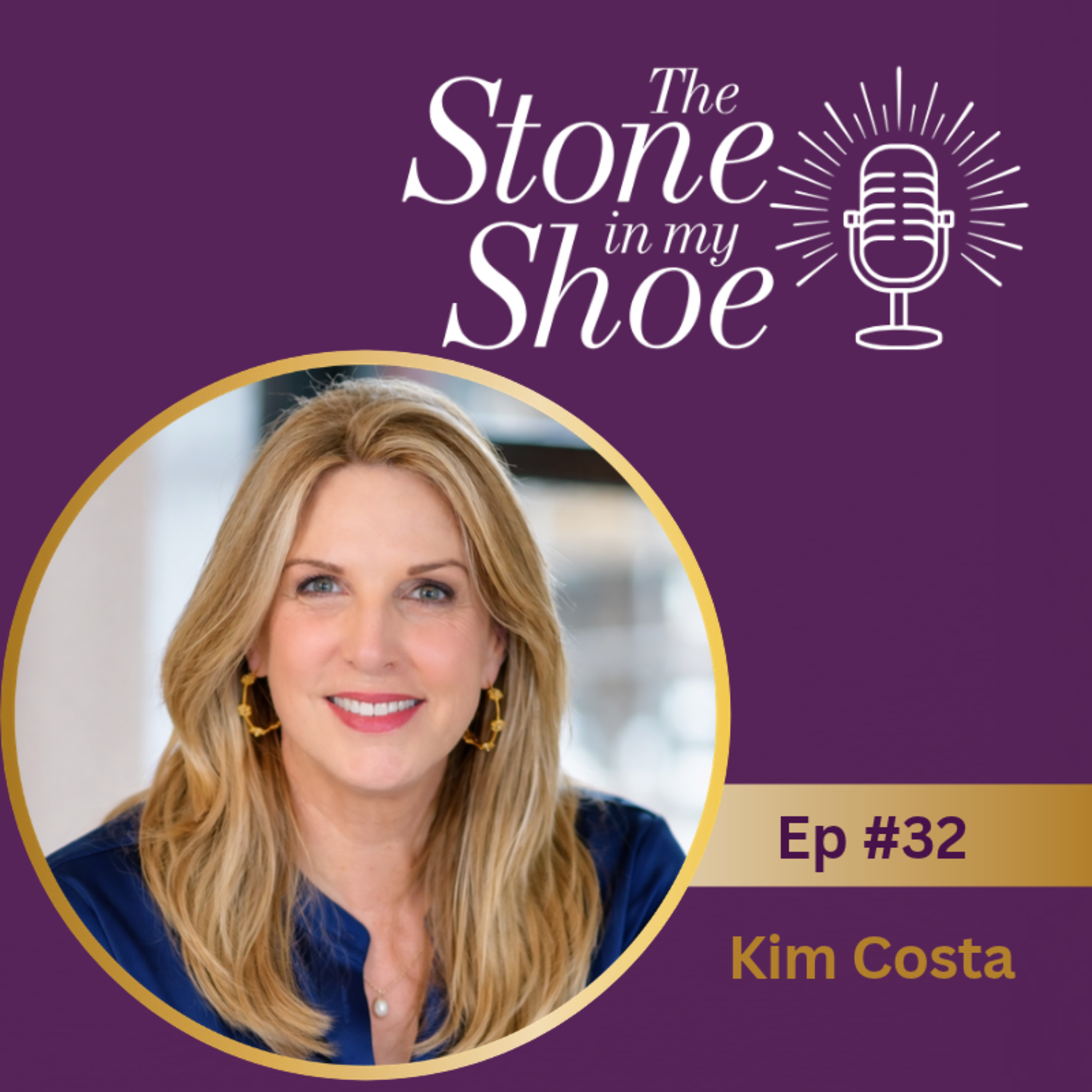
The Podcast · 28 September 2026 · 41 min
Self-Abandonment: When Your Perfect Life Stops Feeling Like Yours | Kim Costa
Listen to this episode
Chapters: tap one to jump to it
Have you ever looked at a life you worked hard for and quietly wondered when it stopped being yours? Self-abandonment rarely arrives as a crisis. It usually arrives as being reasonable, for years.
In this episode of The Stone in My Shoe, Debbie speaks with Kim Costa, a realtor, author, speaker and creator of Lifestyle Foundations and the Wheel of House Assessment. With more than thirty years in residential construction, design and real estate, Kim helps people recognise when their homes no longer reflect the lives they are living.
Kim's own stone was conforming to what everybody else needed from her, no matter what her gifts were. She is a creative who spent decades doing the books for a family business because someone had to, on a forty acre horse farm that was magazine worthy and nowhere near the life she actually wanted. It took a bolting horse, a broken back and a refused invitation from The Oprah Winfrey Show before she began to listen.
Together they explore how people pleasing turns into a loss of identity, why the childhood lesson that pretty girls are not athletic can decide the next forty years, and how to tell the difference between genuinely outgrowing something and simply giving up. Kim also shares the practical inventory she uses with clients: walking through your own home, room by room, and asking honestly what you feel standing in each one.
What you will hear
How self-abandonment begins with a reasonable decision rather than a dramatic one
Why people pleasing is often about being needed rather than being liked
What it costs to build an identity around the role other people require
How a small childhood belief can quietly shape decades of choices
Kim's room by room method for taking an honest inventory of your life
Why finding yourself again in midlife is a course correction, not a failure
If you have been wondering why you do not feel like yourself anymore, or why a life that looks good from the outside does not feel like yours, this conversation is a gentle place to begin.
Read the full transcript
And the horse bolted and the ground was frozen and I broke my back and I almost never walked again. 94% of the people with my injury never walked again and I wrote the Oprah Winfrey show. Well, I won a writing contest while I was recovering and I told the Oprah Winfrey show, you may not come to my house to film because I was so uncomfortable and broken back, couldn't get the house ready. It's too much. And so it really was denying my writing skills, the home that I had built, the recognition for winning the contest, all my friends that I wrote about. It was like the ultimate denial of what I always wanted. She was like my hero. She was the live your best life
person. And I was like, I am such a fraud that I have broken my back. Hi, I'm Debbie Thompson and welcome to the Stone in My Shoe podcast. Like a stone in your shoe, we all carry things to quietly shape the way we walk through life. Through honest conversations and powerful stories, we discover the wisdom that helps us understand ourselves and walk a little more freely. And today I'm joined by Kim Costa, a realtor, author, speaker, podcast host and creator of Lifestyle Foundations and the Wheel of House Assessment. With more than 30 years in residential construction design and real estate, Kim helps people recognize when their homes no longer reflect the lives they're living
or the people they're becoming. But the work Kim does today grew from her own experience of creating what she thought was her dream life and then having to confront the uncomfortable truth that it no longer felt like hers. Welcome Kim. Thank you so much for having me. I really appreciate being here. I can't wait for our conversation. Yes, me as me too. So just for the woman who's listening to this and hearing your story today, just to frame it for her, what do you hope she quietly begins to recognize in herself? Really, I hope that it provides clarity as to does the environment that she has created for herself or even the environment that she has found herself in, because sometimes
we don't get to choose. Is it right for her? And is there more to her life that she's missing out on? And does she need to stay, go or reno? Okay. So is this very much from a physical point of view when you say the environment, the physical, the home, the place you are, or is it more than that? Is it the environment and the people around you? Yes. So it is both. It is the environment. But before you get to your physical environment, one needs to evaluate am I living true to my authentic self? And so that is bigger than your own. It starts with you. And it starts with the four M's, the foundation, like the foundation of a home. If that's off, the whole house can be cattywampus. And there are four,
the first M is myself. Who am I? How was I made? What's my personality mastery? What of my gifts have I mastered? Third is M is mission. What am I applying those mastered gifts to help other people? And the fourth, which is so important is mates. And that means your partner, your friends, your family that you allow into your life. And are they supporting you and seeing the real you? Or are they subtly sabotaging you in some way? But that's way more than just a physical house. That is, it's you and who you are from the inside out. And I guess once you master those, the reflection of what you want externally would be quite different
than not actually looking internally and seeing and looking at those four M's. Absolutely. Because you could be doing what everybody told you to do. You could be doing what the neighbors down the street have done, or what who you were 10 years ago. But who are you? Who do you want to be next? How has your life changed? And what is the next phase look like? Your environment needs to change with that. But it starts with doing that inventory. I love that. I love the four M's. That's nice and easy to remember. Before we get into the stone, who are you in this season of your life? And what feels most important to you? What feels most important to me at this stage of life is to become who I really was meant to be. Here I am turned 60 years old this year. It's a pivotal year.
And so I want to maximize my relationships. And I want to be the real me, which is a creative, extroverted, slightly introverted, intuitive empath. That comes with gifts. It also comes with hardship, but I recognize that. And so it's about taking the leap of faith to use those gifts, even though I can be not as hard-shelled as I was in my previous life here, but that also the rewards are multiplied. My income has five X's. The rewards of what I do really fill me up. And so I want to continue doing that and even more. Amazing. So when you said that it comes with gifts and hardship, I'm curious about that.
Have you ever met an empath, an intuitive person? We feel the entire room. We feel everyone's emotions. I also have the gift of being able to read people's lips because my cousin had hearing issues or still has hearing issues. And so we would communicate by reading lips. So not only can I sense when someone's upset, but I can actually see what they're arguing about in the booth across from me. And so I almost have to turn away to not absorb that energy. So while I want to help, that conversation is none of my business. So I feel the vibes negative or positive of if someone walks in the room and they've had a rough
day, I can feel it. And it may not be my place to ask them. I may not even know them, but if I do know them really well, I have to really wait and see, is this something they want to talk about? Because but when I leave that situation, I take a bit of that feeling with me. And if it's unresolved, it'll stick with me for a little bit. I sometimes need days to recover from a large group of people. Now I hear you. I'm very similar. And yes, what's wonderful with that is that particularly in the work that you do, you can pick up on all the nuances of things underneath. Because sometimes people coming in looking from your home who perhaps haven't done this work and don't really know what they genuinely want, you might be able to and then guide them. And then they go, gosh, I landed up in this most amazing house. How
did that happen? It was actually because you saw something that a stone or something that they couldn't quite see yet. Yes. And it starts as a feeling. It could be frustration that I sense. Like why are you frustrated with your kitchen or your laundry room or the empty bedrooms that your children once lived in. And so it's unspoken angst or frustration or resentment to a spouse or a partner that I pick up on. So when it's a room full of people, it's hard for me to weed it out and have one conversation with somebody. But when I work one-on-one or two-on-two or even in a workshop with people, I can hone in one at a time or there's a group discussion and it goes much deeper, which is what I think is a blessing
and a gift that I have. And that's incredibly powerful for people because if they can unravel that kind of stuff, particularly in, say, something like a house, because it is a lot of money. It takes a lot of effort and you don't want to be moving all the time. But if you go in there and something is wrong and you don't understand what it is, it is deep, deeper stuff, well below the layers of the onions. And having somebody reveal that in a very gentle way so that you don't have to go that is incredibly powerful. We need more of you, Kimmy. Well, I don't know what to say to that. I wish there were more of me because I feel like if I, when I get around intuitive empathic people, it's almost like we don't even need to say words.
It's like, I get you, you get me. And then we, it's almost that we skip over all the things because it's like, I get you. I totally get you because we're not horribly usual. And I think especially in the realtor world, I know many good realtors, some of them are nothing like me. They're excellent at numbers, which I did for many decades was probably not supposed to be doing that most of my life. I was probably supposed to be dealing with people more, but realtors get the rap of being very transactional. And I am transactional. I'll do it. I love a contract. I love numbers and things like that. But it is more about even on the other side creating a win-win situation to the benefit of all the people that need to switch houses because it's stressful. And I feel the stress and I just, I want to provide options to make it better.
Beautiful. And so let's talk about the stone in your shoe. Yes. If you had to describe it in a sentence or a few words, what would it be? Gosh. I think the stone in my shoe would be conforming to what everybody else needed from me, no matter what my gifts were. And so my foundation, my four M's were off. I was an ENFP, which is a creative person in a field that would have been better suited to an ESTJ or an ISTJ, complete opposite of me, right? But I persevered one, one stage at a time, one day at a time, but I was not fulfilled. And I didn't speak up. I just said,
I'll take one for the team. I'd rather be doing interior design or human resource development, but I'll do these numbers because that's what we need me to do. And so decades of my life were spent doing that. And it was not joyous. I spent many years being not the person I was meant to be. And so Kim, did this start when you were younger or only when you started deciding on a career or was it in your childhood and teenage years before, before that? Very little was in my childhood and teenage years. I was a free spirit. I was the one running around outside without shoes on, stepping on B's unfortunately, but still it didn't stop me. I was very tenacious and climbing up trees and very athletic and cheerful. And somewhere along
the way, I was a golfer, right? And so I was very good at sports. And I think somewhere along the way I learned pretty girls aren't athletic. This is back in the 60s and 70s, right? And there was no opportunity for women in those. So I started, I slowly started to learn to not be who I really was, to hide my athletic skills, to dumb it down. And then from there, I just abandoned what I really wanted to do and just did what I was told I should do. And then once I got married, I was doing what I wanted to do. I was going after interior design and human resource development. But my former spouse inherited a family business
and he needed someone to do the books. And so I was like, okay, that was like the last piece of what I thought I wanted. And I was like, I'll do this for the family. And we turned the business into a very successful business. So it did pay off, but I did lose myself. I really lost myself along the way. And was it a slow loss, kind of month after month, year after year? At what point did you go enough? I've had enough because it sounds like you were very successful. You had this family business. It's very difficult to just walk away from a family business. Oh my goodness. Very lucrative. Yes. And the home we lived in was absolutely stunning. 40 acre horse farm in Georgia, magazine worthy. But it was in the middle of nowhere and I'm an
extrovert. I was riding horses and I'm a golfer. It was far away from everything I wanted to do. And I was doing accounting in an office by myself when I'm an extrovert, a people person. And so I really had lost myself. And truly, I think that was the stone in my shoe. I just took a backseat and let other people shine and sat in a back office in the business. When I really should have probably been more forward facing and working with the people on creative designs. But instead, I was doing job costing for all of the jobs. Now, Crimea River, these are first world problems. We were very successful. But I just don't think I was as happy as I could have been. Yeah. And at what point did you realize that something had to change? Because often
these things are very slow and on the outside, people went, Kim, look at her life. It's amazing. Oh, it looked amazing. Amazing. So at what point, being an intuitive empath as well, were you getting feedback from that this was not the life for you and you just ignored it? Or just talk me through it to the point where you go, enough, I've got to change. The feedback I was getting is, oh my, your house is so beautiful and you're such a great entertainer and you should have a cooking show. You're so personable and you're a great cook. And so it was like a lot of things surrounding the home that I was maximizing, but not in my own personal life. So I would hear all these things and I went and took interior design classes and went and took master's classes and human resource development
fascinated me. But still eight hours a day, I would do the numbers. So the feedback was, wow, you write a great letter or that was a fun story or we throw a great party and everybody, I feel so at home here in your house. So it was all externally focused to make everybody else happy while I was struggling with my daily, what I had to do every day. So what happened? So you were getting this feedback, this feeling of just not being comfortable in your own skin, not as happy as you, not as living your authentic life. So at what point did it get to the point where you went, enough, I have to change. And what did that look like for you? So really, there were, this is a two step process. One was the whispers
of I don't enjoy this and this, this is not exactly what I want to be doing. And I'd rather be golfing than doing this entertainment and fun. And so what happened was at that beautiful home called Clarity Farm, I was riding a horse that I was not hardly comfortable on and I wasn't comfortable on most horses. And the horse bolted and the ground was frozen and I broke my back. And I really badly and I almost never walked again. I was 94% of the people with my injury never walked again. And so while I was recovering, I started writing again. And I wrote the Oprah Winfrey show. Are you familiar? You're familiar with Oprah Winfrey. I'm pretty, she's pretty worldwide, isn't she? And so who doesn't know her. I won a
writing contest while I was recovering. And I told the Oprah Winfrey show, you may not come to my house to film, because I was so uncomfortable and broken back, couldn't get the house ready just recovering and in a bad way. And so I said, you can, you may not film here. It's too much. And so I really was denying my writing skills, the home that I had built, the recognition for winning the contest, all my friends that I wrote about. And again, I was like the ultimate denial of what I always wanted. She was like my hero. She was the live your best life person. And I was like, I am such a fraud that I have broken my back.
And so that was 2001. And so I just put my head down and kept going another 10 years or so. And by 2012, when my kids were older, I said this, I've tried and tried. I, my kids are almost grown now. It is time for me. And so around 2012 to 2015, I started changing my marriage, my job, my hobbies, got back to golf. The way that I ran my life, I would go out and meet people for dinner instead of being stuck at home. And, and eventually got divorced and remarried as well. So really big changes. That's those are huge changes. And to have the experience in 2001, where you broke your back,
that, that is huge physically and mentally, because you, you've got to get over the trauma of the physical injury, but also that you might not walk again, which changes everything, particularly for someone who is, who is very athletic. And even though you had this big wake up call, this is time for a change and you won the competition. It just shows you how powerful these stones are, or these ideas are, or our idea of what the world is grinds us down. And most people go, there's a sign, give me a sign, any sign, please, any sign. And it was such a big sign, but it was only later. And probably ground that stone down so that it was easier to feel, to really feel later on, to do something about.
So in between 2001 and 2012, you'd had this experience of winning this competition, so you knew you had these skills in this ability. Was the uncomfort and the, so I'd say the discomfort between the life you were living and who you wanted to be even more acute than, than prior to that? Absolutely. Absolutely. It was an unspoken reservation that I was just holding myself back and doing for others that I loved, but also sacrificing to the point where I lost myself and I was not as joyous. And it became a, let's, how good can we look?
How good can the house look? How well can the kids do in sports? What can I volunteer for and run things in the community? And that was my escape. It was achievement-based, but it was not based in what I actually, yes, I did love talking with the other parents. I loved communicating and writing letters. I loved the sports side, but again, it wasn't me playing sports. It was my children. And so while it was a worthwhile thing, it was also draining because I never got to do those things. And so do you know what I mean? It was like, oh, I totally understand. And I think, yes, somebody I was talking to said the curse of the Western world is to be busy and to keep busy because when you're busy,
you have no time for self-reflection and to see who you really are and what you really want, because sometimes that's uncomfortable because when you look really deep, you go, this life of yours, it looked so perfect, my goodness. And you go, no, but it's not because it's not authentically me. This is not what I want. And looking at that is uncomfortable, not just for yourself, but for those around you. So I totally get it. Any of us, stay busy. Yes. And people don't want you to change. They just want, they, and they don't necessarily want you to be the authentic you. They just want you to go along with what is easiest. And so that's why my whole process starts with the four Ms because I built a life based on a false persona,
that outward persona that was running things. And I would rather be doing yoga, playing golf, which are, you know, refilm reading and also dealing, talking with people, but not so much on a you do this, you do that, but tell me about you kind of way. I'm not directing, I'm listening now. And so it's become a deeper conscious effort to see people for who they really are, not the position they're going to play in the bigger organization that is needed. And that takes, it's interesting for anybody listening from 2001 to 2015, that was the major thing, but prior to that it was happening as well. So these things are slow burning and can often take
a number of slaps in the face or whatever you want to call it, same wake up, this is not who you want to be. But the thing is, it's a process and it's learning about yourself and learning sometimes jumping off a cliff because I'm sure leaving the marriage and leaving the business and was hard, but knowing that when you jump off, you're going to be okay because you've done the inner work, you know who you are. And so these the forums are very important. Can I just ask this experience that you had, what did it reveal about what you've been believing about yourself, success and what life was supposed to look like? I think it revealed to me that I didn't have to be the sitting in the stands watching.
I didn't have to be the bystander. I could be the participant in my own life, that I didn't have to be the cheerleader. I could be the person in the arena. And that was a big leap of faith because I had not experienced that very often growing up. But certain people would see me and I remember when I was younger, teachers would, a teacher specifically, I remember her reading at a very young age, one of my stories, and she didn't read anybody else's. And so that always stuck with me that I have a knack for communicating the written word. And I had given that up. And so it was really just about getting back in touch through the
whispers and the bonks over the head and the injuries and to be who I'm supposed to be and not what is prescribed. And for somebody, because sometimes if you haven't done this work, if the stone is not that sharp, you know, just the quiet whispers, how do you genuinely, and this is just a question, I don't know if there's an answer to it, but how do you know when you've genuinely outgrown something and give yourself permission to choose again without seeing your first choices of failure? Really, there is no such thing as failure because people often ask me, would you go back and say yes to the Oprah show? And I don't know that I would
because I would not have had the pain of all those years and the denial of what I had turned down gnawing at me to really make the changes to turn my life around into what it is today. Maybe I would have just lived in mediocrity if I had not had that big pain point in my life, the broken back, the turning down of Oprah, all the things. So I had to feel that pain to make the leap higher. It's like this is a horrible example, but the boiling frog, you turn the water up, you turn the water up until, and if they just experienced it so quickly like the broken back, they would have just jumped out of the water because it would
out, and that was an out. That broken back was a huge out. And so it was like, I, this water, otherwise it would just, I would have just slowly boiled to death, boiled to death without just, yeah, without realizing the pain is so incremental that you're just building small amounts on previous pain. Whereas if you would jump straight in, you go, holy moly, this is not what I want to do. I'm jumping right back out. Exactly. I think, and also, what you said that was quite interesting is you really had to experience the pain to do this. Now what if somebody doesn't have that level of pain, they're uncomfortable, they're not as happy as they, or joyous as they perhaps once were, or they know some things off, but they don't really,
how do you, what would you say to somebody like that, to almost give yourself permission to choose again or make a change? Yes. It's almost like they can't really put their finger on it. It's just a feeling that something's missing. Honestly, I would say go back to who you were, maybe between 10 and the time you graduated high school, and maybe even 10 to 15 before you could draw, you know, all, you were just doing the things you wanted to do. You couldn't work yet, all those things. What did you enjoy doing? What made you happy? My son loved to build things, and that's the way his brain works. It's a very, the things that you did when you were younger are keys to how your brain works because you are naturally inclined and you have the free time
to do the things that your brain wants to do. So think back to what you were doing then, the things that you like to do. So I would say to those folks, it's not about making a huge change. Maybe on the Wheel of Life, you have a lot of five, sixes and sevens. Take a look at one of those eight areas in the Wheel of Life, and if you've scored it a five, or you just, that's where you're feeling unrest, one of the areas is fun and leisure. And maybe it's the simple fact that you don't get enough rest. That's leisure, right? And so what would make that better? I used to love to read books. I used to love to read romance novels or historical fiction, or I used to love to just sit by the river and put my feet in the grass and daydream and look at the
clouds. Maybe that is the simplest thing that's missing from your life that you're so busy looking at the screen, and you're so busy interacting with people and in traffic, that you need to find a little walking trail or a park and lay out a blanket and just get back to who you are and get that rest. It may be something as simple as that. Yeah, and it's interesting because a lot of people I talk to, it's the simple things that people overlook because they seem too simple, where the magic is. And finding that quiet time, a lot of them were saying, I was so busy I had no quiet time to listen to that little inner voice. And sometimes that inner voice was giving me some amazing feedback, like go and lie by the river and watch the clouds. And sometimes it was giving me feedback that I didn't want to hear.
I'm not sure I'm so happy in this relationship, which it's very easy to go, no, my life's great, don't be ridiculous. I'm fine. I'm fine. And think of all the people you're let down. And it's all these external things. What do people expect of me? And I think you'll hit the nail of the head by saying, just by slowing down, seeing who you are and getting this this joy in this piece back is when you can actually set back and go, oh, that's out of balance, that's out of balance. But when you're out of balance and spinning, it's very difficult to see what's out of balance, isn't it? It is. It is. And my biggest thing that I love to tell people is hit the pause button. If you feel like something is out of whack in your life, or
you're frustrated and you just can't put your finger on it, hit the pause button. Don't make any rash decisions, if possible, and just sit with and take an inventory of all the different areas of your life. If you're walking around your house, your, your physical home is a representation of your soul and your current stage of life. So as you walk and each, each room has a different function, your kitchen is normally health and family. All right, your bedroom is romance and health again, because you're, you're resting. Some more common areas could be entertainment and fun, et cetera, spirituality. You could have a meditation room. You could love to garden and that's your quiet time. So when you're, you go into different parts of your house, it represents different parts of your soul.
And so as you walk into a room or you pass a room, think about what that area represents and what feel, are you joyous or are you frustrated? Are you lonely? Are you resentful? Stop and take an inventory of how you're feeling. So if you say walk into your kitchen and you feel anxious and frustrated, or give me an example of probably some of the most common things that you get and what that means, what somebody could do just as an example. Walking into your kitchen and feeling anxious might be, I don't have access to good organic food. I'm in a, a food desert. There aren't such places that people cannot readily get good food. And so that, that's an environment situation or the kitchen's quiet.
It's a huge kitchen. There's a big island that can fit six around it. That's where the kids used to sit, right? And now they're at college or they're gone or they're across country with kids or they just don't live there anymore. Maybe your spouse has passed away and it's you in a big kitchen and there's no one there. Loneliness, sadness, angst. And so it's like, gosh, maybe I don't need this big house. Maybe it's just become such a maintenance issue that instead of me cooking food for nobody in this big kitchen, I can have a smaller place that's closer to a downtown situation and I could meet friends for dinner and I won't be lonely anymore. So that's interesting. You, it's interesting you said that because we, our kids left or six years ago, the last one left
home and we had a big sprawling beautiful Queensland house on four acres with kangaroos outside, the most amazing place. And I just remember when they left, I had this feeling of severe loneliness, almost bereft. And my husband goes, no, we'll keep it here and they'll get married here on the lawn. And I went, no, Phil, I have to leave. I have this overwhelming sense of sadness. I can't be here without my children. And this was our family home and it's time to move. And not almost divorce, but he was like, I'm never leaving. And I just said, I'm leaving. You can come and visit me. I've got to get out of here. But that was, it was very acute and very obvious. And very this, it was somebody shouting at me,
you need to leave. And I think I would have felt that loneliness and it was a beautiful home and everyone's going, you're mad. And I'm going, no, it's time. I'm a different person. It's a new stage. It's a new stage of life. And maybe most likely, I've seen this many times, you would have felt stuck in that home and waiting for them to come back when they moved elsewhere. And now they have a bedroom in their home for you to come visit because the children have activities and they want you to see that part of life. I just got back from visiting our two grandchildren and we went to gymnastics. And we, it was like, they want us to see their life. And so we don't necessarily expect them to come stay at our home. And that's just a different stage of life is as sad as it is for a couple
of years until you adjust. But a daily reminder of the people who aren't in your home, that I almost started to cry when you said that. It was visceral. It was so visceral. And I knew it was the house. And I just knew it was the house because the house was beautiful to us, but it was no longer, it was no longer serving doing its thing. And it needed, actually, one of the things I felt very strongly is it needed to be passed on to another family. I was just about to say that. And what a great feeling to pass on that home to another family that then fulfilled all of their memories. And you left a little bit of your soul in that house, which probably was very comforting to them. You can feel the energy in a home. So I'm sure you left a lovely home for the next people. Yeah. And we went back to, it's interesting
because we went back to see them. We became quite good friends with them. And when we, because Phil, my husband was really upset about it, but when he went back and we walked in, he said, it's not our home anymore. I said, no, it's the walls were there, but the whole feel was someone else's and the whole soul and the whole energy. And it was like, okay, it's done. It's moved on and it's beautiful. Yes. And now you can take your souls into the next home, not to be too woo-woo about it, but that is what it boils down to. That is the deep dive that I do. And sometimes I don't even get to go that deep with people because I feel at a couple recently, lovely marriage, they were making the right move. The kids were gone. They had great retirements and they just wanted to downsize and start fresh and live in a 55-plus
community with the raised gardens and the pickleball and the parties and the lovely golf cart community. And I was like, we don't need to do a deep dive on the 4Ms. I think, you guys are fine. Let's just go, let's just go find the house. Exactly. Exactly. And that's, yeah. So I just wanted to, for the person listening, where life looks absolutely fine from the outside, but something is, keep whispering, this isn't right for me. What would you want to leave her with? Don't let that feeling fester. That's a whisper. And when you hear a whisper, you need to pay attention and do the little bit of a deeper dive and sit with it in journal or
reflect at least or go for a walk without music or anything and just think about it and see what pops up and try to fix things a little bit by bit along the way so that it doesn't become a whole, I need to change my entire life because I have traveled. It's like being in a plane that's off course and you're headed to Chicago, but you've wound up in Washington DC because you've taken so long to correct your path. And so I would say, do some inventories as you go. And when you get that little feeling, talk to your partner or a friend or a therapist about it and come up with some options to correct the bad feeling that you have. I love that. And I love it's getting it at source before it's too late because it's
so much easier to course correct when you're only 100 miles out rather than a thousand miles out, right? Because then the course correction is so much harder. And there's so many other people along the way that you've, who don't want you to change. And so if you do it earlier and it's about listening to that little voice, finding the time to be quiet, to be still and then trusting that what it's telling you is something that you need to pay attention to. I agree. And oftentimes people have a fear that they're going to make the wrong, the bad decision. But just because you're going to course correct doesn't mean you're going, not going to course correct again. And so you can't view that, that trial, that thing that you tried as a failure.
It's just, you had to see that wasn't for you or was for you. And then you have a little bit more knowledge to course correct the rest of your life, what you enjoyed, what you didn't enjoy, what you were good at, what you weren't good at. It's just tweaking along the way. Nothing wrong with that. Because you have the four Ms, I have something called the three C's, which is curiosity, courage and compassion. And it's being curious what's out there, the courage to actually make those steps. And then when it doesn't work, just being compassionate as well. So that there's nothing set in stone, we're all meant to change. We meet new people, new opportunities, our children leave, something happens, it's okay to change. And just because we're on that course does that not mean it's a failure to change.
That's right. And with life change, you have to change your circumstances and your environment, you have to adjust. And people always think adulthood is okay, I turned 22 or whatever the age is. And then adulthood is till you're 90. There's toddlerhood, childhood, adolescence. But adulthood's got stages of before marriage, before career, learning, children, after retirement. And then we're living so long now that we have the chance to become almost completely different people or to investigate different facets of ourselves after retirement. We have another 20, 30 years sometimes. And so are we going to waste that? And just, or are we going to investigate what we're fascinated with?
And I think that's so true. We almost have another chapter that perhaps our grandparents didn't have. And use this chapter to be our authentic selves. What you said earlier is who am I meant to be? What's most important to me right now? And that one of the reasons I do this as well is I listened to a podcast by Bronnie Ware and she was a nurse with people who were dying. And she said the top regret, I don't know if you've heard her, the top point was I wish I'd lived, and I'm not saying her words exactly, but the sentiment was I wish I'd lived a life authentic to me and not what others expected. And that was the number one regret. Yes, exactly. Wow. Okay. I have to pay attention to this. I have to find out
who I am authentically like you. And it was, it wasn't just, oh, this is who I am. I have to dig away, find the stones, throw some out, chisel some away. And it's been an amazingly interesting journey. And I'm more joyous. I'm better for everybody out there. Yes, some people didn't like me changing. The majority of what I put out there is just so much better. Yes. Yes. And if I might add, it's maybe it's also who am I supposed to be in this stage of life? Because things, people change, things change, and we adapt. We also assimilate our experiences and oftentimes through hardship become different people, hopefully for the better, if you've processed. And so it's okay to put on a new hat sometimes.
Yeah. Beautiful. Kim, is there anything that we haven't talked about that we should have talked about before we finish? No, really, the only thing is in my process, there are eight areas, and it's the wheel of life. It's a very popular coaching tool. And so once these, and I love talking about the foundation, but once you have that all set, there's a way to analyze creating an environment that matches who you are and who you want to be. And I, and that's the top step, but I love talking about the foundation. I really do. Beautiful. I will link all your, all the ways of getting hold of you, but most of anyone wants to get in touch with Kim, please do. And thank you so much for sharing your story. Thank you for being vulnerable.
Thank you for being honest. And thank you for all the work you do out there. Thank you Debbie. I so appreciate you having me. Oh, it's a pleasure. And as you finish listening today, perhaps it was a moment where you recognized something in yourself. And if it was there, just stay curious, because sometimes listening to another person's story helps you see your own. Thanks for listening.
Want to know what your Stone could be?
Take the free reflectionKeep listening
 Self-worth: why you feel like you don't matter | Teresa McLellan23 October 2026
 Choosing Yourself Over Belonging | Ramona Kossowan on Identity, People Pleasing & Finding Yourself6 August 2026
 Living Your Dream but Still Seeking Approval | Nyasha Ngwena on Identity, Self-Worth & Trusting Yourself9 July 2026