The Podcast · 2 October 2026 · 52 min
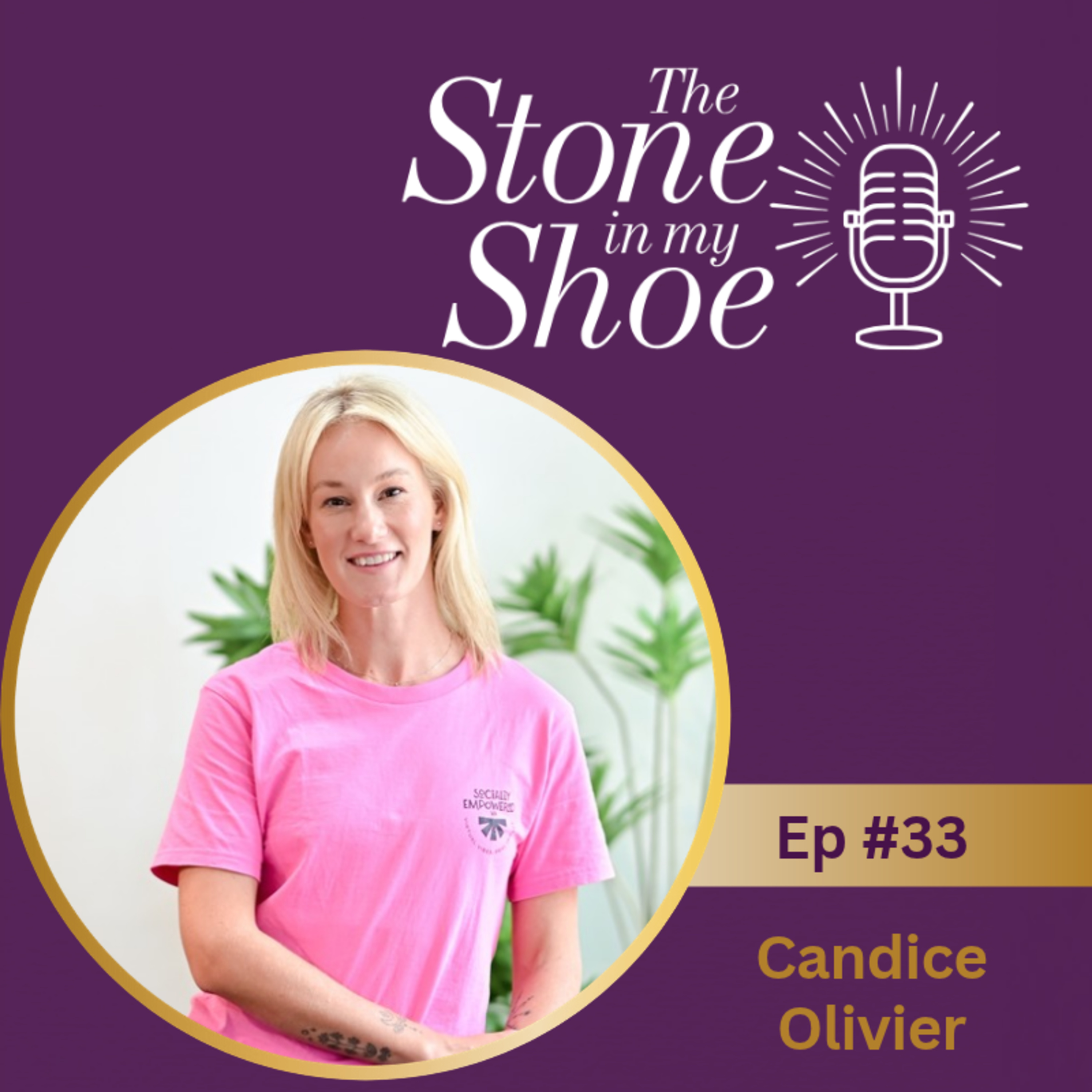
Identity After Trauma: You Are Not What Happened to You | Candice Olivier
Content note: this episode includes a discussion of sexual assault.
Listen to this episode
Chapters: tap one to jump to it
How much of who you are was actually chosen? Identity is hard to separate from history, because a story you've carried since childhood doesn't announce itself as a story. It simply feels like you.
You will hear why the people who always help are so often the ones nobody helped.
You will hear what emotional healing can look like when you stop expecting to be finished.
You will hear two small exercises that changed how Candice sees herself, from writing her own eulogy to asking five honest friends.
Candice Olivier's Stone is the victim story, and she names it with real precision. What she carried, she says, was never what happened to her. It was that there was no one there for her, and that one sentence explains the life of service she built afterwards and the years she worked for free.
Together we explore what it means to integrate a story rather than push it away, why Candice doesn't expect to be healed and finds that a relief, and how she deliberately calls in joy alongside the work. We talk about the limiting beliefs about money that shaped what she let herself charge, and why she built a structure around a pattern instead of relying on willpower.
Candice is the co-founder of Socially Empowered VA. Born in London and raised in Zimbabwe, she now lives in Australia, and she has spent ten years in therapy learning to live alongside CPTSD.
What you will hear
How a childhood wound quietly becomes an adult identity
Why the people who always help are often the ones nobody helped
What emotional healing looks like when you stop expecting to be finished
How limiting beliefs about money shaped what she let herself charge
The eulogy exercise, and what she found when nothing she had achieved appeared in it
Asking five honest friends how they would describe you
If you've done the work, can name exactly what happened to you, and still find the story running your decisions, this conversation is an honest place to sit for an hour.
Read the full transcript
And most people say it's about time that I have called in the most beautiful man into my life who's very safe, but I still wanna fight him on a weekly basis for no reason. I think I still watched these patterns in myself, but I think coming from there and the difficulty and what kept me going, that actually hasn't changed, right? Because I think inside myself, I still see that many people need help and the victim timeline that I've carried for the whole time is that it's not what happened to me. It's that there was no one there for me.
Hi, I'm Debbie Thompson and welcome to the Stone in My Shoe podcast. Like a stone in your shoe, we all carry things that quietly shape the way we walk through life. Through honest conversations and powerful stories, we discover the wisdom that helps us understand ourselves and walk a little more freely. And today I'm joined by Candice Jane Olivier. She's a co-founder of socially empowered VA and a social entrepreneur who believes business should build something worth leaving behind. Now living in Australia, but originally from Zimbabwe, Candice grew up seeing firsthand what happens when opportunity is scarce and that experience has shaped not only the businesses she builds,
but the way she thinks about purpose, impact and legacy. Her story is also a deeply personal one. After 10 years of therapy and learning to navigate CPTSD, that's complex post-traumatic stress disorder, Candice has thought a lot about how we allow our experiences to become part of our story without allowing them to define who we are. Welcome Candice. Thank you, thanks Debbie for having me. Oh, it's a pleasure. But before we begin, I would love to ground this for the woman who's listening. As she listens to your story today, what do you hope she begins to recognise or see in herself? That's a beautiful question. For me, my journey has been really colourful.
I say to all, I'm like a diamond, I'm multifaceted and navigating in this. There's something that I've always just anchored on and it's that life gets to be beautiful, but it is also hard. And in that journey, the anchor piece that I'm talking to is not only what is my purpose, but what brings me joy and what am I doing this for? Yeah, I think so many of us wake up each morning and some mornings are more difficult than others. And we are anchoring to purpose and that's quite widely spoken about now, which is beautiful. But purpose changes all the time through different phases of our life. And what I experience is as the world gets busier,
our sense of purpose is almost pushed and pulled so frequently. That anchor isn't the anchor it used to be. And so the question now is whether that's personal or business is it bringing me joy and does it serve bigger? What I'm doing today, is it impacting someone else? That's, it doesn't have to be a great grand gesture. It's like if you're going to get a coffee in the morning after dropping the kids off at school, are you asking the barista, how's your morning been? And maybe skip a little bit more of how's the morning been but also really anchoring to who they are. How are they? Reflect upon yourself. I'm here every day. Am I getting to know this person?
Am I bringing joy into the environment? So I would say, yeah, for me, that's the moment that's my biggest, my biggest piece is that joy. And am I serving beyond myself? I think that's multifaceted because not only is it purpose because sometimes you could get so fixated by am I being purposeful? And in our Western society, purposeful could be being busy. Am I achieving ticking things off in boxes? Did I do this? Do I do? Gosh, look how much purpose I have. But one step further, am I feeling joy and am I giving joy? Which is a, it's a really beautiful way of seeing life because sometimes we can be so internally focused,
so busy that we don't see the barista. We don't actually go, who are you being present in the moment? And what impact am I having? Does it serve a bigger purpose? So I love the fact that you've built those on there. Yeah, I think a sense of community. I think for many who have identified a stone in their shoe, regardless of where it's come from and at what point, I have a deep belief that as human beings, we yearn for companionship and we yearn to be in community. And life is so busy now that we have to consciously make a decision to step into community, to step into a place of joy. And so witnessing the barista
or witnessing just something beautiful, there's such a beautiful sense of belonging by witnessing bird bathing in a puddle. It's the small moments. And I think you're absolutely right. From an ancestral point of view, from a deep genetic point of view, community and belonging was so important because if you were kicked out of your tribe, you died. So being in a community and being part of a tribe is a really important visceral thing in us. And but not just belonging to a community humans, but the earth as well, seeing the beauty in the earth, the wind in our hair, rainbow raindrops, as you said. I actually saw a rainbow two days ago and I was driving. I saw this rainbow, one of the most clear rainbows
I've ever seen. The colors were so vibrant and it was beautiful. I was like, oh, I was like fighting back tears, but not like fighting them back. They were just present in watching how beautiful this phenomenon was. And as I got closer, I had convinced myself that the end of the rainbow was in my backyard because it was in the same direction. And I didn't really have the time but the plate, the child in me was like, I wonder where it is? Like, where is the end of this rainbow? It's actually in my suburb somewhere. And I just went on a wild goose chase trying to find the end of this rainbow. And I didn't quite find it, but I gave myself 10 minutes of pure child joy just chasing this rainbow with the music blaring and about 7 a.m. after school drop-off.
And right there is all at wonder and magic. Yeah, it's just coming back to this story in my shoes. We all have something and some of us have many things, but the beauty in this and the beauty in raising conversation and being vulnerable and conversing about what is mine? What was yours? There is always going to be a piece of what do we do? And now what? And that's so complex because we're complex animals. When you invited me to have this conversation, I just thought it can be another personal story about what the stone is for sure. But I just really wanted to highlight that.
It's equally as important from the onset to manage what is the stone, but also what am I doing to... I'm sorry, what am I doing to bring awareness to it, but a positive awareness rather than masking, rather than diagnosing. Going, okay, in this moment, the stone for me and we can get into that more is having to shift identity after having been diagnosed with CPTSD and being challenged fairly often with why do I feel depressed? Why am I not seeing joy in things? Why are people around me having fun and I'm not having fun? And I didn't recognize the weight that I was carrying. It's the subconscious weight of patterns upon patterns.
And throughout the last few years, to me what's really made the shift is when I feel the stone, I can bring awareness and I can do the work on it because I don't believe that it's the work stops. But I've learned to just call in joy, bring it back. I only have this one human experience and am I meeting it with joy and the reality of what's happening in my world? Yeah, it's just humans, we're so complicated. Our lives are so complicated. What happens to us is so varied and so complex and it's what happens to us in the story we make about it
and how we define ourselves and our lives in the world based on what's happening to us. That is complex and it's not one shoe fits everybody. I'd love to go back to, and before I say anything, I love the fact that you've gone, I call joy in. And joy is like love for me, the two things that I can bring in whenever. If I ever do anything and I go, what would love do in this situation? What would joy do in this situation? And it just reframes the story or whatever I'm thinking but we'll come back to that. I wanted to talk to you about the stone. What, if you could describe the stone that we're talking about today and I know that people have so many different stones
but what I'm gonna talk about today, how would you describe it in a sentence or a few words? For me, the stone is acknowledging the victim's story in my experience of how it has played havoc in my success, in my willingness to be open to loving relationships and also suffering that I don't think I really acknowledged until recently was how I was being witnessed
within the community. And just to speak on that, I know a lot of people but when I really strip things back of, do people really know me? And that sort of allows you to acknowledge and witness the depth of your friendships. And I realized that the stone for me having had my diagnosis with CPTSD, there's these layers upon layers of victim's story that I have internally that I've worked on so that they're not an outbound story but I also acknowledge that everything I do comes from that place. I've worked in service for 10, 15 years now. I'm gonna say service. I've built businesses for good. I've volunteered. I've just been in that space of service
and for me it was just normal. If you wanted to volunteer, if you wanted to know about charities, if you wanted to start a business that did good, you go and speak to Candice. It was just what I've been known for. And then I asked myself the question, but why? Because in lots of these spaces, I've got big dreams and goals but in lots of these spaces, they probably aren't the right spaces to be driving a business that needs the revenue to allow me to do the things I want to actually do. And so I played small for such a long time with such a big heart that these patterns again kept coming up to go, okay, you can have success but this is what success is. You don't need any more. It's at the glass ceiling. It was like I came from a household
where we didn't have enough food. We couldn't pay bills. But now I can pay my bills and I have got enough food. So that's okay. That's enough. That's all I needed. And maybe a little bit more to give. Whereas the work I've done and I've shifted that money mindset to go, hang on, money is not evil. Just because you didn't have any growing up in those stories of you can't do that. We don't have money. Do you think money grows on trees? That was part of a story that built in my CPTSD. Because I witness it now. If I go out for dinner with friends or my fear, like all my fiance in the early stages and someone starts calculating or you owe $73.25, my brain immediately tells me
you can't be friends with this person. That's how they value money. And now I'm trying so hard to have an abundance mindset. Things like that will trigger me. And it's wild. I catch myself. And that's often where you know where the stones are. What's trickering you? That is beautiful feedback. Instead of going, oh my God, there were pale in the ass. That's so rude. Hang on. Why is it triggering me? And looking internally and there will be a story in there. So this complex PTSD, can you just paint a picture? You don't have to go into too much detail of where this came from. And then we can look at some of the, as you said, these stories and this victim story that you were in
and what your beliefs were. But let's start with where this PTSD came from. This CPTSD hand from? Yeah, sure. No, I said all. So just if anyone listening that doesn't know what CPTSD is. So it's a complex post-traumatic stress disorder. And it is actually a mental health condition that develops from prolonged or repeated trauma. And they can layer on like child abuse, domestic violence and domestic violence from a child. So either witnessing it, witnessing your parents yelling throughout your developmental years. And in my case, it's been a beautiful journey. But when I, for example, if I read a definition of CPTSD, I could probably tick 95% of the boxes,
which I think at the time of diagnosis, I would war as a badge of honor. Well, I'm the best candidate as a definition for that. Paint a picture of CPTSD and it was me. So I grew up, so I was born in London actually. My mom is Zimbabwe, my dad's Australian. They met while traveling. They separated when I was three and I was taken to Zimbabwe. Didn't see my dad again until I was 18. And I heard from him probably once or twice. And on that, it's not that he didn't want to have anything to do with me. My mom had her chip on her shoulder with him and essentially didn't allow me to have a relationship with him. So I think I said to people, I promise you I don't have daddy issues. I have a really beautiful relationship with my dad
and I honestly do, I have an amazing friendship with him. But I think naturally it started there because I knew that this other person was in my life and I have photographs of this other person in my life but knew nothing of the person. Then you go to school and I think like most, you grow up in single parent households. There's always a question of where's your dad? Who's your dad? And my mom had struggled from her teenage years with different addictions, whether it was drug addictions, alcohol addictions and drugs even to the point of an excessive painkiller addiction. And I grew up in an environment that all of that was normal. And I grew up in Zimbabwe in my developmental years and the culture there is a big drinking culture.
So being shout to that, being beaten as a child. And I think in Australia when people think about how you got beaten, you got like a snack on the bum, we would beat it. It was a constant question of, do you want me to give you something to cry about? There were times where time out for us was like actually not leaving your room for days. And then being in that environment, there's lots of parties, there's lots of unsafe individuals around, excessive drinking. Now I'm one of five siblings. I have a brother that's nine years older than me. And as soon as he was 18, he left and never came back. And then I've got three siblings that are younger than me now. So between us, there's three dads, say mom. So it's just like a spider web of stuff, right? When I was nine years old,
I remember coming home from school and it was quite often that parents of other kids, we'd be like last kids there and like the parents would be like, hey, is your mom coming to pick you up? And they're like, I don't know, I actually don't know. And so often like other parents would take us home, teachers would have to take us home. And quite often we would actually be like the last kid or last kids left at school. So sometimes it was dark. And so I remember this one time being taken back home after a day at school with my younger brother at the time. And my mom was not in a good way. And we ended up having an ambulance come and take her.
And she then spent the next four years. I think in and out of rehab, she was in rehab, but there were times where she was allowed to have home stay. And I was raised by, I think if you can call it raised by my stepfather at the time who didn't love the fact that there were other kids in his life. So it was very just hard environment to grow up in. His community were very, I'm saying throughout, those are the years before I was like 13. And I automatically became a parent-child. We were like fishing in the lake down the road trying to find like food. And when I look at it now, it was like character building and it was fun. Like I'd get the fishing rods and would go out.
I mean, you can strip it back down. And I'm like, well, that is the reality of how I grew up. And I remember just the other day someone saying, oh, have you ever tried? Oh, when you were a kid, did you ever have, let's say it was equivalent of peanut butter and jelly sandwich. And I was like, I had to go to school with black tomato sauce on bread. We didn't have a lot of food. And in me growing up in that space, like a place of service, because I said I've been giving for my entire life, we didn't have much. And I grew up in an environment witnessing people that didn't have anything either. And so even if that was like my tomato sauce on bread, I would in most times give half of that to someone that I saw on the street, from young. So I think I built the foundations of the woman that I am today on that.
Fast-track a little bit into like my teenage years, if you like. I was sexually assaulted by a teacher at school who I then in my early adolescence years actually went on to having a, let's call it a fling, right? Because I think if we put a label over that of rape, which essentially it is, right? It shows that I had no consent in there. And when I look back on it, I was the one that was climbing out the window of the house to go and see this individual. So there was consent at the time by being underage, do you really know what you're doing? And I had that experience and that lasted for a year.
Until there were stories coming out that this individual had actually raped other kids that were in our school, pulled me into line. Obviously at that time there was no way in hell I was gonna be telling anyone that what I had been agreeing to participate in. Few years later, I found myself in a relationship with someone who's older that my mum acknowledges, but she's all for it because now this person can drive us to school because our from school can help. Ends up living with us, help pay the bills. And then at 15, I moved out with this individual who was seven years old, I mean. And that was like the start of my adult life. And these are like the main pivotal moments
of becoming the woman I am. There's nothing really positive in them, but great determination to keep going. And it wasn't like it was a sad story at the time. It was just happening. That was just my life. I've always made friends with the weirdos, as my mum called them. I didn't grow up with a close knit family. I'm really lucky to have had one really beautiful girlfriend growing up in her family would take me on school holidays, school holidays. This was my mum's version of a school holiday trip would be like, can you all ask your friend's parents if you can go stay with them for a week? That was like our school holiday. We weren't really allowed to come home. We just had to go find someone to go stay with. So looking back at that, as you said, you just got on with it,
going looking for food for everybody else. We've been like, my gosh, that is so challenging. And I know coming from Africa as well, it's difficult, it's different for somebody, say living in the States or the UK to really appreciate what it's like living in Africa. But at that time, looking back now, perhaps you didn't see it back then, what were your beliefs about the world and yourself that kept you going? I think what kept me going was the fact that I had siblings to look after, right? If I'm really honest, I think within myself, I hadn't quite come to a term that there was another option. There was just day by day needing to survive
the best that we could. And I had three younger siblings to look after. So this deep-seated service, not only comes from where you lived in Zimbabwe, where so many people had so much less in you, it was you became the mother to these other children, so responsible. The world is just unsafeless and I need to do whatever I can to keep it safe for them. And the buck stops with me because I'm responsible. That's a huge amount of responsibility for somebody so young, isn't it? Yeah, definitely. And I witnessed it in, I moved to Australia when I was 17, 18, and I said, moved. I was sent to Australia by my mom at that time.
I have a younger brother, one of my younger brothers is we have the same dad and he was, he's not diagnosed, but he has clear symptoms of AST and ADHD and she just couldn't cope. And so we got sent here and I remember that time being so heartbreaking to have to lead my two younger siblings behind in that environment that I was so torn of what is life. I've been a parent of my child. I've had to look after all of these kids and all the extended people in my environment. And I was a child. And so moving into Australia and getting to Australia the first few years
were very complicated. I worked. I worked three jobs, but I found myself in a terrible relationship. And so the patterns were there, but I kept pushing forward with sheer grit and determination. And over the years, I've acknowledged that those developmental years on my younger years on my time back in Zimbabwe, I can't change that and I survived. But what I do acknowledge is that instead of using there's so many scenarios in my life that I could just take on a tagline that I was a rape victim that I was a child in a school environment
who was abused by someone. I could take on the domestic violence in a childhood setting. I witnessed such extreme violence. And my mom is bipolar as well. I've witnessed stabbings, people dying. I've witnessed just awful things for a child to see. I could take on that. Moving into Australia, I was in a five year domestic violence relationship and domestic violence from physical to all types of coercion. But I painted it with a brush of love. It was love because that's what I acknowledged. And so I think so beautiful that you coming back to the very beginning, you bringing this and my bringing love to it.
I'm still nurturing this concept of love. I'm so grateful and I'm so blessed. And most people say, I'm like, it's about time that I have called in the most beautiful man into my life who's very safe. But I still wanna fight him on a weekly basis for no reason. I still watch these patterns in myself. But I think coming from there and the difficulty and what kept me going, that actually hasn't changed, right? Because I think inside myself, I still see that many people need help. And the victim timeline that I've carried
for the whole time is that it's not what happened to me. It's that there was no one there for me. And so for years I carried around this feeling like if somebody needed help and that is where my place of service has come from, I would be that help them. There is so much to unpack young. There is a lot of stories, a lot of ways of defining the world. So many, I can see why this, it's complex. Yeah, because there's a lot of things, it is very complex.
But what I'm hearing and is that there was this little girl with so much grit and determination, but with so much empathy and compassion that she could see that others needed help as well. And so went out there and helped them, your sisters, other people and also what you're doing in your work. And so there's this enormous strength, but you were a child and all these things were happening to you and you were the savior for everything. There was no one there to help you. And the rules about life in the world and where the world's an unsafe place, there's no one there for me. I'm doing this all alone. At what points did you, because you said you carried this victim mentality
of it's not what happened to me. It was the fact that no one was there for me. And as a result, and not as a result because that's too singular, but all these other things that the school teacher, just people letting you down constantly and you having to rise above it. At what point did you go, I need to change the story and I can't let the past shape me any or define me anymore. I need to take what happened to me and redefine it and change the story and change the meaning of the story. From my own little back, I actually recognize that I love having these conversations. I recognize, well, it actually has been such a big story.
For me in not letting it define me, I feel like that phrase still has shackles attached to it because it's still there, but I'm fighting against it. Whereas I feel like, I don't know if it was a pivotal time in particular, but a phase through my life where I acknowledged that nothing was really going right. And not that things were going bad, they were just coasting. And I also said, I'm a Sagittarian, I'm a manifesting generator, I'm a visionary. I see more.
Someone invites me to a party. In my head, I've already been to the party, I know what I'm wearing, I know how it was and I've got home, had a cup of tea. I just live in my head of experiences. And again, part of that is I'm creating safety. So in everything that I do, I've learned to understand that these patterns that I have or these protection mechanisms, they're not going away, but I can either identify them as a negative or I can welcome them in as a positive or something neutral, acknowledge that it's there and let it be and let it go rather than being stuck in my head to question,
why is this happening to me? Is this because of this that happened? And then you find yourself almost in a spiral that you have a sense of like, you've lost control of where it's going, where you're going and then you fall into victim. So it's like the process. So for me, I would say, it's honestly only me over the last four years, five years, that I've really just anchored into my authentic self and gone, okay, I know I can be a little bit more blunt than others or direct. I acknowledge it's because I like to get things done
and because I was never given the time to speak or express, et cetera. And I think we need both types of people, right? I'm used to a modified counselor by background and I did that study just to better understand myself. But what I also recognize that within my personality, I'm probably not the person you want to go for a kiss on the forehead. I'm tough loves and everybody needs a tough love, anchor in their life and that's me. And I've acknowledged in myself that's where it is. So just coming back to that stone, the journey and coming to a place of love within myself so that I'm not operating from a victim mindset is not that I've pushed it away, I've integrated it.
And that integration, because that's a lot to integrate. That's a lot to integrate. I look at my life and I'm just integrating every day. And this is exactly the point, it is not a done and dusted. It's not a take a pill and it's all over. I'm sure there are days when you said you put this beautiful man in your life and every now and again you just want to fight with him and that's the old, but it's okay because you understand why that's there, he understands why that's there. I just tell him, I love, I wanna fight today. I've learned to be verbal. Yes, I think that's really helped. I never really spoke growing up. I was a shy kid until I was seven. I used to hide in the corner. If mom had people around and obviously
we were at the party house, that would be quite frequent. It's a funny story and there's lots of photos. I would take my nappy because I was in town nappies and I would have it over my head and why I'd be stuck in the corner. I didn't wanna talk to people. And now I talk to everybody. I talk to the barista. I know what the barista's dog's name is, because I deeply care about the people that are around me. Verbal coming back to my beautiful fiance. When I have those feelings or I feel like, but I just wanna fight him. It's the pattern of I'm not loved or I'm not good enough or you're gonna leave and I can create that story in my head. And I just create, in my head, I create a scenario of drama just so I could get him to bite back.
But he doesn't. He's really grounded, but we've done a lot of work together and he knows where I'm coming from. But even beyond that, it's coming back to a place of self-acceptance. I just say to him, I don't know what is going on but I just wanna pick a fight with you. So if I pick a fight, can you maybe just offer me an art wrestle or something? Like it needs to get out of my system. And you know, the beautiful thing about that is you're just taking everything out of the shadows. Nothing is, because I think shame and fear are the two things that really keep you stuck and bringing it out going, I don't know what's going on, but I really wanna fight. I wanna have a fight. So let's do this in a really lovely, loving, compassionate, joyous way so that this can come out. And I just think anything hiding in the shadows,
it's like a monster when we're little. But it happens in business as well. Like I have learned for years in business, I would provide service and then someone would say, I can't really afford it. And I'd be like, don't worry about it, it's okay. And because again, the money problem, like I can't afford it wanting to help someone, like everything started to come back and I'm just working for free a lot, like a lot and for a long time. And so like I've had to put practices in place and I do it even now in business, where I've got a healthier money mindset as I'm calling in the resources to be able to do what I would like to do and how I wish to serve the world in a much larger capacity because I am focused on building a legacy from my story
and not the victim tagline wound story. And so what I do now is I will discuss how much something may cost for a service. And then I have a dedicated person within my team that handles all money things because I can't trust myself all the time to not buy into someone else's story and just falling back into a trap of, you can have that for free because as much as I would love to do that, I'm still building the ladder to be able to serve at a much greater scale that if I continue to operate in this way, I know that I'm not going to get there. And I think like even from a personal perspective, it's if I don't do the work, if I don't explore different modalities,
if I don't keep searching for a little bit of micro learning about these spaces from time to time, like I say spaces like spaces that I feel are like within me, that I'll become stagnant and I'm not growing as a person. But I don't expect to be like healed. I don't expect to get to the top of the ladder right now. I've become really grateful in being able to acknowledge and witness in myself, like I'll just that one step forward or that one step forward. And sometimes they're larger this weekend, this past weekend, I've just been at a three day conference and I've made a very heavy investment into myself
to work with a mentor to just keep me accountable. And again, the stone, the victim, where you're going, it's what are you doing within yourself to keep you accountable? And for me, I asked myself at the end of the day when my partner and I sit down for dinner, we have this thing, what are you grateful for today? Like three things you're grateful for. And we always laugh because we say, I know you're grateful for me, but other things as in, can you go deeper within the day and it's so beautiful that we can reflect back on that you saw like just yesterday, I saw probably a little boy about five years old holding his like little sister who was about two. And I just watched for about five minutes and there was just such a joyous, beautiful energy
around them of like care and compassion and love that like I was in tears. I was like, how beautiful does life get to be? And I did acknowledge them on and I just said, oh, it's so cute to see them. And so then that's separate of conversation. And that's again, like I'm embedding myself into community. I'm embedding myself in witnessing joy and gratitude for these little moments because I'm acknowledging within myself that whilst witnessing that, I'm very likely healing a part of myself because I've acknowledged it. So it's the mirror. If I'm seeing joy and I'm seeing something good and it's bringing emotion to me, it's evoking emotion in me.
What is that healing? And it doesn't have to be like so heavy. You don't have to ask the big questions, but just acknowledge that when you do that, that is what you're doing. Yeah, and I think what I'm hearing is just living so radically honestly and allowing everything to come out without judgment or curiosity and compassion. So that's interesting, Candice, that's... But also being so proactive in your choices, I am going to choose to be really present and see the barista, to really see them, to acknowledge them, to be in joy, to be in love,
to just be present and to know, without judgment, I'm hearing this beautiful thing of I am on this journey and it's okay because sometimes the waters are turbulent, sometimes they're beautiful and smooth, but either way I'm going on this journey and I'm going to absorb all of it, the beauty of it, the pain of it and I'm going to bring this all into my little boat of life and I am going to make that part of me because I think part of your pain and part of your story is part of why you see people so clearly and why you... Oh, what's this move? If you know what to mean. It's a blessing, I say sometimes it's a blessing and a curse because...
Exactly, yeah. Energetically, again, things I've had to learn along the way and I've studied and been a part of communities that focus on different modalities throughout the time, seeping, help-seeking, understanding actually Yeah, it's really interesting. I can walk into a room and I feel people and I know that sounds weird to lots of people but I also know lots of people listening will understand that I got to Australia and 18 people were going to festivals and gigs and everything and I learned I can't be in that environment because my friends will lose me and I will be at the medic tent looking after a woman that I found in the bathroom who has some long-winded story and I've been nursing for two hours.
That's me. I always find the people that need help or they find me and I've learned to love that as well but it's a really, it's a gift. And as you said, with every gift there is the side that's amazing and the side that's not. Nothing in life is ever just, it's black and white. And part of it, like for me, I speak on legacy. What I'm building in my life and what I'm building in business is legacy and it's not that I'm a big author or I'm a big star or I'm what, it's legacy within myself. I remember sitting in a workshop two years ago
and we had to do an activity which was to write your own eulogy and it was one of the heaviest things I've ever done and what I acknowledge and it's beautiful because you actually mentioned some of the words that I, what do I wanna be remembered for? That's my legacy. Not how much money did I make and essentially part of it is I come and you people did I help and where did I help but who was I? Who, like how do people, how did people remember me? And I have that coming back to those moments of joy with the brister, et cetera. Do people remember the energy that I walked into a room with? Do people remember how I made them feel?
Do they remember me for helping them and not to acknowledge, oh, that's Candice, she's done this, she's done that, isn't like me as a human. Did I come into someone else's life and put a smile on their face? Did I offer a handout when they needed? That's the life that I'm building through my personal journey and through my business. And I think anyone who hasn't done that yet, writing a eulogy, it's very confronting but it's also a very good anchor on where you're going and are you on track? Because I did exactly the same thing and what came out to me was not, oh, she's done this, she's done that,
it was who she was. She made me feel so loved, she made me feel so seen. She encouraged me, she saw stuff in me before I could see it and I went, wow, that is actually deep in my core, what's in it, it sounds like it is for you as well. So anyone who hasn't done that, I would highly recommend. Oh yes, definitely. Highly recommend doing that, definitely. Yeah, so legacy is a deeply personal, deeply human, deeply authentic thing to you. Yeah, yeah. I mean, the legacy, as I said, it's not the accolades, it's not Candice wrote three books or she featured here or she won an award,
it's the identity. So coming from your wound, your trauma story, what's defined you, that the environment, whether you could have controlled it, the sense of control, which I don't believe, but whether you felt like you've had a sense of control over the circumstances, whether you didn't, there's, that's the waves, right? That's just life, life gets to be big and beautiful and as you said, sometimes the waters are calm and then sometimes they're just, it's just torrential. But coming from all of that, it's like at every opportunity, like when it's rough, you're building determination and grit and when it's calm, you're building your yin energy, the feminine
and you're learning to master like how that encompasses love and compassion and curiosity. And so it's just, the legacy is the journey, right? But what's underneath it? What was the driving force to keep that grit and determination continuous? The love continuous, the curiosity continuous. And for me, it's been like to help and to serve. But I get to do it in such a big, bold, beautiful, weird, wonderful, which is what most people describe me way because I'm multifaceted, I'm multifaceted
because I don't have just one mental house disorder. It's complex. And so I'm not a complex individual. I just, I said to people like, I just a lot of different things. I'm a 34 year old woman who has half a garage full of camping and fishing gear. Well, on the other hand, it's about crafts and my sewing machines out and I've been taking up curtains yesterday. I've got half a renovation at home going on. I've just repainted my office this morning. I'll put another layer of paint, a coat of paint on. I'm just doing all these weird and wonderful things whilst building and business. And I've got a friend coming over later on for a coffee who's not doing the best. I just get to be in this beautiful part of building legacy of, if you think about who is Candice?
Who was Candice? What does Candice mean to you? Another exercise that's really good to do that maybe if you're not ready for the eulogy part is to reach out to five of your closest friends, right? And always pick the one that's got no filter, which is generally me, right? And say, hey, I'm just doing an audit of myself right now. The most loving thing you could do is to be really honest and list a couple of questions. Do you feel like I show up for you? How would you describe me to someone else? Those types of self-reflection things. I'm sure you've got the longest questions that could be included if someone wanted to learn. But that's just such a powerful piece because if you take all the answers for that,
that is your legacy. And exactly right, and you could go, I'm on track, brilliant. I'm just gonna do more of that. Oh, I didn't realize I'm going to change tech on that because one of the things that really drives me more than anything is being, one of the top regrets of the dying is I wish I'd been authentic and to myself and not what others expected of me. And you have to be, and that's the top regret of the dying. And I'm like, no, I need to be authentic to me. What my gifts are, of course, I'm going to be kind, joyous, whatever along the way, but I need to be authentic, whatever that looks like. But sometimes being authentic isn't always kind and joyous. Sometimes it's quite putting up boundaries.
Absolutely. It looks like saying, that's not for me. I'm sorry, I don't have capacity for that right now. No, but doing it in a loving way, that's what I mean. Yeah. So yes, you have your boundaries. You have, you say your truth, but you say your truth in a kind, in a way, because there are different ways of doing, of being authentic, right? And what I hear about you and what you said earlier was community. And I really hear that coming out and your deep care for people around you. But also that this journey is, it's your inner, it's part of your journey as well. So I love the fact that it's internal and external as you are doing all these amazing things.
Not healing parts of yourself, but because are we ever healed, but acknowledging and seeing different parts of yourself and giving the little girl who might never have had the chance to play now, to be joyous, to be silly, to do all those things. And I think that's incredibly empowering and you're an incredibly strong, resilient, capable, kind, caring person. And I can see that the legacy that you're building is something that is very deep, got such good foundations and is going to ripple out to so many people. So keep doing what you're doing, Candice. Thank you, Debbie. Thank you. I appreciate that. And thank you for the opportunity to reflect back. I think anyone who has acknowledged
there is a stone or a something, it's jumping to the authentic piece and the legacy and the story. It's such a beautiful process to just have a conversation about what it is or what it might even be if you're not sure. We learn so much about ourselves in the spoken word with someone else where there is that no judgment and curiosity piece. So thank you for the opportunity. Oh, no, it's a pleasure. And yeah, thank you for being authentic and honest and vulnerable because I think that is where when we can be authentic, honest and vulnerable, we can really be seen and other people can be seen as well. We're not hiding, we're pretending to be who we are. This is who we are. And as humans, we're all complex and we have shades of everything.
Just on a parting note, so if there's someone who's listening and they're going through a difficult time and they're stuck in this belief that what happened to them is who they are, what parting words would you leave them with? My first parting thought to this would be that if somebody is in a position where they have acknowledged they are stuck with the story, then stuck in victim, it's definitely to seek help in some capacity, whether that is talk therapy
or if you're more on the spiritual side, haven techniques, kinesiology, I think the first step for anyone who's acknowledged, that's the hardest part. The hardest part is to acknowledge, hey, I don't think that I'm okay right now and it can come in waves, but if it's consistent and for prolonged periods of time, they say that depression is very normal, but if it's prolonged, that is when you should seek help. I think it's the same in this victim because we get to acknowledge, but if it remains there and it's starting to create a bit of a spiral and you seek help for sure. But the second part of it is acknowledge yourself and how beautiful it is
to have come to such vulnerability within self. So many of us have so many masks and so many layers or masking as they call it in shadow work is that being radically honest with yourself is so beautiful and it's so painful and it's where all the ugly tears come from, but there's such light in it. And the next step from that is to focus on that joy and legacy. You are who you are and you have so much joy to bring to the world and the legacy is about keeping it consistent. Love it. Thank you, Candice.
No worries. Thank you. Thank you so much for having me, Debbie. That's a pleasure. And as you finish listening today, perhaps it was a moment you recognized in Candice's story, something in yourself. And if it was there, just stay curious because sometimes when we listen to someone else's story, we can see our own in there. Thanks for listening.
Want to know what your Stone could be?
Take the free reflection