The Podcast · 12 October 2026 · 44 min
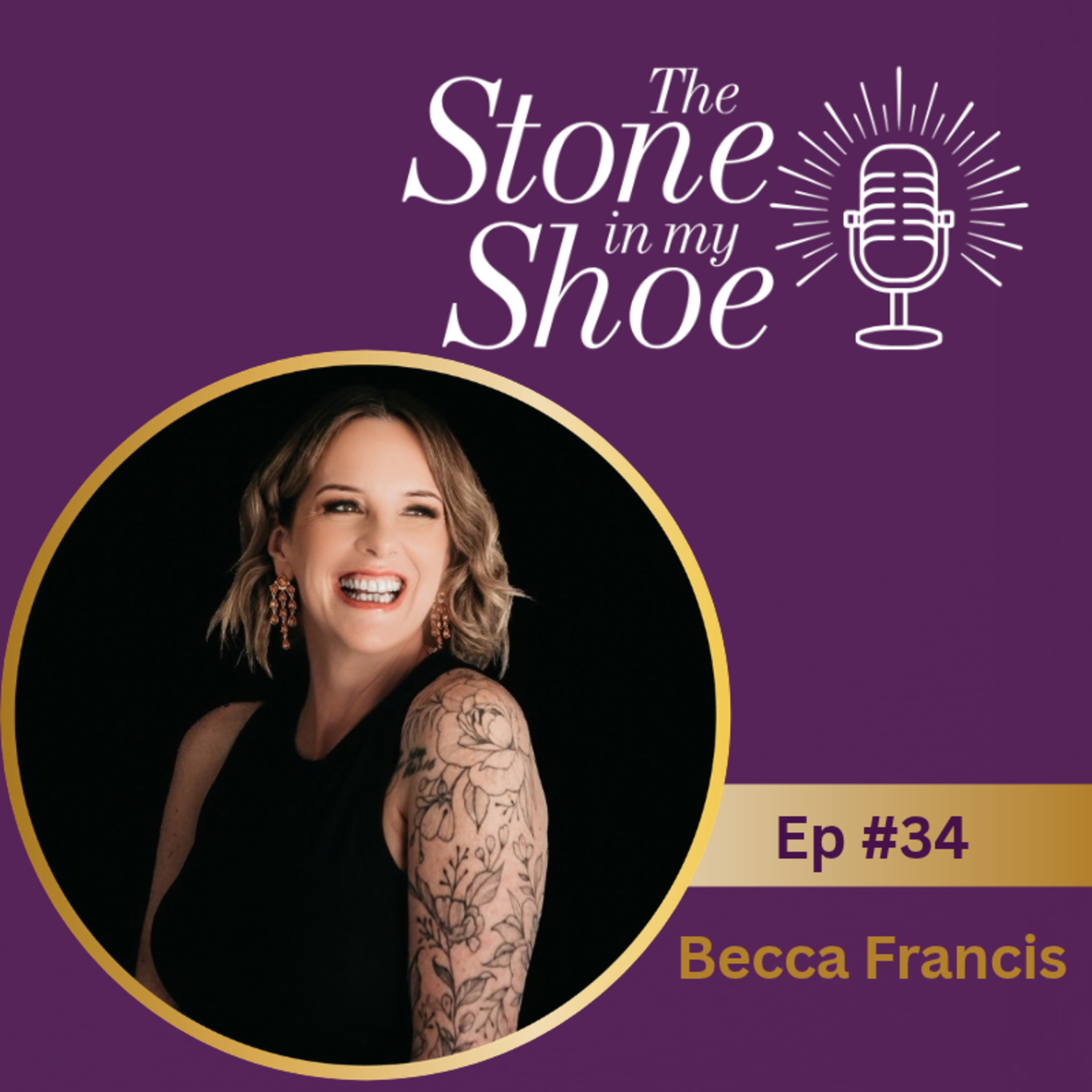
Self-Abandonment: Why You Don't Trust What You Already Know | Becca Francis
Content note: this episode includes a discussion of an abusive marriage.
Listen to this episode
Chapters: tap one to jump to it
Have you ever known the answer and gone looking for it anyway? Self-abandonment doesn't always look like giving yourself up. Sometimes it looks like fifteen years of searching for something you were already holding.
In this episode of The Stone in My Shoe, Debbie speaks with Becca Francis, a Lisa Williams Certified Spiritual Adviser, internationally certified psychic medium, healer and Human Design teacher. Originally from the UK and now based in Brisbane, Becca has built a global community of more than 6,900 students.
Her stone, in her own words, was a lack of trust in herself. She'd learned to question her own instincts, minimise what she felt, and believe someone else must know better. It started with several years of bullying at school, where she worked out it wasn't safe to be who she was. It hardened in a toxic marriage in her twenties. And then it followed her into a successful corporate career where, from the outside, she looked entirely capable.
What it actually looked like was searching. Fifteen years of side hustles, one after another, while she waited to feel certain about something she already knew. Together they explore how doubt outlives the situation that created it, why making yourself smaller tends to make things worse, and what changed when she finally stopped hiding at work.
What you will hear
How self-abandonment can look like competence from the outside
Why making yourself smaller gave other people more power, not less
What fifteen years of side hustles were really about
How shame kept her from telling a supportive husband that things weren't working
The question she uses to get past "I don't know what I want"
Why she says it's never too late, and what she understood on her fiftieth birthday
If you're on your fourth idea and still waiting to feel certain, this conversation is for you.
Becca has shared a free intuition bootcamp for listeners, self-paced and designed to help you start developing your own intuition: beccafrancis.com/intuition
A note before you listen: Becca talks about several years of bullying at school and a toxic marriage involving coercive control. She speaks about both plainly and without graphic detail.
Read the full transcript
Hi, I'm Debbie Thompson and this is a Stone in My Shoe podcast. Like a stone in our shoes, we all carry things that quietly shape the way we walk through life. Through honest conversations and powerful stories, we discover the wisdom that helps us understand ourselves and walk a little more freely. And today I'm talking to Becca Francis and we'll be talking about what happens when you stop trusting yourself. When your own instincts become the last thing you rely on. We'll talk about the 15 years Becca spent searching for the things she was meant to do while quietly ignoring what she already knew. In her 20s she was in a toxic marriage and got very good at adapting herself to find
peace. She left rebuilt and went on to a successful corporate career and then spent the next 15 years searching for one thing after another. And just before she turned 50 everything changed and she's now a psychic medium and a human design teacher with a community of nearly 7,000 students around the world. Welcome Becca, lovely to have you on. Thank you Debbie and thank you so much for that warm welcome. That's lovely and thank you for inviting me to share this with your lovely audience. I'm excited. Yes, so am I. And the thing I'd like to start with is for the woman who's listening today, what do you hope she takes away from your story today? She takes away from my story that it's never too late.
And I know that sounds cliche and you hear that a lot, but it literally is my life didn't change until I was in my late 40s for reasons I'm sure we'll talk about. But I was canicking in my 40s thinking it's too late, it's too late, it's too late for me to do what I really want to do, but it isn't. It absolutely isn't too late and actually when I stepped into my 50s almost literally when I woke up on my 50th birthday, I thought, what have I been worrying about? This is like that there's a whole new path to my life that's opening up. So I would say never give up, never get discouraged and think this hasn't worked and that hasn't worked, maybe I should stop, carry on, try the next thing, fail a lot, expect to fail a lot, but there will be something that just catches fire. So don't give up and it's not too late is what I'd say.
And those are incredibly powerful ones because so much of the narrative that we have particularly in the Western world and based around social media is what people should have by what point and the comparison. And if you haven't achieved this by this, you're somehow a failure. And it's very, I think it's really important to realize that it is just a narrative, it is not the truth and that it is never too late. And at any stage, you can make a decision to change things and everybody's story is different and that's what makes it so interesting. And I also love the fail a lot. I tell my children that because if you're failing a lot, you are really giving life ago. Yeah.
Exactly. I have failed a lot, Debbie. And actually what is failure? Because failure is when you stop doing it, but I think learning and wisdom comes from trying new things. They didn't work perhaps the way you thought they were, but you learned something about life, about yourself, about other people. And so the benefit is so much greater than what we call failure. Absolutely. I heard somebody say, somebody said to me yesterday, we were talking about past experiences in my life. And he said to me with the difficult experiences, he said, I always say to take the learning things, but don't drag the baggage around with you. And I thought that was really great advice because we know that there's learning inside every experience, but it is tempting when you go through really hard things to drag
that baggage around behind you. So I thought that was a great philosophy for life really. Don't drag your baggage around, leave it where it is. I love that one as well. And it's so visual as well. It's almost like a backpack holding you down and you're more and more stooped. And then you don't even look up at the sky and the opportunities. You're just looking down. So that's beautiful. I'm going to use that one. Every stone has a story and you've had a lot going on. You've lived in a lot of different places. Let's start at the beginning where perhaps now that you can look back, you started realizing that the stone, and we'll get into the stone, that belief, the conditioning whatever was starting to drag you down.
And let's just go through that and hear your story. Thank you. I would say the first time it occurred to me there was this stone in my shoe would have been at high school. I was really badly bullied for four or five years at high school. And I learned pretty quickly that it was not safe to be who I was. I couldn't show anybody who I really was. So I twisted into exactly what people thought I should be so that I could be safe and under the radar. And so no one would notice me. And that was my safe place. And that was the catalyst for then getting into this very toxic marriage in my 20s. I met somebody who was very manipulative, very, very coercive. These days we will call it coercive control.
But back then this was in my 20s. There was, I hadn't even heard of it. But that experience at school, that stone in my shoe, not being safe to be myself, set me up for not being safe to be myself in my marriage. And then when I moved into the corporate world and trying to try to find my way, that environment where I encountered a lot of toxic relationships, particularly with women, because I didn't trust women. That was another stone in my shoe as well because I wasn't safe to be who I was. As soon as I showed people who I really was, I was attacked for that. So it's taken a lot of years to work through this. And I'm still working through that. But I would say that's the common thread in my life that has always been present. Yeah. And just taking you back to when you were bullied,
I'm assuming you were bullied by girls. Yes. And when you said it wasn't safe to be yourself, and what I heard then, I don't know if I got that right, is you had to shrink to almost not be seen. So not only was it not safe to be yourself, it actually wasn't even safe to be seen and have a voice. Absolutely. Absolutely. Even smaller and quieter, I could make myself the less of a target I assumed I'd be. But it actually had the opposite effect, because the more I withdrew, the more their power grew as well, because they could see they were having an effect on me. So it actually had the reverse effect to why I intended. But that behaviour got so ingrained in me. And I think also being the youngest child in my family, I've got a fantastic family, but I did suffer from that kind of youngest child syndrome
where you had to get on with it. And you couldn't be loud and proud. You just had to get on with it. I think, yeah, there's a lot of times in my life that I learned, just be quiet, be still, don't be seen, and you won't be a target. But yeah, throughout my life, it actually had the completely opposite effect, yeah. Which often it does, but all these things that we put into place once served us, right? And this is the thing is it's not like we're broken or there's something wrong. This behaviour or belief or whatever served us at that time because you had to get through high school. Now back then you didn't have an option, right? And the problem with this is you drag the stone and this belief with you and it just gets sharper and sharper because by not having a voice,
how can you ask for what you want from others and from yourself? Because how can you, if you're not asking it from yourself, how can you ask it from others? Yeah, and I didn't even know what it was that I wanted throughout most of my life. I just didn't want to be a target. So a lot of my decisions were informed because of that and the times when I did make decisions, I was still a target. So when I met my first husband, I was working for Virgin Atlantic, I was a long haul cabin crew and I loved it. It was my dream job. But because of that, that made me a target because I made that decision, that made me a target in his eyes. And that caused a lot of abusive behavior in my marriage because of that. So that's another kind of stone that I picked up
was when you do say what you want and you dare to put your head above the parapet, it's gonna get shot off. So don't do it. And in the end, I gave up that job when I was with him, a decision which I regretted for many years. But it was because as soon as I said what I wanted, the situation got worse. So I pulled back into my shell even more, unfortunately. And that's really hard because you're going, okay, I'm going to do something different. I know that this is keeping me small. I'm gonna put my head up and yet it was even worse. And then that embeds that stone there because at the end of the day, being safe and being part of a tribe is really foundationally what so many of us hanker for. And so we will do anything to protect ourselves.
At what point did you go, how did you unravel that toxic relationship? And what happened inside of you that you had the strength and the courage to do it? What unraveled it in the end? I think the behavior, we had two very small children. So the decision wasn't just about me leaving, it was about splitting up the family. But in the end, first of all, the situation got so intolerable. I tried to hide it for years and years, but his behavior got so bad, it was spilling out. I couldn't control it and I couldn't contain it anymore. And my family were starting to notice, my friends were starting to notice, and it was like this poison that just seeped out of my life and people could see what was happening. I also looked at it from the point of view
of I could stay for the children, but number one, I'm gonna be miserable. And having a miserable mother does nothing for a child, I don't believe. And second of all, I had a pretty good feeling, my intuition said, if you stay, then at least one of these children is gonna be damaged from his behavior. And one of my children was a boy and I was very conscious that I didn't want him to pick up that pattern of behavior from his father. And I remember very distinctly, I used to smoke back in those days, this was many years ago, I remember very distinctly putting the kids to bed, standing outside in the garden and having a cigarette and saying, I'm feeling at my loneliest because it was only me that could make this decision. But I thought, I can't do this anymore.
I know this is gonna disrupt my life entirely, but I have to leave. And it did disrupt my life, obviously, but it was the best decision, one of the best decisions I ever made. So I only ended up being in that marriage for six years, thank goodness. But it just got intolerable. And I think when it started to spill out and I couldn't cover it up and contain it anymore, that's when I started to feel that shame. Or nobody made me feel ashamed, but I felt this real shame, I can feel it in my cheeks are going red. This real shame of now my toxic marriage is there for everybody to see. And what kind of example does it set to anybody if I just tolerate this behavior? It was really a breaking point. There were a couple of things that my husband, my first husband said to me, that made me wake up.
At one point he said to me, I want to leave you, but I know you'd be devastated if I left you. So I have to stay. And I'm glad that he said those things because they really woke me up and from this kind of zombie-like state almost. And I went, oh no, we're not having that. So I'm really grateful that some of the things he said as cruel as they were, really threw a bucket of cold water over my psyche and woke me up, which I think is those kind of, him saying those kind of things to me were catalyst for leaving as well. I just thought, what on earth are you doing? And I was just, it was like I was able to step back and see clearly for the first time who this person was and what situation I was in and that I was putting my children in as well.
It sounds like there were a lot of things all coming together. The fact that it was, as you said spilling out, but it was so toxic and some of those things that he said, if it's a slow boil and they cruel, but they're not that cruel, it's like the frog in the boiling water gets to it. But when it's, and as you said, it did you a favor because it was almost like a slap in the face, right? And that stone became so sharp, but it sounds like you've got a lot of courage from a lot of different places. There was your inner voice saying enough, it was the cruelty of your ex-husband, but also the future of your children that were all such palf things to go, Becky, you have a voice
and you are, even though it's going to be difficult and all the other things that go with breaking up a family and imagine everyone's got an opinion, but it sounds like you've got a huge amount of strength from a lot of different, I'm not actually getting goosebumps as I say this, but from a lot of different places to hold you in that space, because it couldn't have been easy to make that decision. Exactly, you're exactly right. And a lot of support from my parents as well and my sister, they had an inkling of what was going on, but their approach has always been until you have to say something to us. I found afterwards, I found out that was the approach, but as soon as I remember one day I went over to my mum and dad
and my mum took one look at me and said, what's wrong, what's going on? And it all spilled out and she was just like a warrior. She just stepped up and said, no, absolutely, we'll support you. There was never a, you're married and you must make a go of it and you must this and there was never any of that. As soon as I'd made the decision and I was the catalyst, they stepped up for me and my dad became the father figure to the children because their father was absent a lot of the time. So yeah, now looking back and actually it's the first time I've thought about it like that Debbie, like looking at all the different things that had to come together to help me make that decision. And it was also, there was a friend of mine who was very fair minded, very, she never really said anything about it, but she could see what was happening. But there was one day she said to me,
really? Are you sure? Really? And that's all she said. And for her to say that, I was like, oh, and actually therapy as well because I remember saying to him, we need to have some counselling here. We need to have some therapy. And back then was the marriage, marriage guidance council in the UK. And I called, I got my, the phone book I got the yellow pages and I rang them and they said, we do one trial session to see whether you are good candidates for this or not. And I went in very wary thinking they were going to try and talk me into staying, which I did not want to stay. And I remember sitting there and my husband's car alarm went off. So we'd had a chat and he talked a lot. His car alarm went off. So he went outside to turn it off.
And I will be fit. Oh, I'm getting emotional. I'll be forever grateful to this counsellor because she leaned in and she said, you need to leave. Wow. Do you want to leave? And I said, yes, I do. She said, okay. That's all she said. So she obviously just picked up all the un-said things she could see because if he's manipulative you can't hide it. People can see it. If you're, if you're intuitive in people and you understand people, it's not the words. It's all the stuff behind it, isn't it? Exactly. You really have this team of people almost like this army standing up and going, even though you crumple and even though this is really hard for you, we've got you.
And did you feel held at that and supported? Definitely. I felt very supported in that session because I didn't think and maybe they're not allowed to say that kind of thing these days to be so like you should leave. They're probably not allowed to say that. But sometimes I wish I could, that person knew, that woman knew what an incredible thing that she did for me. But the rest of my support system I would drop the kids off at school in the morning. I had a job that was an hour's drive away. Sometimes I would stop in at my mum and dad's on the way and just cry. My dad would come out and get me out the car and I'd cry and cry. God, sorry. Oh no, it's, you know. I've done this for years. Yeah, and but look at what you did and look at the courage you took because that was not easy. But just from hearing your story
it's almost like your intuition said enough, Becca enough and put enough things in place so that it wasn't just you, but it was you with your support crew that could do this. And I'm interested is once that had happened and you're taking that step, which I'm sure all these things are complicated and they take time, what did you learn about yourself in terms of asking for what you want and trusting your instinct? Such a good question. It's like I woke up for the first time in my life and understood why I was capable of because and that my instincts are correct because I won't go into the details but one of my children at one point has said,
I'm glad you did that. That was the right decision. And that means the world because now you look back and go as a mother and as a wife and a person that that instinct was correct. And yeah, it really taught me that when push comes to shove and there's no one else around I can rely on myself. And I'm glad it was me that made the decision. No one talked me into it. No one talked me out of it. But I had to be the final arbiter of that decision. And I sometimes when I wobble in business I sometimes go back to that time and think if you can make that decision and it was the right one then you can make all the other decisions in your life. So it was like waking up like I said out of a stupa. And I was like, oh yeah, I am capable.
I can make these decisions. And it's a very public decision, isn't it? To get divorced is a very public kind of failure or a public statement of a previous decision you made to get married. But yeah. There again is failure at the time. And I don't know, maybe this is a question. Looking back because you said it's a failure of your decision to get married. But maybe looking back, I hope you don't mind me asking this question, is were there any signs that maybe you shouldn't have married him? There wasn't just red flags. There was like red, oh God, I don't know. Huge fields and fields of red flags. And I ignored every single one of them. Every single one of them. From the day I met this person
from one of the first things he said to me was a red flag. But I was just very vulnerable and very naive and had never met anybody like this person before. There was red flags before our wedding day. There was red flags on the wedding day. They were just permanent red flags. And when I talk about this with my children they're 28 and 30 now. I do say to them, I do regret marrying him. That is a regret and I feel like it was a mistake. But you two would have come to me in another way. If it hadn't been via him, I would still have got you another way. You would have come to me, whether that be through another person or I've done it on my own,
but kind of destiny-wise, because I never want them to feel the whole thing was a mistake. Because obviously they were a product of that. And the thing is, the chance of a child being born, it's, you look at the universe and all the stars, it's almost like one, I don't even know Trillion. Trillion, yeah. So the fact that child is alive and you have these two beautiful children, that was part of the journey to have them. Even though it's, and as you said earlier, it's the wisdom that you take, but not taking the baggage. So you take these two beautiful children, learning about yourself and your intuition. Maybe the stone had to get that sharp. Yeah. That it had to be something like this for you to eventually go, okay, I trust myself. I deserve these things.
And these stories, we all have these stories, don't we? And there are some things we have to be slapped and others we just learn organically without the pain. So you left this marriage and then you went into work and you said it was difficult because there was a lot of toxic relationships, particularly with women. Was this happening at the same time that you were getting divorced or was this after the event? So I got divorced when I left my husband when I was 31. And it was then I went back to full-time work because I couldn't do that when I was with him because he had all sorts of views about it. And that was one of the freeing things. I went out and got myself a job, but I very quickly, and that was full-time. So I work, like we were saying,
I work for the Crown Prosecution Service. And then when we moved here, I worked in law firms, but I would always have these very toxic relationships with women, very toxic. And it happened in every job I had. And I used to say, so then got remarried in 2015. And I remember being embarrassed and saying to my husband, is it me? What am I doing? What am I doing? So that was a whole, that took a long time to unpack the fact that I didn't trust women and I didn't feel emotionally safe with them. And it's taken me a long time through some of the work that I do now to now I work with women. Now I speak to wonderful women like you and I have a lot of trust and or in the way that women conduct themselves
and the relationships I have, but it had to do a real 180 because it was not good. And it's funny what we say about conditioning. I remember my mom saying to me when I was very small, maybe five or six, she said to me, you're much better with male friends than female friends. Something like that. And she didn't mean, she's lovely, she didn't mean to implant anything in me, but she did inadvertently because I feel like I took that on board and went, okay. So it's safe to have male friends but not safe to have female friends. So that took a lot of unraveling as well. Cause I think that was buried in there. But then I ended up in a relationship with a very toxic man. So I think who is, who is safe? Men aren't safe, women aren't safe.
So who's actually safe here? So that did take a lot of unraveling. But sorry, I'm not listening to this. No, because we all do this and we will say something. And the thing is with children, particularly at that age, they don't have this filter. It's almost whatever they hear, they absorb as the truth. And they're at that age and it's, your mom didn't, it was just an observation. You're really, yeah. And yet this is the thing about the stones is they built not consciously, subconsciously and we don't even know they're there. And it's only when you start looking, okay, I feel unsafe with women. Where did that come from? It was that one comment from your mom. It would have been the bullying from girls at school. It would have been this combination of things that built this stone. So what I'm interested in is you had all these toxic relationships
and you were like, okay, I actually don't feel safe around women. What did you discover about that? What did you see was in you? And how did you change that? So I just to give you the backstory, by the time we got to 2020, I was still in my corporate job and I hated it. I found it very difficult to function in an office environment. And for the 15 years before that, I tried all sorts of things to get out of my corporate job, lots of side hustles. I did everything. Debbie, wedding planning, jewelry selling, sold dog products, sold teacher. I tried everything. I was so desperate to get out of my job. Then in March, 2020, as a last ditch attempt, I joined a female coaching group. And one of the speakers there was a human design expert.
And I thought, what on earth is human design? Never heard of that. She told us to go and create our charts. So for anyone that wants to, if you go to jovianarchive.com or bodygraph.com, you put your birth details in there and it gives you a map of your energy. So I look at this map of my energy and I snap my laptop shut and I walk away and think there's no way I will ever be able to understand that. That's crazy. But it kept coming back and kept coming back and this teacher in this session said to me, I've never seen a chart like yours. You've got this and this and my ego is like, oh, interesting. Maybe this is what I thought can endure a bit more. So I started to use the principles of human design and it's basically a way of looking at your energy
which shows you how you operate. And it gives you labels and I like the labels of human design because I was able to recognize traits in myself that I was trying to change to twist and fit in with everyone else. And for the first time in 48 years, I was able to look at my energy and go, oh, I actually am a workaholic and that's fine. I actually do have a high risk tolerance with money and that's fine. I was able to look at my traits and as soon as I did that, the energy of my life, my business, everything started to change and by the November of that same year, my business, my side hustle had got to a point where I could leave completely. After 15 years of trying.
And in answer to your question about how did I start to address those relationships with women by studying my human design at deeper levels, I was able to see my core wound was around excluding myself from relationships before I could be excluded. So I'm not saying that it was all my fault or their fault, both parties had a bit to play in this but I was able to see, okay, I'm excluding myself from female relationships and from morning teas and drinks after work before people can exclude me. And that was a real unlock for me and about starting to understand the sister wound
and I was getting into intuition and psychic work and the witch wound and how we relate to women. And that really started to open up my energy. So I started to take things into the office that were very me. I started to take in Oracle cards and essential oils and those same women that had a real problem with me would line up at my office store for a drop of essential oil in the morning or for me to pull their cards. So I started to see by changing my own energy or understanding my energy, I was able to show people who I really was and they actually liked that. What they were responding to before was me just, they couldn't even see me because I was trying so hard to be small and not a target.
They couldn't even see who I was but when I started opening up and started saying, yeah, this is what I like and I am a bit intuitive. I am a bit this. Everyone, all these women in the office would say, I think I am too. Can you pull me a card? Can you do this? Can you do that? And everything started to change. So it was finding human design was a way of looking at that core wound, understanding why it was there, what part I had to play in it. Although it was very confronting, when I learned that I was like, it's not my fault. Well, no, you do part of your energy is involved in this. And it started to turn everything around, everything, complete 180 with my relationships with women. Amazing. Gosh, there's a lot in there, isn't there? And it's interesting how we all find a different modality
of getting to really understand ourselves. Some people like talk therapy, some people did yoga, some somatic healing, some all sorts of things in human design. It doesn't matter how you get there, it's the thing that makes you look at who you are. And what I loved what you said is, I am designed, I am a workaholic and I am this and it's okay. And I think whenever we're in resistance or walking against the stream, not only is it hard for you, but it's hard for everybody else because the energy we're giving out is not of love and openness and acceptance, but of resistance. And that shows up in so many different ways, doesn't it?
Yes. And I'm just thinking back to my corporate career and my resistance might have shown up as arrogance or not interested or better than others. Who knows, whereas when you are who you are and you open up, everyone can then, because when you're authentic, you invite such a beautiful energy of everybody else being authentic. And then the judgment falls away, doesn't it? And the shame and all the things. Yeah, you're so right, you're so right. That's absolutely hit the nail on the head. And my worst in my previous job just before I left, a woman that gave me the most difficult time, the day, maybe the day before I left, she came into the office and she said,
you're so brave. I wish I had the courage to do what you're doing. It's just amazing. You're really cool. And I thought, and it's not that I needed that validation, but it was nice to hear after so many years of being made to feel like I was weird or maybe arrogant. Maybe that's what I was putting out there. I thought I was better than her or arrogant. I don't know, but that was nice. That was a nice note to finish on because it brought things full circle. And then I could see I could, it is safe to be me. My relationships are better. When I talk about seeing spirit or hearing spirit or using essential oils and it spreads, my husband started to use essential oils with his team as well. He's got a little box in his drawer so things started to change for him. So yeah, the effort and energy it takes to not show who you are is really damaging.
But I spent a lot of years doing exactly that. And I'm just, I'm hearing your story. And it's interesting that it wasn't safe to be who you were and yet you were a very spiritual person who are getting more and more accepted in our human design. I don't know, five years ago, people go, we want, no, it's okay, yeah. A lot of people are starting to look at the spiritual side because they're realizing there's so much more than just our prefrontal cortex in charge where we're realizing it's got such a small amount of real estate compared to everything else it's going on, medically and everything. And so it was almost like yours had to be out there to go, look, I can do it. And I can feel safe saying this, and this is not vanilla.
I'm on the outskirts. And people go, wow, and that courage which you got over the years from so many different things, your whole story. But to transfer some of that courage onto other people that's a gift to the world. Thank you. It is. And it's so funny what you say about it affecting other people because I remember I managed a very small team in a wider office and I recruited somebody probably about nine months before I left and we got on really well. And she'd been there maybe six months and I knew she had a business on the side and she knew I had a business on the side but no one else really knew. And one day she used to sit next to me and one day she just, she thumped her hands on the desk
and pushed away and she said, I can't do this anymore. It's destroying me, I can't do it. And I went, oh, thank God, neither can I. And we were able to bond so closely because we were going through that same journey and in the end we job shared before we left and it was a way that we were both able to leave. So it does and we've had very parallel journeys. And I don't think that she would have said that if she did, because I was her boss. So she must have felt very safe that would be received and she would only have felt safe if I'd have started showing who I really was and vice versa, it has such a big effect. And that's exactly how we show up with the energy we give out into the world to the effect of the energy that we get back from people.
And if we go with flow rather than resistance things flow in our lives and it's very difficult to see that at the time because it's so easy to blame them and this situation and I was in a toxic marriage and it was really hard for me and I had to work full time and I'm exhausted and but I think the more I find out is that everything is in us. It was all in us from the beginning. It was all just shut down by life and expectations and whatever. And looking externally for stuff is not the answer. It's there, but we need to give it a voice. So you said your intuition was shouting at you at some point, but it never leaves you because it's always there and we'll keep knocking. Becca, listen to me, Becca, listen to me. And then you listen.
So just looking back, what do you understand today that you just couldn't have understood back then? Oh, that's such a good question. What couldn't I have understood? And maybe it's a few things. I don't know. I think that it does take courage to show people who you are, but it can only lead to good things. Continually suppressing who you are and what you want. People feel it in the end. If there's something that I want to do, for example. So for example, I want Elvis to have a friend. So I want a second dog. And it was a while before I talked to my husband about it but he could feel it. He could feel it in my energy. And he's, I know there's something.
What is it? I know there's something. So we can go through life suppressing who we are suppressing, what we want. But like with my toxic marriage, it will seep out. It will. And you're gonna have to deal with it one way or another. So you might as well just be upfront and talk about it and say what you want and what it is that you need. Because it's gonna happen whether you're on board or not because your subconscious will push it out into your external world so that you can't ignore it in the end. And that's exactly what happened when I found human design. When I started to work with it, my subconscious pushed out my energy so far into my external world that things had no choice but to change. So I think, yeah, I wish I'd known that back then. I wish I'd learned to see red flags much earlier.
Don't get me wrong. But yeah, I wish I'd understood that whether you're, even if you're not honest with yourself about what you want, it will appear. It will seep out somewhere. So you might as well get on board with it and talk about it and ask for what you need and what you want. And maybe that also comes with age and life and learning lessons about yourself. And because I'm in my 20s, I don't think I had the courage. Where's now at 58? And I don't mind asking for anything if it's something that I really want and it's reasonable. And if I get rejected because what really is rejection, it's okay. That thing I wanted, it maybe wasn't for me or maybe it needs a slight tweak before it can, and I don't take it so personally.
It's not, yeah, it's not a slight on me. It's, and the other thing I think is, it's flowing with your design. This is who I am. To be seen authentically yourself, I think the power that has to the other people to then be authentic in themselves rather than pretending to be what everybody expected. Or I think that is such a gift to the world if anything is be authentic because that will ripple out. Exactly. I 100% agree. And I couldn't do the work that I do now without trusting myself and without being authentic. Because if I'm bringing through somebody's loved ones, I have to trust myself to trust
and the spirit has to trust me as well. The client has to trust me, the spirit has to trust me. And I have to trust myself that, yeah, that clairvoyant image or clairaudient image, that's what the spirit's giving me. And I have to trust myself not to filter it through my own experience to give it to the client so that they can understand it. So I sometimes think, ha, I wish I'd developed my mediumship when I was younger. But I wouldn't have had the self-trust in order to be able to serve clients and to have spirit trust me as well. And sometimes it takes spirit a little while. It can take them a few minutes to warm up and to trust me. But because I trust myself, I'm steady in that. I go, I know that will come in a minute. I just need to let them talk and let them see that their loved ones there
and their loved one is safe with me and that their nervous system is calm enough for the client to receive this message. So yeah, I don't think I'd have been able to do this work when I was younger. And when I was with my first husband, my abilities were completely shut down anyway. Thank goodness. And maybe this whole journey was part of it because by suppressing it so much, when it came out of the genie box, so full of, so ready to grasp life, and maybe it's going back to the analogy of the boiling frog. Maybe if it had been just a little bit of a stone, it would never have flourished like that. You know, who knows how these stories work. Just before we leave, I'm just speaking to the person listening to you and she spent years,
perhaps she's still in a toxic marriage or she's been searching for what she's meant to do. But she can't hear herself over the external and the internal noise. What would you like her to know? That even if you think you don't know what you want, you actually do. You really do deep down. You do know what you want. And there's a process that I used by somebody called Amanda Francis. She does a lot of money mindset work particularly, but she also does general mindset work. And I often use her process that goes, okay, so what do I want? You write it down. I don't know. But if I did know, what would I want? I still don't know. But no, if you did know, what would that thing be?
And using that process has really helped because I can't con myself and say, I don't know what I want. I don't know. Oh, I don't know. Because that keeps me safe. If I'm not declaring what I want, I don't know. But as soon as I have opened up and go, if I did know, what would that be? That opens up your thinking. That really opened up my thinking and helped me understand actually, you do know what you want. You're just embarrassed about it or you're scared to voice it or there's some shame around it or what is it that's stopping you from saying what you want? Who do you think it's gonna affect? Why do you think it won't be well received? But just that small exercise from Amanda really helped me open up a lot of things. And I love that one as well. And the other one is if you couldn't fail.
Yes, if you needed to. Then what would you want? Because it's usually, I can't have that because, no, it's too big. And that's all for me. And if I voice that and I fail, people will go, oh, how's that little side hustle going? And shame is a big thing holding us back. Fear and shame is totally opposite from authenticity. And we've got to recognise that they're there. But for you, for keeping you safe in your circle of friends, for what your family will think, it's your life. We've got this one shot at it. Exactly. And when I was trying to start all these side hustles, I was so ashamed that they didn't work, that I wouldn't tell my husband, my second husband, what I was doing because I was so ashamed. But I wish I had because he's just, he's unconditionally supportive.
So I know he would have said, that's okay, just try something else. But instead, I pretended that it wasn't happening so that I didn't have to be really ashamed when it failed. I think we can build shame up to be something that eats us alive, instead of if we actually share what we're thinking, it's not such a big deal that we think it is. And also if we take this thing as a failure, as not failure, but as lessons in life. And so when we do that business, I bet in every single one of them, you learn some really invaluable lesson that you wouldn't have learned through something else. If you're not learning lessons in life, then are you living as authentically and as vividly as perhaps you should be?
Maybe one of the questions. Exactly, exactly. Because if I hadn't persisted through all of those quote unquote failures, they set me up for being more resilient in my business now when I go through a tough time. So if I've spent that long and I still survived, I can survive this or I can survive that. So it helps with resilience, I think. And I think every thing we learn is part of the tapestry of who we are. And it's what makes us interesting and what makes our lives interesting, going with it rather than resisting it. Is there anything else you'd like to say before we finish? I'd like to say that we're all intuitive. Remember that. We're all born with that ability. We are talked out of it. It's conditioned out of us.
But those gut feelings are important. So our gut is like our second brain, they say, isn't it? Because it's got so many nerve endings in it and there's so much wisdom in that gut. So trust it, trust it. And if you get an intuitive hit about something, write it down, write what it was, the time and the date, and then you can go back and validate it if you were right. And that process starts to build that self-trust. That's how I started. It might be, oh, I know, I think so and so is pregnant. Of course, we don't say it, we keep it to ourselves, that kind of thing. Of course, we don't voice it. But then you can go back and then check and say, oh yeah, that person actually was pregnant. How interesting. What's possible now?
Let me practice a bit more. So practicing your intuition and welcoming it back in, understanding that we've had it the whole time, is what I think I'd like to leave everyone with today. Beautiful. Thank you so much, Becca, for sharing your story, for sharing it vulnerably and so authentically, and sharing those, the stones which you're right, we shouldn't be ashamed of. We all human and so much of what you said I can relate to. And I'm sure so many other people can as well. So I really appreciate your time today. Thank you. Thank you. Thank you for giving me the chance to share it. Felt like therapy, Debbie. And I know it's a pleasure. And as you finish listening today, perhaps there was a moment where you recognized
something that Becca said in your self. And if it was, stay curious, because sometimes listening to someone else's story helps us finally see our own. And if you're curious about the stone in your own shoe, there's some free resources on the website and the links are in the show notes. Again, thank you for listening.
Want to know what your Stone could be?
Take the free reflection