
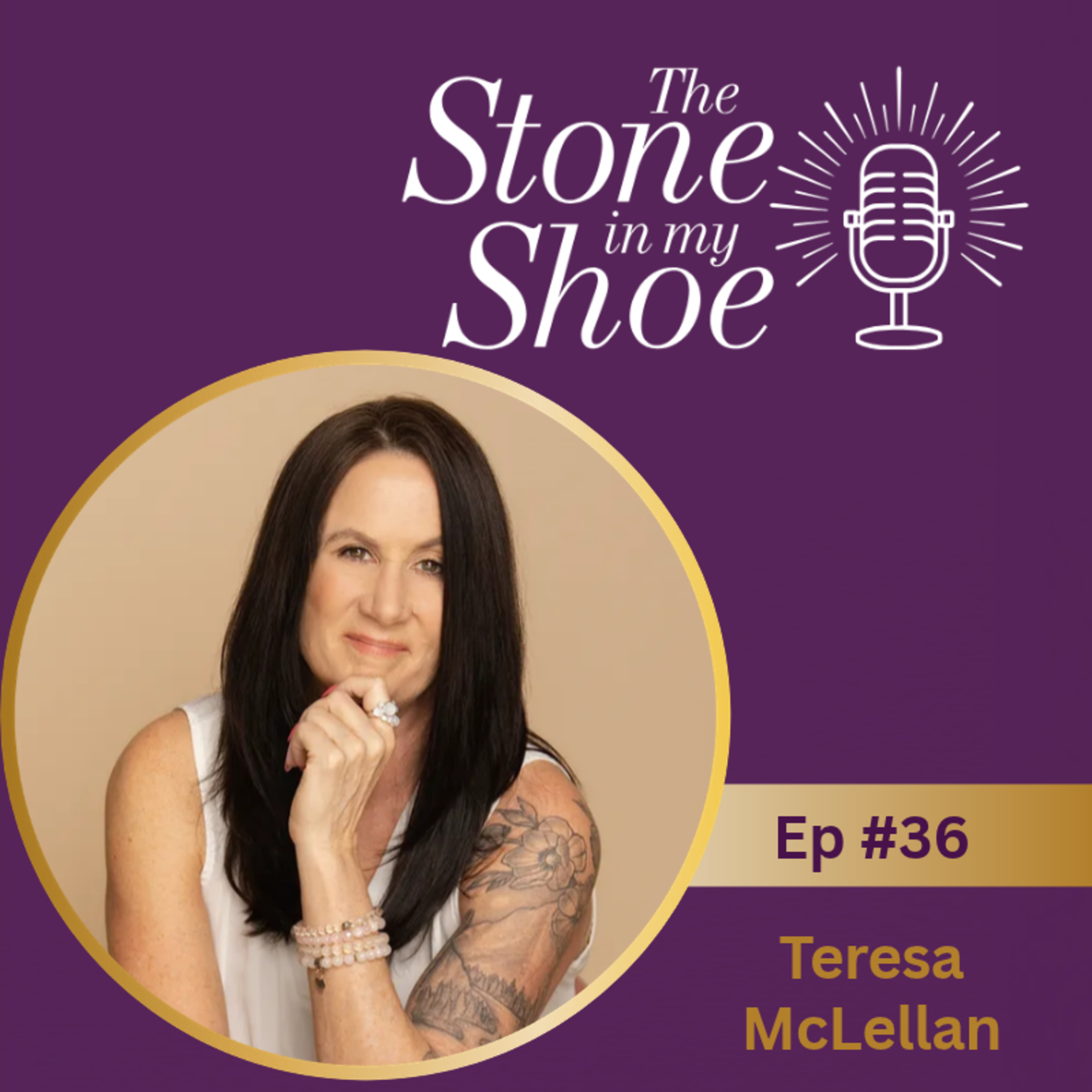
The Podcast · 23 October 2026 · 40 min
Self-worth: why you feel like you don't matter | Teresa McLellan
Content note: this episode includes a discussion of sexual abuse, self-harm and suicidal thoughts.
Listen to this episode
Chapters: tap one to jump to it
Why do you feel like you don't matter, even when you give so much? Self-worth can be shaped very early, and it can follow us into the way we love, give and make ourselves smaller.
In this episode of The Stone in My Shoe, Debbie speaks with Teresa McLellan, a trauma therapist, somatic practitioner, university professor, co-author of three books and speaker. Teresa names the Stone she carried for years: the belief that she didn't matter. She talks about learning to be the good girl, quiet and smiling, as a way to feel safe and loved, and how small decisions slowly began to change the direction of her life.
Their conversation moves through people pleasing, self-abandonment and emotional healing, and what it can mean to give love to everyone else while finding it hard to receive any yourself. Teresa speaks openly about how childhood trauma can shape what we believe about ourselves, about becoming pregnant at 19, and about the practices that supported her healing, including mindful self-compassion, meditation, journaling and time in nature. She also shares what her daughter remembers about those years, and why it wasn't what she expected.
Throughout, Teresa talks about authenticity and personal growth in plain, human terms, and about finding the courage to follow your own compass.
What you will hear
Why feeling like you don't matter can feel like identity rather than a belief
How people pleasing can begin as a way to feel safe and loved
Why giving everything to others can lead to self-abandonment, and why receiving can feel so hard
How small decisions, one degree at a time, can change what you believe you deserve
How mindful self-compassion, meditation, journaling and nature supported Teresa's emotional healing
What her daughter remembers about her childhood, and why presence mattered more than money
If you've been wondering why you feel like you don't matter, or whether you're allowed to include yourself too, this conversation offers a gentle place to begin: with curiosity and compassion rather than judgement.
Read the full transcript
Yes. And I think that some of the stuff that helped later really was receiving that love, because I think the idea again, and I think I even had this then at the time, it's like, I'm not supposed to get the love for my children. That's not supposed to be, I'm supposed to give it to them. So it was very one-sided. So I wasn't receiving. And I think that again, those beliefs really blocked my ability to actually receive it. I don't know that there was a lot of it other than my children anyway in the beginning. But for a long time, even when I had access to it, it was really hard to receive care, to receive positive feedback and support. I did a lot on my own. I did most on my own.
Hi, I'm Debbie Thompson, and this is the Stone in My Shoes podcast. Like a stone in your shoe, we all carry things that quietly shape the way we walk through life. Through honest conversations and powerful stories, we discover the wisdom that helps us understand ourselves and walk a little more freely. And today we're going to be talking about why you make yourself smaller, accommodating or low maintenance. Not because anyone told you to, because somewhere very early you understood that it kept you safe and made you lovable. We'll talk about what happens when you choose yourself and how it changes how you authentically show up and live. And my guest today I'm delighted to introduce is Theresa McClellan. She's a trauma therapist,
somatic practitioner, university professor, co-author of three books, and speaker. Wow! Her work explores the intersection of psychology, neuroscience, somatic approaches, and ancient wisdom traditions, with a particular focus on authenticity, wholeness, trauma healing, and personal growth. Theresa shares her personal story that honors the complexity of healing while offering hope that our deepest wounds can become the foundation for growth, authenticity, and transformation. She's also a mother and grandmother. Theresa, welcome to the Stone in My Shoe podcast.
Hi, thanks Debbie. Thanks for having me. Oh, it's a pleasure. Before we begin, I'd just like to ground this for the woman who's listening. What do you hope she takes away from your story today? You think the biggest thing, the biggest message really is that there's hope, no matter what you've lived, no matter what struggles you've had, no matter how extensive the trauma or difficulties that healing is possible, that change is possible, that really living is possible? And that's a beautiful one, Hope, because it's something that all of us can understand. And I'd like to, we will go into that a little bit in a little bit more detail,
because it sounds, it is so profound, and it sounds so simple. And yet, there is so many complexities around that make it more challenging than we think, because it sounds so simple, doesn't it? Yes. And I hadn't always had it. So, I know that people who may have experienced some of life like I did are probably in those places where it's a lot further away. And what is hope, if you had to describe hope, how would you describe that? Oh, that's a good question. I think for me, it's really something to hold onto, and maybe even in some way, something to live for, that things are possible, that change is possible, that it doesn't have to be this way
forever. And it's a big one, isn't it? Because once you start thinking about change as possible, and then you think authenticity and peace and love, and there's so many things that ripple out from hope. Yes. Yeah. And I think initially, I didn't think of those things, it was just, I don't want to be here, I don't want to do this, I don't want to feel this way. So, if change is possible, I can start moving in that direction. All those other things are possible. Yeah, beautiful. Possibility. I like that. So, who are you in this season of your life and what feels the most important to you right now? Oh, there's a lot that I'm living today that I never dreamed possible.
And it's not the big stuff. I had hoped I would own a house and have this really fancy relationship in all these big material things. And I feel like what's happening in my life today is I get to really be present. And it is currently filled with so much love and so much joy. That is what is the exact opposite of what I grew up with. So, being a grandma is probably the biggest part of that. My grandchildren are three and a half in six months. And so, the play, the freedom and play that I get to do today is almost like repair and healing in and of itself. So, that's huge. Being able to be there for my daughter while she's parenting, I didn't have a
lot of support raising my children. But the other really speaks to, I did this work, I started on this journey when I became a mom for my children so they didn't have to grow up like I did. So, to now have this sort of coming full circle with my grandchildren is beyond my wildest dreams. And I guess when you started on this journey when you had your children, it was the learning stuff. And now, you've got the wisdom of that plus the knowledge and embodying this. So, it just sounds like it's almost supercharged what you can give back to your grandchildren. Yes. And what they give back to me. I was just about to say that. Yes. And I think I have a psychology degree. So, whenever I see what they're doing, it's like,
I understand the Child Psychology textbook but it's alive in front of me and it is completely embodied inside of me because there's the exchange, the exchange of life and love. Yes. And I think that's so important the embodiment because so many people listen to podcasts, read books, but there is it's knowledge, but that knowledge has to become part of you. You have to live it, you have to feel it. And I think for me especially, when I first started on this journey, I did a lot of reading and nothing really changed. And I realized I had to stop the reading and start living and embodying it because that's where the magic is. Yes. And I think for me again, the learning,
the reading, it gave me a foundation to live. Again, most of it started with parenting and her child work and then starting into psychology because I just had nothing to draw on. I feel like I was just, that was really what the message is. I felt like I was nothing and I had nothing. Therefore, I could do nothing. So I had to learn how to do that. And then it grew from there. Yeah. And it's just like any little seed, right? It grows and you never know what branches come up, what, what, when it flowers. And this is the wonderful thing about the journey, right? Yes. I just wanted to be a good mom. That was all I wanted when I was with my son and it has become so much more than that. I will definitely go into that because that is a,
it's just a beautiful thing. I want to be, did you say a beautiful mom? I want to be a good mom. Just a good mom. It was very simple. Yes. Amazing. And how many of us feel that as well? So we're going to, we're here to talk about the stone in the shoe. So if you could name the stone or maybe just describe it, what would it be? I think it's corn. I think there's many of them. I think I came across many of them, but I think they're all different flavors or maybe even different shards or fragments of the same one was worthlessness. Just, I don't matter. Nobody cares. I'm not important. And then that sort of, I don't even deserve to live. There was a real core of that.
Thank you for naming that because a lot of people, it's hard to actually put words into it. And I'm sure at the time it was difficult to understand, but now you can look back. So let's take you back to how this, this belief in yourself, because it was only a belief. It wasn't the truth, came about and how this stone kept getting compounded and compounded and the story of how you saw yourself got stronger and stronger. Can you just take us through that journey? It's a long journey because it starts at the very beginning. I'm 57, but I think part of it was, is it's just always been there. So I think even before it, it just has always been like identity rather than belief. It was just this experience. And I don't have a lot of really concrete
ideas or memories about growing up really young, but there was just always this sense that something bad was going to happen, that it was very unpredictable and chaotic. And I don't recall anyone telling me it was going to be okay. I don't recall any kind of comfort and nurturing in that emotional sense. So with that feeling that, so in our identity, that something is not, things are not safe, they're unpredictable, and feeling alone without this comfort, what did you start believing about, because you talked about what you believed about yourself that you were unworthy, you didn't belong,
you didn't, but what did you start believing about others in the world and where you saw yourself in that? I always felt different. So I have a history of sexual abuse as well, but this stuff started even before that. But I think that was really where it's like, what's wrong with me? What have I done? Why is this happening to me? I think in some ways there was those sort of threads. Why won't they love me? Why can't I get it right? It showed up in how I was doing school, even I tried really hard to get it all right and to be really good and it was just never good enough. So there was always that lacking sensation. And then of course, when I compared myself to others that was, other people seem to be getting it or figuring it out. I don't think that was as
concrete in my mind at the time. And so how did that play out? Because you wanted to belong, you wanted to do well, you wanted to show up and do the right things to be loved. So how did this shape how you showed up as a person? So I think initially for a long time, probably even the first maybe 10 to 12 years or so, it was like being a good girl. So it was also brought up Catholic. So there was a lot of ideas about what good was. And even within a lot of sexual abuse in my family, the idea of honor your father and mother seemed really confusing. But again, respecting your elders, not talking back, being quiet, putting on a happy face, pretending
everything's okay, doing what you were told, those were really the messages and the behavior. It was like, this is what I need to do. To be a good girl. And a girl to be liked, to be been safe, even though it didn't work. Yeah. And pretending, because it's the opposite of authenticity, which is highest power. So there's this, we naturally come into this world as these pure beings who want to be authentic. And then you're told that actually to be lovable and to fit into this world, you have to do the opposite of that and pretend. Yes. And as a young child, that's too difficult to put the two together. Yes. So you as a young child, you were the good girl. And then you weren't getting
the feedback wasn't you weren't getting what you were looking for. So that wasn't working. So how did you react? Did you change from the good going into something else? Yes. Not sure it was necessarily a choice like that. But I think along the way it was this, I don't even think it was as conscious as this isn't working anymore. But as I got to be, I started drinking when I was still a blurry, but 10, 11, 12 was starting to fit in with peers. So trying to belong. So it was definitely not so much as do what you're told with family and authority, but it's how do I fit in with the crowd. And for some reason, the crowd that I
wanted to fit in with were the ones that were already drinking and smoking. So that was really where it turned. By the time I was 12 years old, I was blackout drinking. I got kicked out of school in grade eight. I was smoking and then smoking pot. And that just took off. And so the sort of good girl got quite lost. And how did that work with the Catholic family where you don't talk about pretending everything's okay? That unfortunately was a big part of my family to begin with. And I think these really mixed messages that what I was getting at home, what was happening out in public, what was happening in the church, I also went to a private school. And so the messages were so mixed and so confusing that I think it just it distorted
so much. And even then it's like, you're not supposed to do these things, but everyone else is doing these things. So how come they're wrong? I don't understand. Confusion was a huge part of my experience. And there's no North Star, is there? There's no guiding light. It's scattered. Yeah. And everybody's got a different message. And if you don't feel one of your core beliefs is you're worthy being here. That must have been a very confusing place internally, but also externally. Where do I go? What do I do? How do I, I don't like this, but how do I change it? Because it almost sounds to me like there's so much noise. Yes, there was a lot of noise. So what happened after that? I think some looking at, was there a point where things were so bad?
Well, the stone was that sharp that you had to change? Or was it a series of events? There was a couple, because I think I started when I was about 18. It was kind of like, because it got worse. I was suicidal, self-harm, dropped out of high school. But it was like, is this really it? Is this the end? I was just, I can't even kill myself. So what's the point? It just felt like I had failed at everything. And there was just this almost like a restlessness. Is that really it? It almost felt like it was this huge question to the universe of, I wouldn't have known that at the time, but it was kind of like, this can't be it. And I started, I actually went to adult children of alcoholics because it felt because my family had
alcoholism. It was kind of like, maybe that's my answer. I wasn't looking yet at my own substance use. I wasn't looking at any of this sexual abuse. But so I would, there was certainly a searching, a questioning, not necessarily knowing what to do with it yet. But there was, yeah, there was some kind of rumbling. Your intuition going, see me. Yes. And then I got pregnant. So at 19, I got pregnant and that, that was the trajectory that totally changed my life. Okay, because that's when you said you wanted to be a good mum. Yes. And I was willing to do whatever it took to get there. And I knew I needed to be sober to do it. Now that sounds very easy to go, here I am. And this is where I want to be. But I can't imagine
that journey was not as straightforward as it sounds. And there was obviously something very deep in you to go, there is something more and I'm going to, and the, the pregnancy was the impetus to make this happen fast. Can you talk me through that process of where you were to, and not the finished product, because obviously it's all a journey, but that initial step, because that's often the hardest to take that first step. And then so can you just, yeah, I'm curious about that. I don't know if that I can fully explain it because it still feels so mysterious, like it really does feel like it was bigger than me. And yet I just, I knew it was just this knowing that I needed, that this child needed me. And I needed to do whatever it took to give him,
my son was born first, what the life I didn't have. So it was like determination. And I'd lost a lot of that. I had a lot of fight me throughout my substance use and a lot of anger. And I tried a lot. I wasn't very motivated because I had so much discouragement in me. So this was very, it was a very different experience inside my body. So that is you said, the life experience that you had, give you the strength and this resilience and having being pregnant with the motivation. What did you do? Did you see a counselor? Did you read books? How did you know to be a good mom? Or the process of? Yeah, and it was all of that. Initially, it was, I knew I needed to be sober. And so I started, and I think again, my partner
at the time, boyfriend at the time, was well deep into his own addiction. So I started with 12 step programs, Alcoholics Anonymous, Alenon. I started some counseling right away. It felt like it was easy to stop drinking and to step away from substances, although I spun around to it a few different times and it wasn't so easy. But it was about making that same decision. That's not what I want. That's not what I want for my kids. I think the substances were a huge part of the chaos of growing up in my home. Not the whole picture, but certainly a big part of it. Yeah, sorry. I'm just saying, gosh, that guiding light, that North Star of your baby growing inside of you, that is really profound, isn't it? Because I'm sure coming off,
I've never been addicted, but I read about it and I've listened to it. But it's a big thing to come off. It's not as easy. I'm not going to put labels on it. But I just, I feel this amazing sense of this North Star just pulling you on and guiding you and shining that light in the really, and I'm sure there were dark times. Yes, yes. And I now understand that guiding light a lot better in terms of spirituality. And I did a lot of sort of depth psychology. So even just the great mother archetype, there was someone holding me, guiding me that I still felt like I was alone. I still felt like I was alone, but there was something in me that was just driving me to do it different. And I think even in that it was like that it was, I had to do
this. It was like a lifeline. And I think in some ways I was afraid of failing at that too. It was just, there's lots of layers to it for sure. And so you got to that your son was born. And that process was probably just the beginning, wasn't it, of this new. Yes. And taking that first step was having your son, there is a guiding light, so to speak, was amazing. What kept you going? And where did this journey take you? So I think the wanting to be a good mom was always kind of that compass I got into. So again, my partner and I split up, so I was on my own. We got back together again. I had
very sort of tumultuous relationships, very inconsistent relationships, very unhealthy and dysfunctional relationships. And it was always, this isn't what I want. This isn't what I want. This isn't what I want. I don't think I really knew what I did want, but I was getting clear about what I didn't want when I was in it, not enough to prevent it from happening. So every time I found myself there, again, it was like, okay, this isn't what I want. What do I need to do instead? And so again, it was counseling. It was meetings for a long time. It was parenting courses. I mean, I don't think there was any podcasts back then, but yeah, books. A lot of the books that I read really were parenting from the inside out. So it was like I was re-parenting me and doing a lot of inner child work while I was learning how to be a mom.
I did psychology quite a few years later and I really wish I had a psychology degree while raising children. But yeah, we all, figuring it out as I went, the parenting, the life, the family, the relationships. And so as you were going through this process, and as you said, you were parenting yourself while you were parenting your children, what did your belief, what did you start believing? Could you flip this one of, I'm not worthy, nobody cares? And if you did flip it, what did you flip it to? I think it took a long time for that to be the shift. The focus really was on doing it for my kids because they were worthy, because they were lovable,
because they were important. And I think even the struggles that I had in relationships, the struggles that I was still having with my family, I was starting to get memories. Once I was sober, I started getting memories of sexual abuse. And so just those, I still held a lot of shame around my substance use. So those just stayed in the background while I tried so hard to be a good mom. They didn't touch the underlying stuff, even though on the outside and in the surface, I was changing all these things. And I was doing from the outside looking in so well in many ways. But it never felt like that on the inside. Not even a little bit of a shift on the inside. It all felt very external. Interesting, hey. The love I had for my kids,
I think there was like medicine happening inside of me, that it was working from the inside out, but it wasn't conscious. And it was probably love just permeating through you. And it was eventually going to come up into the conscious mind, right? Yes. Yes. And I think that some of the stuff that helped later, it really was receiving that love. Because I think the idea again, and I think I even had this then at the time, it's like, I'm not supposed to get the love for my children. That's not supposed to be, I'm supposed to give it to them. So it was very one-sided. So it wasn't receiving. And I think that again, those beliefs really blocked my ability to actually receive it. I don't know that there was a lot of it other than my children anyway in the beginning. But for a long time, even when I had access to
it, it was really hard to receive care, to receive positive feedback and support. I did a lot on my own. I did most on my own. And this is the thing, it's so multi-layered, isn't it? And for so many people out there looking at someone else's life, oh my God, look, they've got it all together. And but underneath, as you were saying, you were living the one side, looked like something else and something else was different was happening internally. At what point, and it's never one point, I guess, because you're really doing some amazing work here. You're working on all these things. You've got this guiding light, you've done your psychology, you've really understood about trauma and how it affects us
and in a child and all these things. At what point did that armor start cracking so it could be released and new narratives coming? I love how you said the cracks because I think that's really what happened. Again, it was these small decisions. And I think it started with I'm not going to do that, I'm not going to do that, I'm not going to do that. So ending relationships, leaving jobs, like the transition between I'm not going to do that this is what I want, this is what I deserve, this is important for me. And I'm not sure I can really even pinpoint that one decision where it was this massive turning point, but it was like
turning, it's almost like again, when you have a, you're turning one degree at a time, you don't really realize when you've done the 180, right? Yeah. Yeah. And that's the thing, isn't it? It's the 1% today. It's, and what I'm hearing from your story is the consistency. It's the commitment, being curious first, then the commitment, the courage to keep going, being compassionate to yourself when you fall off the wagon, and just consistency. And it was the 1% today, the one degree, and then suddenly you're facing the other way. Yeah. And I did take a mindful self-compassion course with, Kristin Neff didn't teach it, but Chris Germer and Kristin Neff, and that was significant for me in terms of, because it was an embodied experience, it wasn't just a learned experience, it was
experienced and practiced. So that was definitely one of those game changers. And then a lot of the trainings that I did as I got further along in my career, as I got my master's degree and did a lot of the trauma work, I was practicing it. It was experiential. I was, so those were some of the pieces too, where it was like unlayering or detangling, dismantling all of those deeper core structures. But definitely was the embodied experiences that started to crack it open. Yeah. And just reading through your bio as well, it's not only have you got your, is it a university professor, but the fact that you're looking at psychology, neuroscience, somatic approaches, ancient wisdom techniques. So you're just not just taking the
conscious, you're taking the subconscious and then the super conscious and bringing them all together, which is, but you can't go to this, the subconscious is always there, our intuition, whatever you want to call it. But listening to it when you're stuck in this place of fear and judgment is very difficult to see. Yeah. Yeah. But unraveling it all, you get to that point. And so you were going through this enormous journey of change and how did your children, I don't know if you've asked them, how they saw how you changed and what it meant, because I'm intrigued to see what your family thought and what your children thought of this transformation. Is it a transformation or I think it's reclaiming who you were, not a transformation. Yeah. So I haven't necessarily asked what my kids thought about that,
but I know that since my daughter has become among, we've had some of these conversations about how she experienced growing up, which again, some of her memories, these little moments, the ways in which I made it special were certainly not financially extravagant, but emotionally very much about living. And I don't know that I realized that because I think I had so much shame in not having any money and not being able to provide for them like the other families did. Those were again the evidences that I wasn't worthy, right? But the things that she remembers, the things that they remember, really are about presence.
And I don't think I really realized how valuable and precious that was. All the other stuff wasn't available. And that goes back to what you said at the beginning. What was most important to you is being the present love and the joy. And you were doing this all to them. Yes, I think we should try. Really in your cup up with this, maybe externally doing it to eventually be able to receive it. Yes. Yes. Yeah. Some of the work that I do with clients too, it's like very usually, very compassionate, very intuitive, very kind, very generous. They just haven't considered themselves. So by the time it really was, it's like, oh, I've been doing the mothering and the nurturing. This has been
such a huge part of my life. Can I just now include me too? It wasn't a huge shift. It was internally a huge shift, but in terms of the practices. And so making time for the things that mattered to me. Usually the stuff I did with my kids was stuff that mattered to me so that I could have joy, meditation, journaling, nature. Those things again were very important in my ability to breathe more deeply. I totally resonate with that. For me, meditation and nature are my two go to places. And it's amazing how I can shift 180 degrees this thought pattern, whatever. And then you, nature has this amazing way of just calming
your central nervous system and focusing on what it just love, joy, presence, beautiful new set of glasses. You just get put on straight away. Yeah. And how did your family, you were growing into this authentically, this person who was authentically being yourself with courage and wisdom and love and joy. How did they receive it and how was that for you? I'm not even sure if I know how to describe how they received it, but it was very difficult to be that growing and changing person with my family. So I eventually grew apart and made some very tough decisions to walk away. Yeah.
And the thing is, you have to protect yourself. And some of these decisions are hard, but putting yourself first in your healing first is really, have you managed to go back to them or is there, and so you don't have to answer this question if you don't want to? Yeah. No, I have not. And so now that these cracks have come and this slow release of this new view of yourself came through, it wasn't one big thing. How do you view yourself now? You had some rules before about being good about respecting others,
the rules that kept them in your world. I'm curious about how you see yourself now and what your guiding principles are. So I think some of the spiritual work I've done in just getting connected with consciousness, the universe, the cosmos, nature has been a big part of that connected to the land. And some of that I got Celtic background, so that has always been really meaningful. So this idea that I'm part of the whole that my presence matters, right? That I'm one with it all has been, I think that's the stuff that started
to seep into those cracks. That is the, we sound like woo-woo and fluffy, but it was like that's the meaningful stuff. So I've done a lot of different sort of Buddhism, shamanism, plant medicine, indigenous practices, like lots, yoga, energy healing, just, and so all of it started to say very similar things, right? I am the soul, the spiritual being living a human physical material world. And then so how do I be that, that presence? And that sort of fits again with the idea of I am love and love in and of itself is medicine and divinity.
Well, I'm just hearing this deep sense of being held and supported and knowing the fact that you're alive is just a miracle. And knowing that you're meant to be here, your, your souls, but it's not just meant to be here. You've got everybody supporting you, which was so different from when you first grew up, where you, you were on your own and had to make sense of all these conflicting and actually quite dark and sinister rules that we had to live by. And so all these, these cracks, it just sounds like it's just filled up with this, this beautiful, you almost see a triple of water going into this, this rock that's had these cracks and it's, and it's just full
of this lovely cool water. And so moving, like living your true purpose, your sole purpose, what does that look like going forward? I think it keeps changing. I think, again, this unfolding, unraveling, dismantling, and again, what is underneath that. So I've been doing a lot of writing. It really has been this year that I've written three chapters. So I've co-authored three different books, The Rise of the Self-led Woman, The Architecture of Survival, The End of Self-Abandonment. I'm just submitted another chapter on Breaking Cycles, which again, The Inheritance of Silence. And then I'm currently working on another full book,
hopefully to be out this year. But it feels important that, that my life, I remember being in psychology, right, and reading the Child Psychopathology textbooks and it's, I shouldn't be alive. Never mind thriving. Given the statistics, given what's happening to women and young girls, that, again, the, it just, so it's like, this needs to be shared, this needs to be known, this needs to be seen, this needs to be heard. It just feels like it's pulsing through me. And giving a voice to these shameful things that are not supposed to be talked about. And knowing that you're not alone in this. And I suppose it takes a shame away that
it's not you, it's not, it's the stuff that happened to you and the stories that you made up to keep yourself safe. And that knowledge is so important and empowering for people, isn't it? And it's beginning of the unraveling journey. Yes. Yes. The crack on the stone, isn't it? It's the first hammer. Yeah. Yeah. Even just recognizing that, oh, that was stone, right? That was, that was, again, this covering that wasn't me. That's not true. Those, I think, were some real moments. It's like, what, you mean that's not true? Then what does that mean about me? That's not true. That's incredibly empowering. And I think that the work you do is so important
and getting it out to the world. And also what I love is the way you see it is not just from a very cerebral academic point of view. It's a very holistic. You've almost come 360 degrees. And now the information can flow through you. So it's, is that much more powerful? Yes. Yeah. Beautiful. So before we finish, I just wanted to speak directly to the woman who's listening to this podcast. If she remembers only one thing from your story today, what do you hope she takes with her? You are more than your experience. You are more than what they told you. You are more than what you have believed about yourself. That's very powerful. And is
anything else you would like to add before we finish? I think maybe just that there's so many different ways to heal. I've taken a very sort of non-traditional approach to healing and I've tried all kinds of different stuff, mostly just because I couldn't afford it in the beginning. So it really is, follow your heart, follow your joy, follow those gut instincts, even if they don't make logical sense, but being able to follow your nor star, your compass, whatever that is. Yeah, that's very fun. And the fact that there's not one thing for everybody. No. And but you will know if you listen, your gut will tell you that you're doing the right thing. And if it's not, that's okay. You've learned something. Nobody's failed. It's just some more information like you said earlier. This is not what I want. Yeah. And the more you do it, this is not
what I'm on. The more what you want becomes clearer. Yes. Yeah. Yeah. Yeah. Thank you so much for sharing your time and wisdom today and for just being so open and honest and vulnerable. Thank you. Thank you. Welcome. So as you finish listening today, perhaps there was a moment when you recognize something in yourself. And if there was, stay curious, because sometimes listening to someone else's story helps you see your own. And if you're curious about the stone in your own shoe, there's some resources on the website. And if you would like to connect with Theresa, all her work and all her links are in the show notes below. Thank you very much for listening.
Want to know what your Stone could be?
Take the free reflectionKeep listening
 Choosing Yourself Over Belonging | Ramona Kossowan on Identity, People Pleasing & Finding Yourself6 August 2026
 Self-Abandonment: When Your Perfect Life Stops Feeling Like Yours | Kim Costa28 September 2026
 I Had to Stop Abandoning Myself | Claira J on Mother Wounds, Self-Worth & Finding Your Voice17 August 2026