
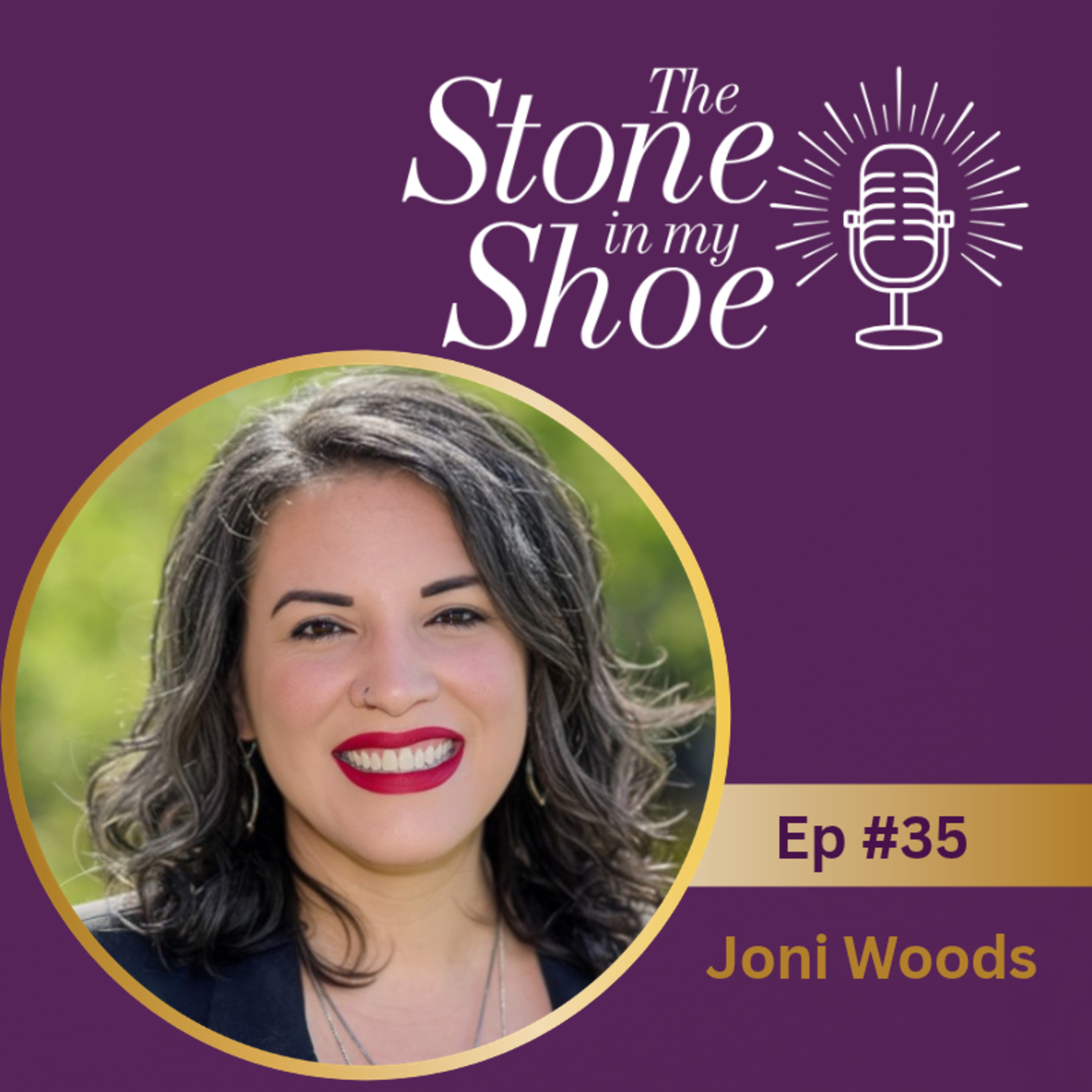
The Podcast · 19 October 2026 · 42 min
People Pleasing: When Love Feels Like Something You Have to Earn | Joni Woods
Listen to this episode
Chapters: tap one to jump to it
Have you spent years trying to earn love by being good, agreeable and easy to be around? People pleasing can begin so early that we mistake it for who we are.
In this episode of The Stone in My Shoe, Debbie Thompson speaks with Joni Woods, a human connection and culture specialist, speaker, author and coach who spent nearly 20 years in ministry. Joni grew up believing that love meant obedience and expectations, and she spent decades checking things off a list that kept changing. Her story moves from a childhood spent keeping the peace between her parents, through years of trying to meet other people's ideas of what a good woman looks like, to the moment she saw that she could never earn the love she was working for.
Their conversation looks at how self-abandonment can look like kindness from the outside. Joni explains how obedience taught her to say yes to everything, why healthy boundaries became so hard to set, and what it took to rebuild her life after divorce, from working several jobs to buying her own home. Journaling helped her pull apart what she'd been told from what she was actually experiencing, and it became the beginning of her first book, Burned, Blocked & Better Than Ever. Along the way she shares what resilience, self-worth and authenticity mean to her, and how she gives herself grace when she falls short. Choosing who she wants to be, every day, is a piece of personal growth she returns to again and again.
How people pleasing can begin in childhood, when being good means keeping the peace between the adults around us
Why obedience can quietly teach us to say yes to everything, and why boundaries become so hard to set
How the relationship patterns we inherit can shape what we believe about love and self-worth, and what healthy relationships might look like
The moment Joni saw she could never earn love by trying harder, and the question about her children that helped her choose differently
Divorce recovery in real life: working several jobs, sleeping in her car for a few days, and finally buying her own home
How writing everything down helped her tell the difference between what she'd been told and what she was living
If you've been quietly wondering whose rules you've been living by, or why saying no feels so hard, this conversation may be a gentle place to begin.
Read the full transcript
I would have described it as I associated love with obedience and expectations and so I kept playing a role assuming that I would receive this love and this acceptance and this just genuine experience but I never did. I constantly tried to listen to what was being expected of me and then thinking I was checking it off, checking it off, checking it off and it wasn't happening and so my definition of love became very much what other people told me I was doing right
or I was doing wrong. Hi I'm Debbie Thompson and this is a Stone in My Shoe podcast. Like a stone in our shoes we all carry things that quietly shape the way we walk through life. Through honest conversations and powerful stories we discover the wisdom that helps us understand ourselves and walk a little more freely. Today we're going to talk about the difference between kindness and self-abandonment and how they can look exactly the same from the outside. My guest, Joni Woods, spent years being the understanding one, the forgiving one, the patient, the easy one to have around. She'd had called it kindness and some of it was
but some of it was her quietly disappearing. We'll talk about what this being kind cost her and what finally hurt enough to make her stop and what it took her to find a way back. If people describe you as easygoing and you're quietly worn out this one's for you. My guest today is Joni Woods and she's a human connection and culture specialist, a speaker, author and coach whose work explores the invisible beliefs that shape the way we lead, work, love and understand our own self-worth. After nearly 20 years in ministry and a career spanning hospitality, leadership, recruitment and workplace culture, Joni began
examining the patterns we inherit and what happens when they stop serving us. She is the author of two books, Burnt, Blocked and Better Than Ever and a forthcoming one, Workplace Wounds, How Our First Jobs Quietly Shape The Way We Lead, Work and Trust. Through her work, Speaking, Writing, Coaching and Research, Joni helps people recognize the difference between compassion and self-abandonment, question the blueprints they inherited and build healthier ways of relating to themselves and others. Joni, welcome to the Stone in My Shoe podcast. Hi, thank you for having me. It's lovely to have you and being in ministry for 20 years, there's a lot of stuff going on here, a lot of human experience.
Yes, so much. I've spent a lot of time with youth and young adults that has just been where I grew up and ministered and stayed with. Amazing and can't wait to go into that. But before we begin, I'd love to ground this for the person who's listening. What do you hope she takes away from your story today? Honestly, I think the biggest thing that I want to tell people through my story every time I get to share it is you get to choose who you want to be and then you get to do it every day. I have, I spent a lot of time talking about blueprints and how we were told who we were supposed to be. But once you get that opportunity to choose, you get to do it every day
and you get to feel proud about how you show up in that choice and it's beautiful and it's fun and it's sometimes it feels great and sometimes you're like, oh, I could have done better. Yeah, that's a good one. The fact that you choose and you choose every day. So if things haven't gone that well, you can choose actually in the next moment, in the next minutes, hours, days and that's actually very powerful. Yeah, I enjoy it because it really makes you aware of how you make in-moment decisions when you're constantly doing this practice of choosing. For me, I want to be known as someone who is full of love and kindness, no matter the situation. I'm going to lean with love and
kindness. And so when I come across hardships, I'm like, okay, how am I making this choice? And sometimes I don't do it. Great. Sometimes I'm like, oh, I could have done it better. And it's not because someone told me I should have done it better. It's because what I, who I want to be and how I want to show up in people's lives and their experiences with me, that means I get to say, oh, I could have done it a little bit better here. Which is lovely as well, because it's an opportunity for growth because we never get there. It's always growth. And I'm sure when you first started this process to now, there were so many more times when you do hit the mark rather than not. And do we ever hit the mark completely? I don't know.
No. And I think for me, what was so empowering with that was it became less about whether or not I was hitting someone else's standard or whether or not I was still, I was hitting where I wanted to be. And then I could grow a little bit more. When I'm angry and frustrated, it may have been a little lower years ago where now it's a little bit higher because I've practiced this over and I've continued to say, okay, I can give just a little bit more grace or a little bit more understanding. And it's less about whether or not I hit someone else's expectation or standard of what they believed I should be, but rather what I was capable in that moment. And it's so freeing and just so wonderful.
Yeah, I love those two words that you use, you know, to practice and to choose. It's the one percent. It's the little things that are done consistently every day. And that's where the magic is. It's not some magic thing you do once it's the little things repeated again and the compassion that you give yourself along the way. So before we go into the stone, I'd love to find out a little bit more about you and who are you in this season of your life and what matters most to you now. Oh, the season of my life. I'm actually finding that I'm coming back to a little bit more of my roots in the sense of trusting what I believed to be me. So for a long time,
I was living through other people's standards and visions and what they believed in me. And so I just abandoned like my instinct and my gut and what I knew was who I was. And now I'm able to, because the season is a lot of, not even transition, but just like building. I'm building my speaking. I'm building a second book. I'm building my brand. And it's just this exciting spot where I'm like, okay, I'm going to stop listening to what other people tell me that I'm supposed to be doing because I had someone sit me down about a month ago. And they were like, you're not doing your business right. And I was like, cool. Thanks. And he was
just like, you need to do this and you need to do that. And it took a good 12 to 24 hours before I was just like, you know what? I appreciate it. Thank you so much for trying to invest in me. But I'm not trying to be you. I'm trying to be me. And I get to be me. And when every time I make that choice, I just feel so rewarded in what's happening in the conversations and the growth that I'm seeing that I'm like, yeah, I made the right choice. So that's who I am right now is leaning back into my gut and into my own personal intuition and into my strengths. And I'm excited for it. Yeah, I think the whole thing about intuition and trust in your garden, being
you, your authentic you, who you're supposed to be, not who you think you be, not what a society expects, not what your conditioning says, but authentically who you are. That's a very exciting and powerful place to be in. Yeah, it's very exciting. Beautiful. So let's go to the stone in your shoe. And we all have many of them. I think the one you wanted to talk to about today is about love and what love looks like. It looks like to describe that stone. How would you describe it? I would have described it as I associated love with obedience and expectations. And I so I kept
playing a role, assuming that I would receive this love and this acceptance and this just genuine experience, but I never did. I constantly tried to listen to what was being expected of me and then thinking I was checking it off. And it wasn't happening. And so my definition of love became very much what other people told me I was doing right or I was doing wrong. And that made it really hard to even love myself because at that point, I just felt like I was never going to be good enough for anyone. And so love got wrapped up into what everyone else told me I was supposed to be.
This sounds like love had a checklist. It wasn't even your checklist. It was everybody else's checklist, which is probably also constantly changing and impossible to achieve. So that that is a hard one to have as your framework because I don't know, but you'd constantly fall short or feel like you're falling short or trying to split yourself into 20 different people to achieve everybody else's expectation of what love is. It was so exhausting. And a lot of that came from I grew up in the church environment and then became a youth and young adult pastor. And so for most women who are in faith, understand or know that passage of
the Proverbs 31 woman, and that one is a very hard standard to live by, especially because it becomes interpreted by whoever wants to interpret it. So when I was a single woman, there was a set of rules for what that Proverbs 31 woman looked like. And then when I was a pastor, there was a set of rules that came with what that woman looked like. And then when I got married, married, having children, all of those things, they all measured here. And that that's very difficult to live up to, especially because that target would shift based on whoever was interpreting that. And I spent a good 30 plus years trying to figure out how to live up to those expectations
that were clearly written out. And yes, a beautiful manner in the Word of God, but it came down to a person's interpretation of it. And their interpretation then meant this is their expectation of you. And so that was a huge struggle for a very long time. Yeah. And also, I suppose, being in the church, in the ministry, you are up there, and you're extoning all these, you're up there to show what it actually looks like. But yet, the congregation and their expectations of you would be so vast and so varied. That doesn't matter what you did. You are not going to fulfill theirs, never mind your own. And just from what you said there as well is that it was ever shifting depending on where you were
in your life. So you authentically, the Johnny that you were, had to keep shift shaping for people around you and all for what season in life you were. And gosh, that sounds, it does sound exhausting. It was very exhausting, very exhausting. And not just that is, I guess, trying to reach them, trying to do better, constantly putting yourself under pressure to be a better, I don't know, I'm taking this, but to be a better person, to be more like this, to be more like what is expected in the scripture. And then the beating yourself up when you've worked so hard to try and do it. And then you fall short.
Yeah. And it just, unfortunately, the marriage had more personal intentions in his expectations of me. So it was used as leverage. Whereas sometimes you can authentically be like, this is a guiding light. This is something to attain. Whereas, unfortunately, my relationship, my marriage was more like, this is where I get to put you in a box. This is where I get to keep you controlled and in. So recognizing that took a long time, a long time, 15 years of marriage, before I was like, wait a second, like, I just don't feel like what you're saying versus
what I believe should be said lines up. And so because of that, that's where you start to get the freedom to be like, oh, question that. And you're not going to like that. I'm questioning it. Whenever the dawn's changes, someone's feet get trod on, don't they? Very true. So just going back to, to those beliefs, but when you were little and being loved, was there a set of rules like being a good person or being kind or being easy going? Did you have a narrative in a script that you lived like, okay, this makes me lovable? Very much. That happened a lot with my father. He, he really wanted daddy's little girl. Like,
for him, he grew up in a family of six. So he was the second to last. And then the, the baby was my aunt. And everyone in the family knew that she was just different. She was daddy's little girl to my grandpa. And that changed the dynamic for the other five siblings. They all watched my grandfather treat my aunt like she was just the best thing in the entire world. And there was this like intimate connection between them because he just loved her. He adored her. And so my father wanted that because for him, he wasn't, and the
rest of his siblings, he wasn't loved as much as she was. And so he in his mind was like, I can't wait to have a little girl that I can love and adore and just do it on and that kind of thing. And so then when I was born, that I was the first born, and that became my role was I was supposed to be daddy's little girl. And so to do that meant he was constantly guiding me in a way that made him feel like a good father. And so I couldn't be upset. If I was upset, then it became my mom's fault. Johnny, you're, you've done something and Johnny's a bad girl
because of you, not because of me as a father because I'm amazing. And she's my little girl. So it was this constant, I had to be obedient. And if I was obedient, that was because I was good for him. Whereas if I was bad, it was my mother's fault. And so it was this constant line dancing of obedience meant that I was loved and my mother was loved because if I was bad, then suddenly my mom was bad. And that's hard for a little girl to play that role is keeping the peace between your parents crazy. And that's slowly what started to happen. And isn't it so interesting that there's so much generational, there's so many
generational stories and trauma in there. And your dad's intentions were so good because he didn't feel loved. So he wanted to love you so much. And yet with the good intentions, without really understanding the nuance of it, how that can affect not just you, but your mother and your siblings probably as well. And everybody else. And so that's why it's so important to strip things back and see what they actually look like. Because he was trying to love you the best way he could. Yeah. And that was he was filling a hole on his heart that he just realized he had. Yep. Yep. We all passed these things on, don't we? So there's this little
girl who was lying dancing to her parents and then went into the ministry and had what was expected of her, all these expectations at different times. And I suppose being in the ministry as well, service, forgiveness, sacrifice, obedience, putting that's woven into what goodness means. Yep. It really is. And one of the things that I talk about now specifically, and I used in my TEDx talk is when we give into obedience too much, we sacrifice our own boundaries and we allow things to happen in our life when we should be saying just the simple thing of no, just say no, because obedience has
taught us to say yes all the time regardless. And so we make ourselves smaller, we shrink, we allow things in our lives to happen to us that we wouldn't allow to happen to other people that we care about. But because obedience has trained us to say yes, we no longer are able to set healthy boundaries. And so for me, I'm like boundaries are really important. They're very important and they should be something that we insist on setting, but they're so hard. It's also very hard when you're conditioning and you're wiring and what was put into you is this is what's expected. And as a young child, you don't know, you take on your parents, your society's set of rules. And often it's only later on, perhaps when something,
the stone gets really uncomfortable. And you're like, I can't walk like this anymore. So there must have, it's never one moment, is it? And that's become a moment or a number of moments when things began to shift. And you were like, no, I need boundaries. This is not who I am. This is something has to change. What did that look like for you? Actually, it really was one moment and not ironically, but my ex-husband and I, we were married for 15 years and we were in therapy for eight of those. So I did, we did the work. I did the work. And one of our last sessions, our therapist was actually literally talking about a bucket full of stones, where it was like, this expectation or this problem and Johnny's
carrying it around. And in even his history and the stuff that he was dealing with, she was trying to get him to recognize that these are things that weigh down in a relationship. And we were in the meeting and my ex-husband looked at our therapist and said 100% of the problems like, and she just kind of looked at him. She was really trying to get him to understand if you're carrying stuff, you're allowing stuff, these stones are weighing down your marriage. And she was like, really? 100%. And he was like, yeah. And she's like, really? He said, okay,
99.9%. And I was just like, cool. There at that point, there was nothing I could do. That to me was, okay, we're done. If you look at our relationship of 15 years, and you say 100% of it has been my fault, and you're not able to own any of it, then there's no way I will ever be able to communicate my needs, my wants, my boundaries, nothing. And that was the end. That is when it just stopped being a viable relationship. And that's a sign, if anything, give me a sign. It's, thank you. That is so easy to read and
not read between the eyes. That is the slap in the face going, Johnny, it's time. Yeah. That was like riding on the wall. You're good to go, girl. Go find your life. And in some ways, thank goodness that happened, because if it was something was, oh no, 70% is her fault, but 30% is mine, you might have given it more, same results. And he just wanted to say that to pretend he was owning something, but not really viscerally owning it. That is a turning point. So at that point, you were okay, it's done. And then what happened? Because now you've got all these thoughts here. You've got this new path potentially unraveling here. How did you feel and what did you do? Once I knew that there was no way I could
earn his love or fix the relationship, anything like that, it just started to become how would I, because again, as a, I spent my entire life in church, youth and young adult pastor, there are very clear rules. You don't get divorced. You don't do any of that. How do I reconcile making a choice that isn't based on anything that would be allowed? The church doesn't tell you're allowed to get divorced because he's not willing to accept any responsibility. They don't, they didn't back then. I think the church has evolved, but back then it was just like either he's cheating on you or beating you. Those were the only options. And so I had to
start changing my mindset of, do I continue to live in this situation that is clearly killing me emotionally? But then the biggest thing is, would I allow my children to be in a situation? And there was a hell no for that. It was just like, if I knew that these counseling appointments were happening for my kids in their marriage, I'd be like, all right, let's all compact your truck. Let's let's get you out of this situation. And that to me was go time, because I didn't want them to learn that being in that kind of relationship was okay. Having is sorry, at this point,
how old were your children? My son was 10 and my daughter was four. They were learning so many horrible relationship principles that I didn't want to have them carry on in their future at all ever. I didn't want my daughter to feel like she had to live up to a standard that she couldn't ever accomplish and then be told it was still her fault. Do you know what's so interesting is this self abandonment we can do to ourselves. But when it's our children, it's like hell no, that's not happening. And yet we are the person, we live in our body, we are the person, and we will do that to ourselves, but we won't do it to
the others we love, which is so interesting, isn't it? But what is so lovely about what you've just said is that those two things gave you the strength because to go, I have to change the narrative. And I know it's probably going to be very difficult for the church, people around me, my family, everyone's going to have an opinion. But I have got to put myself first. And I love the fact that you've got a lot of that courage and strength from your eight and four year old. Yes. Yeah, very much. And I told them from day one, I said, as we started to explain the process, I said, I want you to know two happy homes, because right now what you know is just one really miserable one. So if we split,
then you hopefully will know two very happy homes to fully satisfied adults that are raising hopefully healthy children. So that process of you going, you have years and years of what love looked like, what was expected, et cetera, et cetera. You now have the impetus and the strength and the courage to go through with this. How was that journey and what did it look like? There must have been some challenging parts along the way. Very challenging. It was difficult because I had been a stay-at-home mom. I was a faster wife. You stay at home, you raise the kids. I did odd jobs. I was cleaning houses, whatever I could pick up. So moving into full-time work, I worked at a hospital,
I worked at a bar, and then I kept cleaning houses. So I was constantly working. And then I knew the divorce would be contentious because that's who my ex-husband was. And it was, there were very high highs when I got to buy my own home, like my own home ever. But then there were also very low lows where I had to sleep in my car for three or four days because the way that he manipulated things. So it was a journey where I just kept going. There's going to be something beautiful on the other side. And the beauty of it was when I got to lay on my couch in my brand new home and just be like, oh, this is what freedom feels like. It was just, it was wonderful.
Amazing. And that's the thing with any jumping off any cliff. There's always something to catch. You never just free fall. And you might get a ledge and then another ledge and then nice soft bit of foliage for a while and then another ledge. But you don't fall into the abyss. There's always something there for when you take those first steps. People turn up. You find courage and strength in places in yourself and other people. And it is a journey. And just some of the things that you said, that was hard. What do you think you learned most about yourself during this transition time from extracting yourself to, as you said, sitting
in your lounge room with this amazing feeling of freedom? Yeah. I learned that I was so much more capable than I thought I was because I had been told in my entire life that I needed my dad, that I needed my parents when I moved in with my mom and my step father. There was a bunch of transition that happened where I had to separate myself from them to gain my own independence. However, Max's husband was already there. So when I left their home and they did a bunch of terrible things to me too, he was there. And so he was like my knight in shining armor. And so I had spent a good chunk of my years, my life probably almost
20 years constantly being caught. Like someone was saving me. Someone was coming in and fixing things. And I always felt, and then I was always told, you should be so thankful that I'm here for you, that I'm taking care of you, that I'm doing all these things for you. And this particular transition was just, it was all me. And I worked my butt off and I worked hard and I put in the hours and I had gained so much life knowledge that I was like, no, I can do this. I can do this. And yeah, it's going to be hard. But I found that not necessarily inner strength, but I just found that hidden strength. Like someone just kept putting stuff over at camouflage. No,
you're not strong. You're not strong. You're not going to be able to do any of this. And it was like, wait a second. Yes, I can. Yes, I can. And watch out. It was so lovely, so wonderful. And that has carried me through a lot of difficult situations since my life hasn't been buttons and roses and beautiful life. It has still continued to throw really hard stuff my way. And I just keep being reminded that, no, I've got this. I do. And so this inner strength that was always there, as you said, it was just, it was so much crap thrown on it. Once that was all peeled away, this beautiful shining
Johnny was in there going, I can do it. I'm strong and I'm powerful and I'm capable and all these things. Did you have to do work on yourself in terms of your self belief? Because you were rebuilding the way you thought about yourself. And I'm interested and curious to know what modalities you used to help you learn all the things that you've learned over the years. Honestly, everything that I learned, I just wrote. Because so what I would have to do is, yeah, there was that inner strength, but it was also camouflaged by a lot of stuff, a lot of what people would tell me. So when I would get down and really struggle,
I had to just journal, journal, journal, journal. And that's honestly where my first book came from, was just writing everything out because then I was able to pull the strings on the lies, pull the strings on the mistruths or the expectations that were holding me back and just keep pulling out all of these strings until I found me. And but the only way I could do it was to write it all down because then I'd have to be like, this is what I've been told, but this is what I'm experiencing. So okay, we got rid of that one and then do it again and then do it again and then do it again. So that was, and still is, it's still my biggest method of always finding myself because I will, I will get overwhelmed and bogged down of feeling
like I'm not good enough, this isn't going to work, things are going to fail. And I just have to write it all down and then go through it, clear the noise and then find myself again. But I'm constantly doing it. I probably did it last month. I'm just like, find myself again. And I think journaling is one of those things that's incredibly powerful because it allows yourself to see things in a different way. It allows you to sit with things because so often we're just on autopilot, we don't even think about it. We don't go, well, I get that thought from, is it true? We just go, oh, that's what happens. And I think the big thing is the pause and they're looking at it and giving it some airtime and also allowing some space for your intuition to give you a nudge and a, you know, smack occasionally. Yeah, I use journaling a lot
as well. I find it incredibly interesting. What I'm curious about the book that you wrote and you were unraveling the strings on this and that, if you had to, and I know this is hard, the top three things that you were like, how did I ever believe this? What would those be? Oh gosh, I think the first one would be that I could make it on my own. That was the very first thing that my ex husband told me when I was getting, when I was telling him we're getting a divorce, he's like, you're not going to make it. And I was like, I really am. But it wasn't just him, it was members of the church would come find me and they're like, you're committing this great sin. Because of that, God's blessing is going to come off of you. And I was like,
nope, not going to believe that one either. Because it would have been really easy to look at me sleeping in the car as a result of my choices. But that actually wasn't the case. And so writing that out was very helpful for me to go, I didn't put myself in the car. That was a choice of how my ex husband handled the situation. And so it was those kind of little things, I would say those were the two big ones. But then I think the one after that would just be that I wasn't broken. Everyone just wanted to assume that there was something wrong with me. And I was like, there's not, I can promise you there's nothing wrong with me. I'm just
choosing a different life. And I haven't chosen a life for myself in my entire life. I haven't been able to do that. And I got to. That goes back to what you said in the beginning is that you get to choose every day. And every year. And I suppose when you get those first two things, and that's not true. And that's not true. It allows space for you to choose. Because if not, there's no space for you to choose. Yep. It's an important one. So do you feel like you're living your sole purpose now? I do feel like I'm coming back to it. It's not necessarily,
yeah, I do think it's funny that the space that I'm working, I'm in hospitality, I'm back to working with youth and young adults. And I grew up knowing that I was going to be a youth pastor. That I was going to be a pastor's wife. I was going to raise kids. This is, this was my calling. This is who I was supposed to be. And so post divorce, it was like, all right, was all of that told to me? And so I just grew into it? Or was that who I was supposed to be? And so over the last four years specifically, as I've moved into the coaching spaces and moved into consulting and moved into where I get to choose what I get to do, I've slowly moved back into youth and young adults and
their first job experiences. And I was like, Oh, all right, God, you got me back here. Everything that I wanted to do when I was in high school, I'm getting to do it. But at a different, in a different way, where I just feel like I'm making a bigger impact. And I'm looking forward to that because I feel like that's just telling me something big is on the horizon. And often you go back, but you have to, you have to, you have to go and burn your fingers in the fire to come back with the wisdom. So that it does make a bigger impact from pain to purpose, right? That is so often the way that it happens. And to be someone who was so told by society what you had to do, these are the rules and live by it with no choice.
And then bring that into young people is amazing. You've lived it. You've jumped off the cliff and you know what it's like as you jump off and the amazing views, the freedom it gives you and the cuts and the bruises as you fall as well. So let's finish by speaking directly to the woman who's listening. What were the parting words of the wisdom that you'd like her to take away with her today? I think for me, the parting words that I love to tell everybody is the same thing I said at the very beginning. You get to choose who you want to be and then you get to do it every day. And because of that, you get to be really proud and then you get to give yourself so much more grace because you're like,
I worked hard in the hard moments to be who I want to be. And then this one challenged me today. So I get to show up a little bit more next time. Just because I want to show up in love and kindness doesn't mean that I get these situations where people are, it's so easy to show up in love and kindness. I think because that is my goal in life is to be someone known for love and kindness. I actually encounter a lot of really crappy people. They are your teachers, Joni. They are. And it's really hard because I've recently, and I was just sharing with a girlfriend today, I had someone who treated me so terribly.
And instead of love and kindness meaning I'm going to sweep it under the rug, it meant I gave opportunities one, two, and three. And now I'm going to pursue whatever avenue to rectify the situation that I need to. So they're boundaries. So it's boundary. But it's allowing loving kindness to be the first thing that comes into your mind rather than revenge and anger and all those other things. But that there are boundaries that you're not a walkover. The boundaries will come from loving kindness, not from spite and anger and all those things. Exactly. That is what I would tell. Pick what you want to do because some people
are more about respect or honoring. Pick the ones that most reflect who you want and then have fun with it. I do that a lot when I'm in a situation that's a bit challenging and you know when you're challenged. And the question I always ask myself is what would love do here? And it could be that today I'm not going to give advice. Today I'm going to give advice. Today I'm going to just hug them. Today I'm going to put a boundary in. And when you ask what would love do or loving kindness or respect or whatever word as you said, it just reframes things, doesn't it? Yes, I love that. Just slows things down, which is incredibly powerful as well. So thank you, Joni. Thank you for sharing everything. And if you want to find Joni's books or links to
any of her work, everything is in the show notes below. So thanks so much for coming on. Thank you. And for the person listening, if you describe yourself as easygoing and perhaps a question you're sitting with today is no, I'm not going to say any of that. Okay. As you finish listening today, perhaps there was a moment where you recognized something in yourself. If there was, stay curious because sometimes listening to someone else's story really helps to see our own. And if you're curious about the stone in your own shoe, there are lots of free resources on our website. Their links are all in the show notes below. Thank you so
much for listening and have a lovely day.
Want to know what your Stone could be?
Take the free reflectionKeep listening
 Why We Say Yes When We Really Mean No | Kirsty Tait on People Pleasing & Boundaries4 September 2026
 I Had to Stop Abandoning Myself | Claira J on Mother Wounds, Self-Worth & Finding Your Voice17 August 2026
 Choosing Yourself Over Belonging | Ramona Kossowan on Identity, People Pleasing & Finding Yourself6 August 2026